The Ingrates are on the trail of the mysterious assassin that made the attempt on Lord Tibor’s life, but run into a…complication…A complication that may cost the Ingrates one of their own! Tune in to find out more!
How-to DM: Creating Your Own Monsters – Customizing Critters
Greetings, esteemed Dungeon Masters and imaginative world-builders! Today, we embark on a comprehensive exploration into the realm of crafting your very own monsters. Elevate your campaigns to new heights as you breathe life into creatures born from the depths of your creativity. In this extensive guide, we will delve into the intricacies of monster creation, providing a step-by-step journey to make your custom critters not just adversaries, but memorable characters in your Dungeons & Dragons world.
Conceptualization: The Birth of Beasts
Before delving into the mechanical aspects, let us first explore the conceptualization phase—the genesis of your custom monster. This initial step is crucial as it sets the tone for the creature’s design and integration into your campaign.
Purpose and Theme
Consider the purpose of your monster within the narrative. Is it a guardian of an ancient temple, a manifestation of nature’s wrath, or perhaps a twisted experiment gone wrong? Clearly defining the creature’s role and theme will guide subsequent decisions and make its presence more cohesive in the campaign.
Backstory and Motivations
Elaborate on the creature’s backstory, origins, and motivations. Is it a creature seeking revenge for an ancient betrayal, or does it exist merely to protect a sacred artifact? Understanding the creature’s history will add depth and nuance to its actions, making it more than just a combat encounter.
Creature Type and Size: The Basics
Now that you have a clear conceptual foundation, it’s time to dive into the mechanical aspects of your monster. The first decisions involve determining the creature’s type and size.
Creature Type
Choose a creature type that aligns with your monster’s nature. Is it an aberration, celestial, construct, dragon, fiend, or undead? Each type comes with inherent traits and features that will influence the creature’s abilities, resistances, vulnerabilities, and immunities. Consider how the chosen type complements the narrative and enhances the overall theme.
Size
Select an appropriate size category for your creature. Is it tiny, small, medium, large, or even larger? Size affects the creature’s physical dimensions, reach in combat, and some game mechanics. Ensure that the chosen size aligns with the creature’s thematic elements and the challenges you intend for your players.
Abilities and Traits: Unleashing the Extraordinary
With the foundational elements in place, it’s time to breathe life into your monster by determining its unique abilities and traits. This is where your creativity truly shines.
Defining Abilities
Consider the extraordinary abilities that set your monster apart. Is it venomous, ethereal, or capable of telekinesis? Determine the core abilities that align with the creature’s concept and role in your campaign. Be mindful of balance; the goal is to present challenges without overwhelming the players.
Incorporating Traits
Explore distinctive traits that add flavor to your creature. These traits can be passive features or conditional abilities that trigger under specific circumstances. Traits contribute to the overall identity of the monster and provide opportunities for dynamic encounters. Balance is key to ensure a fair and engaging experience for your players.
Combat Stats: Balancing the Scales
Now that your monster has a personality, it’s time to equip it with the necessary combat statistics. This includes hit points, armor class, speed, and other essential attributes that will determine its survivability and effectiveness in combat.
Hit Points
Decide on the creature’s hit points, considering its toughness and resilience. Use existing creatures with similar roles as benchmarks, adjusting the values based on the challenge rating you aim to achieve. The hit points should reflect the creature’s durability and its ability to withstand the players’ onslaught.
Armor Class
Set the armor class, determining how difficult it is for attacks to land on your creature. Consider the creature’s natural defenses, such as scales, armor, or magical barriers. The armor class should be in harmony with the creature’s concept, making it challenging but not impossible for the players to hit.
Speed and Movement
Define the creature’s speed and method of movement. Whether it slithers, glides, or teleports, the chosen speed and movement type should align with the creature’s nature. Consider the terrain where the players might encounter the monster and adjust movement accordingly.
Abilities and Skills
Assign relevant abilities and skills that showcase the creature’s strengths and weaknesses. Is it exceptionally perceptive, resistant to magic, or agile in its movements? Tailor these attributes to enhance the creature’s identity and contribute to its role in the campaign.
Attacks and Actions: The Dance of Combat
The heart of any monster lies in its ability to engage in combat. Develop unique attacks and actions that not only challenge the players but also reflect the essence of your custom creature.
Designing Attacks
Craft attacks that resonate with the creature’s theme. Whether it’s a fearsome bite, a paralyzing gaze, or a spellcasting ability, each attack should contribute to the overall narrative of the encounter. Consider the damage output, range, and frequency of attacks to achieve a balance that keeps players on their toes.
Special Actions and Reactions
Introduce special actions and reactions that showcase the creature’s intelligence and adaptability in combat. These could include unique maneuvers, defensive reactions, or abilities triggered by specific player actions. Ensure that these elements add strategic depth to the encounter without overwhelming the players.
Environmental Interaction: Shaping the Battlefield
A truly memorable encounter goes beyond combat. Consider how your monster interacts with its environment, leaving a lasting impact on the world around it.
Destructive Impact
Explore how your creature leaves its mark on the environment. Does it carve tunnels, create hazardous terrain, or summon destructive weather patterns? Incorporate elements that make encounters dynamic and provide players with opportunities for creative problem-solving.
Terrain Manipulation
Consider how the creature influences the battlefield. Does it have the ability to alter the terrain, create illusions, or summon minions? Environmental interactions add layers to encounters, making them more immersive and unpredictable.
Rewards and Loot: The Spoils of Victory
As your players emerge victorious from the encounter, consider what rewards await them. Beyond experience points, think about unique materials, magical components, or rare artifacts that can be salvaged from the defeated creature.
Material Components
Specify any valuable components that can be harvested from the monster. These could be used for crafting magical items, potions, or spell components. The rarity and uniqueness of these materials add intrigue to the rewards.
Magical Artifacts
Explore the possibility of the monster guarding or possessing magical artifacts. These items could become coveted treasures for your players, tying the encounter to larger story arcs or propelling the campaign forward.
Playtesting: Fine-Tuning the Beast
Before unveiling your creation to your players, undergo rigorous playtesting to ensure a balanced and enjoyable experience. Adjust any overpowered or underwhelming aspects, seek feedback from your players, and refine the creature to perfection.
Solo Playtests
Conduct solo playtests to simulate the monster’s behavior in combat. This allows you to evaluate the creature’s abilities, actions, and overall effectiveness. Take note of any adjustments needed to achieve the desired challenge level.
Group Playtests
Involve your gaming group in playtests to observe how the monster interacts with a party of adventurers. Gather feedback on the creature’s impact, difficulty, and overall enjoyment. Use this information to fine-tune the monster for optimal playability.
Conclusion: Mastering the Art of Custom Monsters
Congratulations, Dungeon Masters! You have successfully navigated the intricate process of creating your own monsters. By combining creative storytelling with strategic game design, you’ve birthed creatures that will leave a lasting impression on your players. May your campaigns be filled with epic encounters, memorable monsters, and the boundless wonders of your own imaginative realms. Happy crafting!
Until next time, Dear Readers…
The Inglorious Ingrates: Episode 26 – The Festival of Blood
The Ingrates have a near miss in this episode! Find out the who and the why!
Exploring Different Campaign Settings: From Forgotten Realms to Eberron
Dear Readers, Dungeons & Dragons, the iconic tabletop role-playing game, has captivated the imaginations of players for decades. At the heart of this immersive experience is the campaign setting, a richly detailed backdrop that shapes the world, history, and lore in which the adventures unfold. Two of the most popular and enduring campaign settings for 5th Edition are the Forgotten Realms and Eberron (although in recent years, Ravenloft, Dragonlance, and Spelljammer have made a comeback with varying amounts of popularity; there are also several Magic the Gathering settings that have been released), each offering a unique flavor and atmosphere for players to explore. In this blog post, we’ll delve into the intricacies of these two settings, comparing and contrasting their key features to help Dungeon Masters and players alike decide which fantastical realm suits their storytelling preferences.
Forgotten Realms: A Classic Epic Fantasy
Introduction to Forgotten Realms
Forgotten Realms is arguably the most iconic and widely used campaign setting in D&D. Created by Ed Greenwood, the Forgotten Realms universe is vast and diverse, encompassing a multitude of cultures, races, and landscapes. The setting is known for its high fantasy elements, epic quests, and intricate political intrigue.
Key Features
- Pantheon of Gods: Forgotten Realms boasts an extensive pantheon of deities, each with its own domain and followers. This pantheon influences the daily lives of the inhabitants, and divine intervention is a common occurrence.
- Epic Storytelling: The setting is home to numerous legendary characters, including the iconic Drizzt Do’Urden, Elminster, and the infamous villain, Manshoon. These characters and their stories contribute to the epic scale of adventures in the Forgotten Realms.
- Diverse Regions: From the bustling cities of Waterdeep and Baldur’s Gate to the mystical Elven realms of Evermeet, the Forgotten Realms offer a diverse array of regions, each with its own unique flavor and challenges.
- Magic-Rich Environment: Magic is prevalent in the Forgotten Realms, with powerful wizards, ancient artifacts, and magical creatures shaping the world. This creates a setting where the extraordinary is commonplace.
- Forgotten History: The lore of Forgotten Realms is steeped in history and ancient civilizations. Ruins from fallen empires, mysterious artifacts, and forgotten lore provide a rich tapestry for Dungeon Masters to weave into their campaigns.
Recommended Campaign Styles
- Epic Quests: The high-fantasy nature of Forgotten Realms lends itself well to epic quests that span continents and involve powerful artifacts and legendary beings.
- Intricate Politics: The diverse political landscape allows for campaigns with complex political intrigue, power struggles, and alliances.
- Classic Fantasy: For players who enjoy the traditional fantasy setting with a wide array of races, classes, and magical elements, Forgotten Realms provides the quintessential D&D experience.
Eberron: Pulp Noir and Steampunk Intrigue
Introduction to Eberron
Eberron, created by Keith Baker, presents a departure from the traditional high fantasy of Forgotten Realms. This campaign setting combines elements of noir, pulp adventure, and steampunk, creating a unique and captivating world.
Key Features
- Magitech: Eberron is defined by its use of magic as a pervasive force in technology. Airships powered by elemental energy, magical trains, and devices that blend magic and machinery are common sights in this setting.
- Five Nations: The continent of Khorvaire is divided into five powerful nations, each recovering from the recent Last War. This political landscape creates an environment of tension, espionage, and potential conflict.
- Dragonmarked Houses: Powerful families with hereditary magical abilities, known as dragonmarks, control vast economic empires. These houses play a significant role in the intrigue and power struggles within Eberron.
- Warforged and Shifters: Eberron introduces unique player character races, such as Warforged, living constructs created for war, and Shifters, individuals with lycanthropic heritage. These races add a distinctive flavor to adventuring parties.
- Morality Shades of Gray: Unlike the clear distinctions between good and evil often found in other settings, Eberron embraces moral ambiguity. Characters and factions operate in shades of gray, and players must navigate a complex world where alliances can shift.
Recommended Campaign Styles
- Pulp Adventures: Eberron’s noir and pulp influences make it an ideal setting for fast-paced, action-packed adventures filled with mystery, intrigue, and daring escapades.
- Political Intrigue: The aftermath of the Last War and the power struggles between the nations provide a backdrop for campaigns focused on political intrigue, espionage, and navigating the complexities of shifting alliances.
- Exploration of Technology and Magic: Eberron offers a unique blend of magic and technology. Campaigns can explore the implications of magitech on society, as well as the ethical dilemmas arising from its use.
Comparing Forgotten Realms and Eberron
Tone and Atmosphere
- Forgotten Realms: Epic, high fantasy with a focus on classical storytelling. The tone is often heroic, and adventures may involve saving the world from powerful, ancient evils.
- Eberron: Pulp noir with steampunk elements, emphasizing mystery, intrigue, and shades of gray morality. The setting allows for a more morally ambiguous and complex storytelling approach.
Magic and Technology
- Forgotten Realms: Magic is widespread and powerful, but it tends to follow traditional fantasy tropes. Ancient artifacts, powerful wizards, and divine intervention play prominent roles.
- Eberron: Magic and technology are seamlessly integrated. The use of magitech, dragonmarks, and Warforged creates a setting where the fantastical and the technological coexist.
Political Landscape
- Forgotten Realms: Features diverse political entities, but the focus is often on the larger-than-life characters and epic quests. Political intrigue is present but may take a backseat to grand adventures.
- Eberron: The aftermath of the Last War and the intricate relationships between the Five Nations and dragonmarked houses create a backdrop of political tension and potential conflict.
Player Character Options
- Forgotten Realms: Traditional races and classes abound, offering a wide range of options for players. The setting embraces the classic fantasy archetypes.
- Eberron: Introduces unique player character races like Warforged and Shifters, along with dragonmarked subraces. The setting encourages players to explore characters with ties to the world’s unique lore.
Themes and Storytelling
- Forgotten Realms: Focuses on epic quests, ancient prophecies, and the battle between good and evil. The lore is deep and steeped in history, offering a traditional fantasy storytelling experience.
- Eberron: Embraces themes of mystery, exploration, and the consequences of war. The setting encourages Dungeon Masters and players to explore morally ambiguous narratives with layers of intrigue.
Choosing the Right Setting for Your Campaign
Consider Your Players’ Preferences
- Forgotten Realms: Ideal for players who enjoy classic fantasy settings, epic adventures, and a well-defined pantheon of gods. Well-suited for those who prefer traditional high-fantasy storytelling.
- Eberron: Appeals to players who enjoy a blend of magic and technology, morally complex narratives, and a focus on mystery and intrigue. Well-suited for groups interested in exploring the consequences of war and political machinations.
Tailor the Setting to Your Story
- Forgotten Realms: Adaptable to a wide range of stories, from classic dungeon crawls to epic quests. Dungeon Masters can choose to emphasize political intrigue or focus on ancient mysteries.
- Eberron: Suited for campaigns with a strong narrative focus, whether it’s a detective story, exploration of magitech, or navigating the complexities of post-war politics.
Mix and Match Elements
- Forgotten Realms: Incorporate elements of other genres, such as noir or steampunk, to add variety to your campaign without fully committing to a different setting.
- Eberron: While Eberron has a distinct tone, you can emphasize different aspects of the setting to tailor it to your group’s preferences. Lean into the pulp adventure or focus more on the consequences of war.
Conclusion
In the vast realm of Dungeons & Dragons, the choice of campaign setting significantly influences the tone, themes, and style of the adventures that unfold. Whether you opt for the classic high fantasy of the Forgotten Realms or the pulp noir intrigue of Eberron, both settings offer a rich tapestry for storytelling and exploration.
Ultimately, the decision between Forgotten Realms and Eberron (or any other campaign for that matter) comes down to the preferences of the Dungeon Master and the players. Do you seek epic quests, ancient prophecies, and a world steeped in traditional fantasy lore? The Forgotten Realms awaits. Or does the allure of magitech, political intrigue, and morally complex narratives beckon? In that case, the mysterious streets of Eberron may be your setting of choice.
Whichever path you choose, the boundless creativity of Dungeons & Dragons ensures that your adventures will be epic, memorable, and uniquely your own. So, gather your party, prepare your dice, and embark on a journey into the realms of imagination, where the possibilities are as infinite as the multiverse itself. May your rolls be high, and your stories legendary!
Until next time, Dear Readers…
Happy New Years, Dear Readers!
We at the Daily DM Blog want to wish each of you a very happy and successful New Years!
May your criticals be max damage, and your fumbles non-existent, and may your characters level to get that ability score increase!
Inglorious Ingrates Episode 25: Experiments Gone Wrong
The Ingrates begin experimenting with the strange gems that had fallen from the sky, with disastrous consequences!
Unleashing the Fury: A Comprehensive Guide to the Barbarian Class in Dungeons & Dragons
In the tumultuous realms of Dungeons & Dragons, where battles rage and heroes emerge, none epitomize raw, primal power quite like the Barbarian. This iconic class, rooted in the untamed forces of nature, embodies the ferocity of the wild. In this comprehensive guide, we delve deep into the heart of the Barbarian, exploring their origins, abilities, subclasses, and strategies to unleash untold fury on the battlefield.
Origins of the Barbarian
“In the wilderness, where civilization yields to the untamed, there emerges a force fueled by instinct and unbridled rage—the Barbarian.”
The Barbarian class draws inspiration from the archetypal figures of fantasy literature and real-world historical warriors. In the world of D&D, Barbarians hail from the fringes of society, where the call of the wild is too potent to resist. Barbarians often find themselves on the outskirts of civilization, in tribes, nomadic groups, or secluded wilderness regions where the primal forces of nature hold sway.
Unlike more refined classes, the Barbarian eschews intricate spells and scholarly pursuits, relying instead on a deep connection with their primal instincts. This connection allows them to tap into a wellspring of rage—a core feature that sets Barbarians apart from other classes.
Class Features
1. Rage
“A storm of fury engulfs the Barbarian as they enter a state of unrestrained rage, their strength and resilience heightened to supernatural levels.”
The defining feature of the Barbarian class is the ability to rage. When a Barbarian unleashes their rage, they tap into a reservoir of primal power, gaining advantages in combat and becoming nigh unstoppable. The rage enhances their melee capabilities, providing bonuses to damage, resistance to certain types of damage, and granting advantage on Strength checks and saving throws.
Rage is not a boundless font of power; it has a limited duration, but as Barbarians progress in levels, they gain more uses per day. The ability to enter a rage is a cornerstone of the class, embodying the untamed fury that courses through the Barbarian’s veins.
2. Unarmored Defense
“Cloaked in the hide of a beast or adorned with primitive armor, the Barbarian’s natural resilience defies the need for conventional protection.”
Barbarians rely on instinct and agility to evade attacks, making armor unnecessary for some. The Unarmored Defense feature allows Barbarians to calculate their Armor Class using their Constitution and Dexterity modifiers, emphasizing their primal toughness. This feature enables Barbarians to forgo the encumbrance of heavy armor, moving freely on the battlefield while retaining a formidable defense.
3. Reckless Attack
“With a wild, reckless abandon, the Barbarian charges into battle, forsaking defense for a flurry of devastating blows.”
True to their nature, Barbarians revel in the chaos of combat. The Reckless Attack feature embodies their willingness to throw caution to the wind in pursuit of victory. By choosing to attack recklessly, a Barbarian gains advantage on melee weapon attack rolls during that turn but also grants advantage to opponents targeting them. This aggressive tactic rewards Barbarians with increased chances to land critical hits, emphasizing their offensive prowess.
4. Danger Sense
“A sixth sense, honed by survival instincts, warns the Barbarian of impending danger, granting them an uncanny ability to evade traps and ambushes.”
Barbarians are attuned to the subtleties of danger, their instincts finely tuned by a life on the edge. The Danger Sense feature grants Barbarians advantage on Dexterity saving throws against effects they can see, such as traps and spells. This heightened awareness further cements the Barbarian as a master of survival, capable of navigating treacherous terrain with unparalleled intuition.
5. Primal Path
“As the Barbarian progresses in their journey, they choose a Primal Path, an avenue through which they channel their raw power, defining their unique combat style.”
At 3rd level, Barbarians select a Primal Path, a specialized discipline that shapes their approach to combat. Each Primal Path offers a distinct set of abilities, reflecting the varied aspects of the Barbarian’s connection to the untamed forces of nature. Let’s explore some of the most iconic Primal Paths:
Primal Paths
1. Path of the Totem Warrior
“Bound to the spirits of the wild, the Totem Warrior embodies the essence of animals, drawing upon their strengths for protection and ferocity.”
The Totem Warrior is a primal conduit, forging a spiritual connection with the animal world. Barbarians who follow this path gain access to a set of totemic options at 3rd level, each associated with a different animal spirit. These totems grant various benefits, such as enhanced resistances, heightened senses, and even the ability to summon a spirit animal to aid in battle.
- Totem Spirit Options:
- Bear: Resistance to all damage types except psychic while raging.
- Eagle: Bonus action to grant advantage on Dexterity checks and attacks until the start of your next turn.
- Wolf: Allies within 5 feet gain advantage on melee attack rolls against creatures within 5 feet of you.
- Aspect of the Beast (6th level):
- Gain additional features associated with your chosen totem.
- Spirit Walker (10th level):
- Cast commune with nature as a ritual.
- Totemic Attunement (14th level):
- Gain a powerful benefit based on your chosen totem.
The Totem Warrior’s ability to tap into the primal spirits provides a versatile and enduring strength, making them resilient and potent allies on the battlefield.
2. Path of the Berserker
“Fueled by a relentless battle frenzy, the Berserker epitomizes unbridled aggression, reveling in the chaos of combat.”
For those Barbarians who seek the thrill of uncontrolled fury, the Berserker path is a relentless march toward the heart of the storm. Barbarians who choose this path at 3rd level gain access to abilities that enhance their offensive capabilities and resilience during the heat of battle.
- Frenzy (3rd level):
- As a bonus action, enter a frenzy, gaining an additional attack on each of your turns at the cost of exhaustion.
- Mindless Rage (6th level):
- Cannot be charmed or frightened while raging.
- Intimidating Presence (10th level):
- Use an action to impose disadvantage on Charisma checks for creatures within 10 feet.
- Retaliation (14th level):
- When damaged by a creature within 5 feet, make a melee weapon attack against that creature as a reaction.
The Berserker’s unyielding assault and resistance to mental effects make them fearsome opponents on the battlefield, embracing the chaotic heart of the Barbarian class.
3. Path of the Ancestral Guardian
“Bound to the spirits of their ancestors, the Ancestral Guardian acts as a stalwart defender, wielding the ethereal might of their forebears.”
The Ancestral Guardian taps into the strength of their lineage, invoking ancestral spirits to protect allies and hamper foes. Barbarians who follow this path at 3rd level gain abilities focused on battlefield control and the ability to mitigate damage for their comrades.
- Ancestral Protectors (3rd level):
- Mark a creature you hit in melee, reducing its damage against others and granting advantage to allies against it.
- Spirit Shield (6th level):
- As a reaction, reduce damage to an ally within 30 feet when they are hit.
- Consult the Spirits (10th level):
- Gain advantage on Wisdom-based checks for one minute, once per rage.
- Vengeful Ancestors (14th level):
- As a reaction, make a melee attack against a creature that hits you.
The Ancestral Guardian excels in protecting allies and disrupting enemy plans, leveraging the strength of the past to shape the present.
Strategies and Tactics
1. The Reckless Assault:
- One of the Barbarian’s signature tactics is the use of Reckless Attack. While this ability grants advantage on attack rolls, it also leaves the Barbarian vulnerable to enemy attacks. Consider pairing Reckless Attack with features like Danger Sense to mitigate the risks associated with this aggressive playstyle.
2. The Rage Cycle:
- Managing rage effectively is crucial. Given its limited duration, Barbarians need to gauge the optimal moments to unleash their fury. In longer encounters, consider pacing the use of rage to maximize its impact throughout the entire battle.
3. Tactical Positioning:
- Unarmored Defense and Danger Sense highlight the Barbarian’s reliance on mobility. Take advantage of the Barbarian’s high movement speed to control the battlefield and engage enemies strategically. Positioning is key, especially when utilizing features like Reckless Attack.
4. Subclass Synergy:
- Tailor your Barbarian’s playstyle to the chosen Primal Path. Totem Warriors make excellent front-line tanks, Berserkers excel in dealing damage, and Ancestral Guardians specialize in protecting allies. Understand the strengths of your chosen subclass and leverage them for maximum impact.
5. Team Dynamics:
- Barbarians can shine in both solo and group play. When part of a team, communicate with allies to synergize abilities. Totem Warriors, for instance, can provide valuable support to the party, while Berserkers may benefit from strategic healing and crowd control from fellow adventurers.
Roleplaying the Barbarian
“In the heat of battle, the Barbarian’s primal instincts come to the forefront, revealing the untamed spirit within.”
Playing a Barbarian is more than just managing abilities on a character sheet; it’s about embodying the essence of raw power and untamed fury. Here are some roleplaying tips to help you bring your Barbarian to life:
1. Embrace the Rage:
- Describe your character’s physical and emotional transformation when entering a rage. Emphasize the feral aspects, such as heightened senses, intense focus, or even a bestial appearance.
2. Tribal Ties:
- Explore your character’s connection to their origins. Are they a member of a nomadic tribe, a lone wanderer, or a guardian of a sacred grove? Use your backstory to inform your character’s worldview and motivations.
3. Moments of Calm:
- Showcase the duality of your Barbarian’s nature. Outside of combat, delve into moments of introspection or camaraderie. This provides depth to your character, revealing that even the most ferocious warriors have moments of vulnerability and humanity.
4. Code of Honor:
- Define your character’s personal code of honor. This could involve a strong aversion to deception, a deep respect for nature, or a commitment to protecting the weak. Establishing a code adds layers to your Barbarian beyond mere savagery.
5. Growth and Redemption:
- Consider your character’s journey toward self-discovery. Perhaps your Barbarian seeks to tame the inner beast, finding balance between their primal instincts and a more civilized demeanor. This can lead to compelling character arcs and interactions with other party members.
Conclusion
In the ever-expanding multiverse of Dungeons & Dragons, the Barbarian remains a testament to the untamed forces that shape the world. From the sweeping plains of nomadic tribes to the depths of primeval forests, Barbarians embody the primal essence of combat. Whether you choose the path of the Totem Warrior, Berserker, or Ancestral Guardian, the Barbarian class offers a visceral and immersive experience, inviting players to tap into the ferocity within and leave an indelible mark on the annals of adventure.
Embrace the call of the wild, unleash the fury that lies dormant within, and let the primal power of the Barbarian guide you through the epic tales waiting to unfold in the realms of Dungeons & Dragons.
Merry Christmas, Dear Readers!
We at the Daily Dungeon Master Blog want to wish each of you a Happy Holidays and a Merry Christmas!
We hope to see you all into the new year!!
And as our gift to you, tell your DM we said to give you each DM Inspiration!
The Inglorious Ingrates Episode 24: The Rescue
The Ingrates are on their way to rescue one of their own, captured by the very bandits they are trying to keep from harassing towns! How will they do this and still keep their companion safe? Find out now!
The Enchanted Arsenal: Unveiling the Top 10 Most Popular Magic Items in Dungeons & Dragons
In the fantastical realms of Dungeons & Dragons, magic items are the glittering treasures that spark the imaginations of adventurers. From swords that gleam with otherworldly power to cloaks that render their wearers invisible, these artifacts elevate the ordinary to the extraordinary. In this brief exploration, we unveil the top 10 most popular magic items that have left an indelible mark on the rich tapestry of D&D lore.
1. The Sword of Sharpness
“With a swift stroke, the sword cuts through the air and, effortlessly, the ogre’s head tumbles to the ground.”
The Sword of Sharpness stands as an iconic weapon in the annals of Dungeons & Dragons. Its allure lies in the promise of razor-sharp precision, granting its wielder the chance to sever limbs and cleave through armor with unparalleled ease. This weapon, often coveted by fighters and barbarians, embodies the fine line between life and death on the battlefield.
2. The Ring of Invisibility
“With a soft whisper, the rogue dons the ring, vanishing from sight as if she were never there.”
Few magical items evoke as much intrigue as the Ring of Invisibility. This elusive accessory grants its wearer the power to become unseen, a tool of choice for rogues and stealthy spellcasters. Whether infiltrating enemy strongholds or evading pursuers in the shadows, the Ring of Invisibility is a timeless favorite for those who prefer subterfuge over brute force.
3. The Staff of Power
“Crackling with arcane energy, the staff becomes a conduit for the wizard’s most potent spells.”
Wielded by wizards and sorcerers seeking mastery over the arcane, the Staff of Power is a symbol of magical might. This versatile artifact serves as a potent weapon, a protective tool, and a reservoir for spells of devastating magnitude. As one of the most sought-after magic items, the Staff of Power is a testament to the allure of wielding raw magical power.
4. The Cloak of Invisibility
“Wrapped in the ethereal folds of the cloak, the adventurer moves undetected through the treacherous lair of the dragon.”
A classic among classics, the Cloak of Invisibility has enchanted players for generations. This magical garment renders its wearer unseen, providing a cloak-and-dagger approach to exploration and espionage. Whether avoiding patrolling guards or orchestrating the perfect surprise attack, the Cloak of Invisibility is a staple in any adventurer’s wardrobe.
5. The Holy Avenger
“Bathed in divine light, the paladin’s sword radiates power as it strikes down the undead with righteous fury.”
Forged in the fires of celestial righteousness, the Holy Avenger is the chosen weapon of paladins on a quest to vanquish evil. Imbued with holy energy, this sword becomes anathema to undead creatures and wicked foes. The Holy Avenger exemplifies the marriage of martial prowess and divine grace, making it a cherished artifact among those who champion the cause of justice.
6. The Bag of Holding
“Despite its modest size, the bag seems to contain an entire armory of weapons, a testament to its extradimensional storage capabilities.”
Practicality meets enchantment in the form of the Bag of Holding. A staple for adventurers burdened by the weight of loot and equipment, this magical bag defies the laws of space and physics. It is the adventurer’s ultimate backpack, capable of storing vast quantities of items without adding bulk or weight. Every party values the convenience and utility offered by the Bag of Holding.
7. The Deck of Many Things
“With trepidation, the rogue draws a card from the deck, uncertain of the fate that awaits.”
A gamble that can alter the course of destiny, the Deck of Many Things is both revered and feared. This enchanted deck, often wielded by eccentric wizards or mysterious fortune-tellers, holds cards that bring fortune, misfortune, and everything in between. Drawing from the Deck of Many Things is a risk few adventurers can resist, making it a legendary artifact that adds an element of unpredictability to any campaign.
8. The Amulet of Health
“Wearing the amulet, the frail wizard finds newfound vitality, his health miraculously restored.”
Health is wealth, and the Amulet of Health bestows the gift of vitality upon its wearer. Coveted by spellcasters and squishy adventurers alike, this enchanted amulet raises the constitution of its wearer to peak levels. The Amulet of Health is a testament to the enduring appeal of items that enhance survivability in a world fraught with peril.
9. The Wand of Fireballs
“With a flick of the wrist, the wizard unleashes a cascade of fireballs, engulfing the battlefield in flames.”
Few magical items embody the sheer spectacle of destruction as vividly as the Wand of Fireballs. This wand, capable of unleashing fiery orbs of devastation, is a favorite among spellcasters who relish the power to reshape the battlefield. Whether confronting hordes of enemies or laying siege to a fortress, the Wand of Fireballs is a pyrotechnic masterpiece that commands attention.
10. The Dwarven Thrower
“The dwarven warrior hurls the warhammer with unmatched precision, its magical bond returning it to his hand.”
Forged by master smiths in the heart of dwarven strongholds, the Dwarven Thrower is a weapon that transcends the limitations of mortal skill. This enchanted warhammer, when thrown, magically returns to its wielder’s hand, ensuring a relentless onslaught against foes. The Dwarven Thrower embodies the craftsmanship and resilience of dwarven culture, earning its place among the most beloved magical weapons in D&D history.
Conclusion
In the ever-expanding universe of Dungeons & Dragons, magic items serve as both tools and symbols, enriching the narrative and empowering adventurers to overcome the myriad challenges of their quests. The top 10 magical artifacts highlighted in this exploration have stood the test of time, captivating players and dungeon masters alike with their mystique and power. As the realms of D&D continue to evolve, these enchanting relics will undoubtedly inspire countless tales of heroism, treachery, and the enduring magic woven into the very fabric of the multiverse.
The Inglorious Ingrates Episode 23: New Allies, Old Secrets
The Ingrates find a new ally as a result of the nilbog encounter, and some of Winter’s secrets come to the forefront!
Campaign Structure Strategies
Dear Readers, welcome again to another exciting exploration into the intricate world of tabletop role-playing games! Whether you’re a seasoned Dungeon/Game Master or a curious adventurer just starting your journey, one of the key elements that can significantly impact your game is the structure of your campaign. The way you organize your narrative, encounters, and overall plot can shape the experience for both you and your players. In this extensive blog post, we’ll delve into various campaign structure strategies to help you create immersive and engaging role-playing game adventures.
Note: While I will often reference D&D, many of these principles apply to just about any other gaming system, be it Cyberpunk RED (super fun), Tales From the Loop (also very fun!), or whatever it is you love to play!
The Foundation: Understanding Campaign Structure
Before we dive into specific strategies, let’s establish a solid foundation by understanding what campaign structure entails. At its core, the structure of a D&D campaign is the overarching framework that defines how the story unfolds. It’s the blueprint that guides the DM and players through a series of interconnected events, encounters, and plot points. A well-thought-out structure provides coherence, progression, and a sense of purpose to the campaign.
Linear vs. Non-Linear Campaigns
The first decision you’ll need to make is whether you want your campaign to follow a linear or non-linear structure. Each approach has its own set of advantages and challenges.
Linear Campaigns
In a linear campaign, the narrative unfolds in a predetermined sequence. Players progress through a series of events, quests, or locations in a linear fashion, much like chapters in a book. This structure is often easier for new DMs to manage, as it allows for more controlled pacing and storytelling. It’s also well-suited for campaigns with a strong central plot that builds upon itself.
However, the downside of a linear campaign is that it can feel restrictive for players who enjoy a more open-world experience. Additionally, if players deviate from the intended path, the DM may need to improvise or gently guide them back on track.
Non-Linear Campaigns
Non-linear campaigns offer more flexibility, allowing players to explore the game world in a less structured manner. The narrative is not bound to a strict order, and players have the freedom to choose their paths and make meaningful decisions that impact the story. This style of play encourages player agency and creativity, as they can pursue different quests or storylines based on their interests.
On the flip side, non-linear campaigns can be more challenging to prepare for as a DM. The story becomes more dynamic, and it requires a higher level of improvisation to adapt to player choices. Maintaining a cohesive narrative while allowing for player agency requires careful planning and a willingness to adapt on the fly.
Session Structure
Once you’ve decided on the overall campaign structure, it’s essential to consider the structure of individual game sessions. How you organize each session can greatly influence the pacing, engagement, and overall enjoyment of the game.
Three-Act Structure
The three-act structure is a classic storytelling framework that can be adapted to D&D sessions. In this approach:
- Act 1 (Setup): Introduce the main quest or objective, set the scene, and present the initial challenge or conflict.
- Act 2 (Confrontation): Players delve deeper into the challenge, face obstacles, and uncover more about the overarching plot. This act often involves major twists or revelations.
- Act 3 (Resolution): The climax of the session, where players confront the main challenge and resolve key plot points. Consequences of their actions become apparent.
This structure provides a clear narrative arc for each session, keeping players engaged and invested in the unfolding story.
Sandbox Sessions
For non-linear campaigns, a sandbox session structure allows players to explore the game world freely. The DM prepares various locations, NPCs, and potential encounters, and players choose their path. This structure requires a balance between prepared content and improvisation, as the DM responds to player choices on the fly.
Strategies for Campaign Structure
Now that we’ve covered the basics, let’s delve into specific strategies to enhance your campaign structure. Each approach offers a unique flavor to your game, so feel free to mix and match elements to suit your DM style and the preferences of your players.
1. Epic Questlines
Embrace the classic hero’s journey by crafting an epic questline that spans the entire campaign. This overarching narrative provides a central focus and motivation for the players. It could involve the defeat of a powerful villain, the retrieval of a legendary artifact, or the prevention of a world-altering catastrophe.
Tips for Epic Questlines:
- Foreshadowing: Introduce elements of the overarching plot early in the campaign to build anticipation and intrigue.
- Branching Paths: While the main quest is the central focus, incorporate side quests and subplots that contribute to the overall narrative.
- Scaling Challenges: As players progress, increase the scope and difficulty of challenges to reflect their growing power and the escalating stakes.
2. Faction-Based Campaigns
Organize your campaign around influential factions within the game world. These factions could be political organizations, secret societies, or ancient orders, each with its own goals and motivations. Players may choose to align with a faction, work against it, or navigate a complex web of allegiances.
Tips for Faction-Based Campaigns:
- Dynamic Relationships: Allow players to build relationships with factions, influencing the balance of power and alliances in the game world.
- Intrigue and Politics: Incorporate elements of political intrigue, espionage, and power struggles between factions to add depth to the story.
- Consequences of Alignment: Players’ choices and actions should impact their standing with factions, affecting the overall narrative and available quests.
3. Mystery and Investigation
Create a campaign centered around a compelling mystery or series of mysteries. Players take on the roles of investigators, solving puzzles, uncovering secrets, and piecing together a complex narrative. This structure works well for players who enjoy a more cerebral and plot-driven experience.
Tips for Mystery Campaigns:
- Clues and Red Herrings: Scatter clues throughout the campaign, but be mindful of introducing red herrings to keep players on their toes.
- Revelations: Pace the revelations carefully, allowing players to uncover the mystery gradually and maintain a sense of suspense.
- Player-Driven Investigation: Encourage players to actively investigate and brainstorm, rewarding creative problem-solving.
4. Hexcrawl Adventures
For a non-linear and exploration-focused campaign, consider a hexcrawl adventure. The game world is divided into hexagonal regions, each containing unique environments, challenges, and opportunities. Players explore these hexes at their own pace, encountering diverse landscapes and uncovering hidden treasures.
Tips for Hexcrawl Adventures:
- Hex Key: Create a key that describes the contents of each hex, including landmarks, creatures, and potential encounters.
- Player Agency: Empower players to choose their path, fostering a sense of exploration and discovery.
- Random Encounters: Use random encounter tables to add unpredictability to the hexcrawl, keeping players on their toes.
5. Time-Traveling Campaigns
Introduce an element of time travel to your campaign, allowing players to explore different eras and witness the consequences of their actions across time. This dynamic structure adds complexity to the narrative, requiring players to think strategically about the impact of their decisions.
Tips for Time-Traveling Campaigns:
- Temporal Consequences: Emphasize that players’ actions in the past can have far-reaching consequences in the present and future.
- Paradoxes and Dilemmas: Introduce moral dilemmas and paradoxes that challenge players’ understanding of cause and effect.
- Temporal Nexus Points: Designate key moments in time as nexus points, where major decisions can alter the course of history.
6. One-Shot Modules Within a Larger Campaign
Blend the best of both worlds by incorporating one-shot modules into a larger campaign. Each one-shot provides a self-contained adventure with a distinct theme or setting, contributing to the overall narrative. This approach allows for variety in gameplay and can accommodate different playstyles within the same campaign.
Tips for One-Shot Modules:
- Thematic Diversity: Explore different genres, environments, and themes with each one-shot to keep the campaign fresh.
- Tie-In Plot Threads: Introduce plot threads in one-shots that connect to the larger campaign, creating a sense of continuity.
- Player Choice: Allow players to choose which one-shots to pursue based on their interests and the evolving narrative.
7. Player-Driven Sandbox
Fully embrace player agency by creating a sandbox campaign where players have complete freedom to explore and shape the world. The DM provides a detailed game world with various locations, factions, and quests, and players decide their course of action.
Tips for Player-Driven Sandbox:
- Dynamic World: Design a living, breathing world that reacts to player choices and evolves over time.
- Open-Ended Goals: Instead of a single overarching quest, present players with open-ended goals, allowing them to define their objectives.
- Collaborative Storytelling: Collaborate with players to build the world, incorporating their character backstories and aspirations into the narrative.
Bringing It All Together
Campaign structure is not a one-size-fits-all concept. The key is to find a balance that suits your DM style and the preferences of your players. Consider combining elements from different strategies to create a unique and engaging experience. Regardless of the structure you choose, remember that flexibility and adaptability are essential traits for a Dungeon Master.
As you embark on your campaign-building journey, take the time to communicate with your players. Understand their preferences, playstyles, and the aspects of D&D that excite them the most. A collaborative approach ensures that everyone at the table is invested in the campaign’s success.
And so, Dear Readers, armed with these campaign structure strategies, may your D&D adventures be filled with epic quests, intriguing mysteries, and memorable moments. Until next time, may your rolls be natural 20s, and your stories be legendary!
Until next time, Dear Readers…
The Inglorious Ingrates Episode 22: The Joke’s On You, Nilbog!
The Ingrates tackle the problem of the Nilbog again, this time looking to avenge their hasty retreat from their last encounter!
Product Review (Sort of?) – Tome of Design: Fantasy Adventure Builder
Dear Readers, you cannot IMAGINE how excited I am to have written this review. Seriously. And for all of you DMs out there, this one is DEFINITELY for you! This product was the reward for a Kickstarter that I recently backed.
First off, let me review the “physical” product, which I’d purchased awhile back on the DMs Guild website (dmsguild.com). That will give you the framework of what I’m actually reviewing…
In the vast realm of tabletop role-playing games (RPGs), the creative process of crafting immersive and captivating adventures is a delicate art. Dungeon Masters (DMs) constantly seek tools that enhance their storytelling abilities, allowing them to weave intricate narratives and build worlds that come alive. One such tool that has generated a buzz in the RPG community is the Tome of Design: Fantasy Adventure Builder. In this comprehensive review, we’ll delve into the depths of this resource, exploring its features, usability, and overall impact on the RPG landscape.
Unpacking the Tome
The Tome of Design: Fantasy Adventure Builder arrives in a substantial hardcover format, adorned with intricate fantasy artwork that sets the tone for the creative journey within. Authored by seasoned game designers and world-builders, the book promises to be a treasure trove for DMs seeking inspiration and guidance in crafting their fantasy worlds.
The book is divided into several chapters, each focusing on a specific aspect of adventure design. From world-building essentials to encounter design, narrative arcs, and even tips on fostering player engagement, the Tome aims to be a comprehensive guide for both novice and experienced DMs.
World-Building Wonders
The foundation of any great adventure lies in the world it unfolds within. The Tome of Design excels in providing DMs with a robust framework for world-building. It delves into the creation of rich and dynamic settings, offering guidance on geography, cultures, histories, and even the intricacies of creating believable pantheons.
One notable feature is the inclusion of prompts and tables designed to spark creativity. Whether you’re struggling to name a city, develop a unique cultural quirk, or flesh out the history of an ancient empire, the Tome provides an array of prompts that can serve as springboards for your imagination.
Crafting Compelling Characters
A key element of any memorable adventure is the characters that inhabit it. The Fantasy Adventure Builder doesn’t just stop at world-building; it extends its guidance to the creation of engaging non-player characters (NPCs) that populate your world. From major quest-givers to quirky merchants and enigmatic villains, the book provides insights into breathing life into characters through backstories, motivations, and distinctive traits.
What sets this chapter apart is its practical approach. The authors understand that time is often a precious commodity for DMs, and the book offers efficient methods for creating compelling characters without getting bogged down in excessive details. Quick-reference tables and character-building exercises streamline the process, making it accessible to DMs of all experience levels.
Plotting the Course
The heart of any adventure is its plot, and the Tome of Design doesn’t disappoint in this regard. The chapter on narrative design breaks down the components of a compelling story arc, offering guidance on pacing, twists, and character development. It emphasizes the importance of player agency, providing tools to adapt and respond to the unpredictable choices made by the adventurers.
One commendable aspect is the incorporation of examples from well-known campaigns. By dissecting the narrative structures of classic adventures, the Tome serves as a valuable resource for understanding what makes a story resonate with players. This chapter is not a rigid set of rules but a flexible guide that encourages DMs to experiment and find their narrative voice.
Mastering Mechanics
No adventure is complete without a solid mechanical foundation. The Fantasy Adventure Builder dedicates a chapter to the intricacies of encounter design, balancing challenges, and handling in-game mechanics. Whether you’re crafting a tense combat scenario or a diplomatic encounter, the book provides tools to ensure a balanced and engaging experience for your players.
An innovative feature is the inclusion of a modular encounter builder. DMs can mix and match various elements – from adversaries to environmental challenges – to create encounters tailored to their campaign. This not only saves time but also encourages creativity, allowing DMs to customize their adventures with ease.
Art of Atmosphere
The atmosphere is a subtle yet crucial element that can elevate an adventure from mundane to memorable. The Fantasy Adventure Builder devotes a chapter to the art of creating ambiance, guiding DMs in using descriptive language, music, and even props to immerse players in the world they’ve crafted.
A particularly useful section discusses the use of sensory details. By engaging all the senses, DMs can transport players to fantastical realms, making the experience more vivid and immersive. The Tome’s emphasis on atmosphere showcases an understanding of the emotional impact that a well-crafted setting can have on players.
Navigating Challenges
Even the most seasoned DMs encounter challenges during their campaigns. The Fantasy Adventure Builder doesn’t shy away from addressing potential roadblocks and provides practical solutions for common issues. Whether it’s handling player derailment, managing a diverse group of characters, or dealing with unexpected plot twists, the book offers insightful advice and strategies to keep the adventure flowing smoothly.
A noteworthy aspect is the inclusion of anecdotes from experienced DMs. These real-world examples add a relatable dimension to the advice, making it clear that the challenges discussed are not theoretical but part of the shared experience of running tabletop games.
Enhancing Engagement
The success of any adventure hinges on player engagement. The Tome of Design recognizes this and dedicates a chapter to techniques for fostering player investment in the story. From collaborative world-building sessions to personalized character arcs, the book provides tools to ensure that players feel an active part of the unfolding narrative.
One standout feature is the exploration of player motivations. By understanding what drives each player, DMs can tailor the campaign to cater to individual interests, creating a more personalized and rewarding experience for everyone at the table. This chapter acts as a bridge between the narrative and the players, emphasizing the importance of a cooperative storytelling experience.
Unleashing Creativity with the Tome of Design
The Tome of Design: Fantasy Adventure Builder stands as a comprehensive and invaluable resource for Dungeon Masters seeking to elevate their tabletop RPG experiences. With its well-organized structure, practical advice, and emphasis on fostering creativity, the book serves as both a guide and a muse for DMs of all levels.
What sets the Tome apart is its adaptability. It doesn’t impose a rigid set of rules but instead provides a toolkit for DMs to pick and choose from. Whether you’re a newcomer looking to start your first campaign or a seasoned DM seeking fresh inspiration, the Fantasy Adventure Builder offers something for everyone.
As with any tool, the effectiveness of the Tome ultimately depends on the user’s willingness to engage with its content. DMs who approach it with an open mind and a desire to experiment will find themselves equipped with a powerful resource that enhances their storytelling capabilities and enriches the experiences of their players.
In the ever-evolving landscape of tabletop RPGs, the Tome of Design: Fantasy Adventure Builder stands as a beacon of creativity, inviting Dungeon Masters to embark on a journey of imagination and innovation. As the final page closes, the promise of countless adventures lies open, waiting to be discovered and brought to life at the gaming table.
Now…all that said, there came a revised version of the document. The revised version is much better (as it should be) with a lot more content.
Then…then they did something awesome. They built the book into an electronic tool.
Let me show you the wonders of this tool!
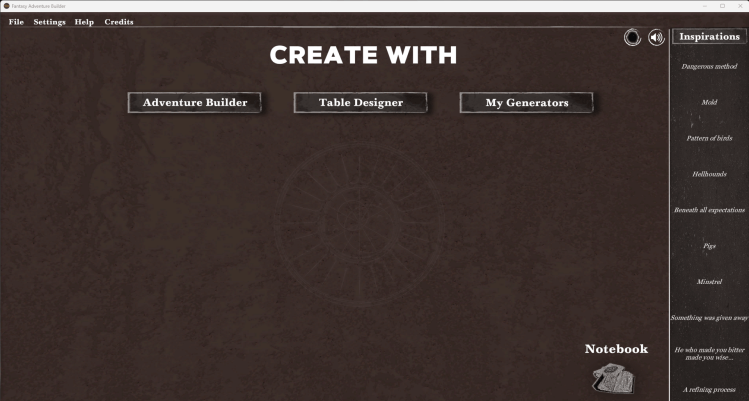
When you open the software, you get this screen. There’s not much going on, but I’ll do my best to walk you through it so you can best get an idea of how very cool this software really is.
We start with the obvious, the “Adventure Builder” button. That takes you to the following screen:
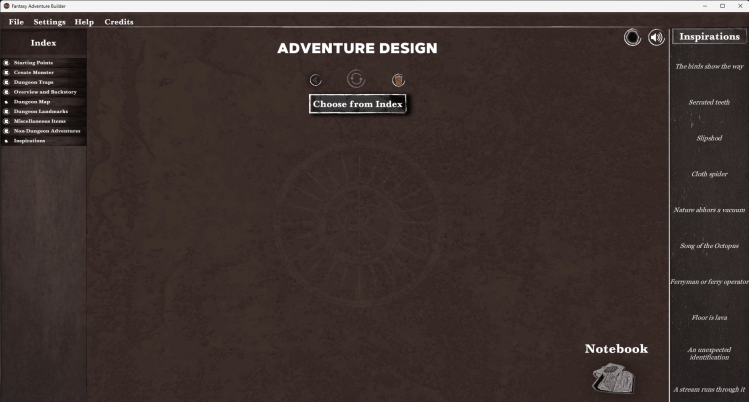
As you can see, we have a bit more to work with. All of those options to the side are things you can roll from the tables that are found in the book. Let’s start with, you guessed it, “Starting Points.” Now, without selecting a sub category (clicking the little icon to the left of “Starting Points” and really any of those options), gives you a roll from all of the sub sections.
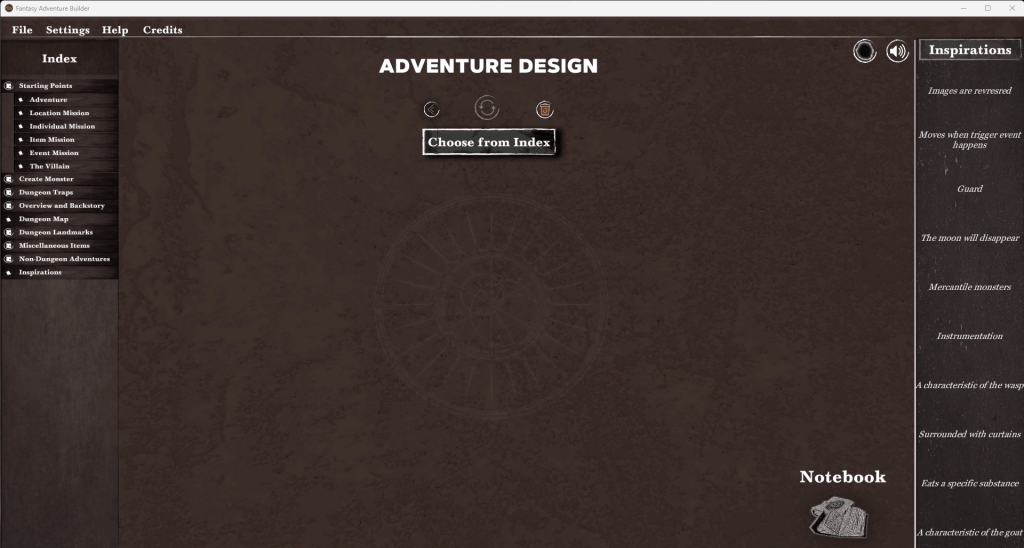
As you can see, there are a number of sub-sections that you can choose from. We will instead roll from “Starting Points” to get a roll from all of the sub-tables. Notice that clicking on that changes “Choose from Index” to “Starting Points.” This lets you know what table(s) you are rolling from.
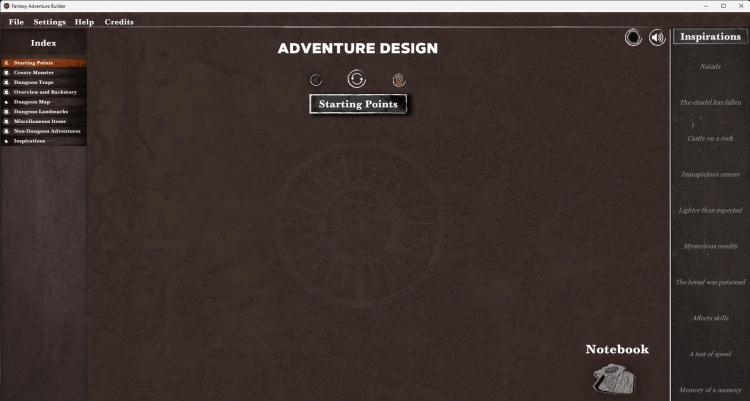
From here, you select the icon centered above “Starting Points” (or whatever you’ve selected), and you get something like this:

Okay, we have the basis of an adventure now!
Now, say we don’t like the patron it generated, a Pikeman (mercenary). You simply mouse over just that part, and BAM, new Patron rolled! This means you can reroll from specific tables within the rolls themselves!!!
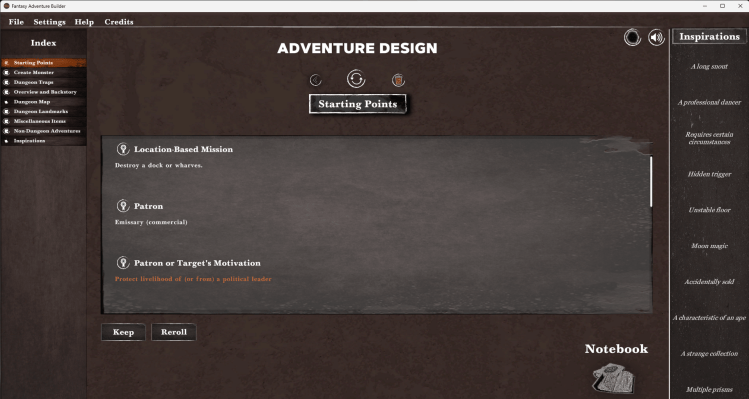
Now we have, as our patron, an Emissary (commercial). Neat, huh?
Okay, so now we have something we like. We’ve done our re-rolls and we like what we see. Now we are going to press that “Keep” button below to send what we’ve gotten to our “Notebook.”
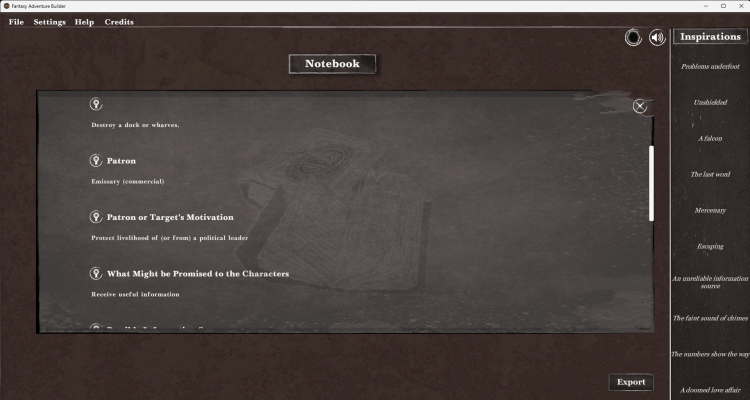
This should look familiar as we just saved what we had from the previous screen. From here, we can actually add notes simply by clicking on the line and typing, like so:
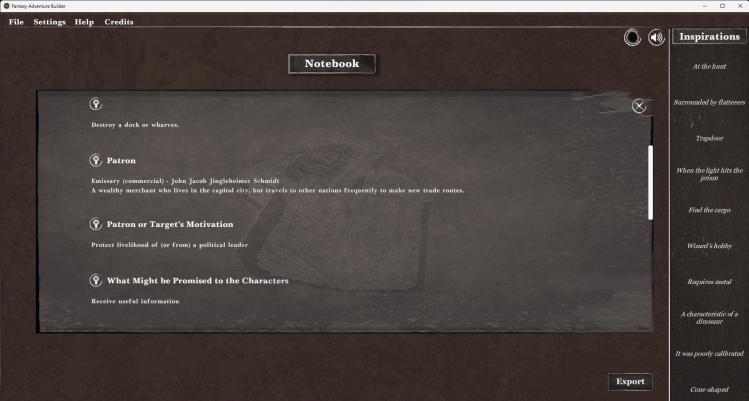
As you can see, I’ve added onto the Patron with a description of who he is and what he does. You can do that for any and every line. Also, if you changed your mind about an aspect, you can click on the title, and select “Delete” when it comes up, deleting that section. Keep in mind that there is no undoing this once you’ve deleted something and the program will tell you so.
From here we can save our “Notebook.” Here’s where things get a little tricky. When you try to load a saved Notebook, it doesn’t take you to where it’s actually saved. You have to go to the following path (for Windows anyways):
This PC>Windows (C:)>Users>[Your Username]>LocalLow>Brave Alice Games>Fantasy Adventure Builder
It’s was a little convoluted to find, but thanks to Mrs. Daily DM, I was able to find it.
Next though…oooooohhhhh, next is probably my favorite part…
If you go back to the starting menu, you’ll see an option called “Table Designer.” You should then see something like this:

This is where you can generate your own tables! For example, in mine, I’ve created, with the tables in the books The Game Master’s Book of Random Encounters and The Game Master’s Book of Non-Player Characters, a table with first names, last names, race, a brief description, wants and needs, secret or obstacle, and what they are also carrying. Now, as the materials contained in these tables aren’t mine, I won’t be publishing them (you know, for legal reasons; I don’t want to get sued), but I will be using them for personal use.
One of the cool things you can do after creating your table(s), are to give it a “Test Roll” where you can see what it will look like to generate based on your tables. For the Main Tables, you can create a series of tables that will generate something like this:
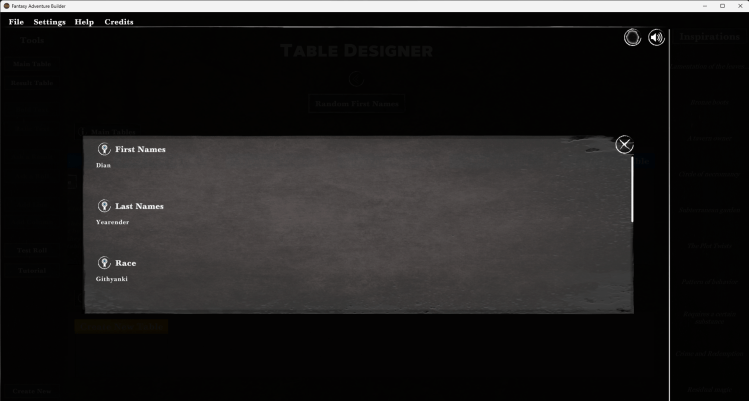
As you can see, it gives me exactly what I ask for. Then you have “Results Tables.”
Then we have “Results Tables.” These are really cool and really spice up your tables. Say you have an entry that you want to say something like “…who wants to find a [insert dragon color] egg” but you want to generate a random dragon color into the table. Well, that’s where “Results Tables” comes in. You can, within a main table, click on “Ask a Result” when editing the main table, wherein it will ask you which results table you want to use. Simply click on it (I selected a table I called “Dragon Colors”) and when it generates that option, it will randomly select from this other table, one of the options therein! In this way, you can customize each entry as you see fit. I am currently in the arduous, daunting, and time-consuming task of filling out a results table with literally every non-named monster contained in dndbeyond.com (I own everything, so I might as well). I’m not even out of the “A’s.”
sigh
I’ve got my work cut out for me. BUT IT WILL BE WORTH IT WHEN I’M DONE!!!
Because at any point, with any table, I can use it to insert a monster/animal in an entry in one of my tables. The only thing I’m wondering is if you can copy a table from one table to a new table without having to recreate it. So far, it doesn’t seem to be an option. You can, I guess, duplicate the save file under a different name and change the main tables to whatever else you are making that you would need the results tables for, but I think that’s the only way to make that happen. A minor inconvenience at worst.
As for the software itself, as I said, I got this off of a Kickstarter, so the Steam version, as of the time of this post, has not been released. There is also, I’m happy to announce, an Android and iOS mobile version of the software, which I also have. That, too, has yet to be publicly released, although it appeared to cost $9.99 on Android (I got it included with my KS). I also paid to get the PDF of the revised Tome of Adventure Design document on the dmsguild.com website, as well as the commercial license so I can do some of the things I am thinking of doing without worry of legalities. Worth the upgrade, if you ask me. Lastly, I purchased the DLC which included extra tables otherwise not available. The level of the KS that I pledged included all future DLC, so I’m looking forward to that. Additionally, the community will later be able to share tables with each other that we’ve created. Not bad at all.
I would post this review, or at least the text review, on Steam, but as it is not commercially available, that was not possible. Once it does become available, I’ll post this review there as well.
In summary, though, I have to say that I give this software and the accompanied pdf document a solid A+. Although some of the parts are quirky, it’s still in early release, and I know for a solid fact that they are adding more DLC tables at a later date (let me tell you how time-consuming it is just to input the tables, let alone come up with the stuff in the tables!). All in all, this is an amazing product, and when it releases to the general public, a product you are sure not wanting to go without!
Until next time, Dear Readers…
EDIT: I found that there is an option for late backers to the Kickstarter! You can head over to https://www.rpgstories.net/marketplace?Category=Software and get your copy of Fantasy Adventure Builder for yourself now! What are you waiting for? Go on! Go buy it!
Monsters of Myth: A Deep Dive into Iconic Creatures in Dungeons & Dragons
Dear Readers, welcome once again to the fantastical realm of Dungeons & Dragons, where imagination knows no bounds and creatures of myth and legend come to life. In the vast tapestry of this iconic tabletop role-playing game (RPG), one of the most enchanting aspects is the plethora of monsters that inhabit its realms. From the menacing dragons that soar through the skies to the cunning goblins that lurk in the shadows, Dungeons & Dragons (D&D) has given birth to an extensive bestiary that captivates players and storytellers alike.
In this deep dive into the monsters of myth, we’ll unravel the tales behind some of the most iconic creatures that have become synonymous with the Dungeons & Dragons experience. These creatures are not merely adversaries to be vanquished; they are the embodiment of creativity, weaving a rich narrative tapestry that has enthralled generations of gamers. So, gather around the virtual table, roll those dice, and let’s embark on a journey through the realms of fantasy where monsters reign supreme.
Dragons: Majestic Lords of the Skies
No discussion of Dungeons & Dragons monsters would be complete without paying homage to the majestic and fearsome dragons. These colossal, winged creatures are not just monsters; they are iconic symbols of fantasy literature and role-playing games. In the D&D multiverse, dragons are not just powerful adversaries; they are intelligent beings with distinct personalities, motivations, and even alignments.
Dragons come in various colors, each representing a different alignment and elemental affinity. The chromatic dragons, including the red, blue, green, black, and white dragons, are typically evil and embody destructive forces. On the other hand, metallic dragons, such as gold, silver, bronze, copper, and brass dragons, are generally good-natured and champions of justice. This alignment system adds depth to each encounter with a dragon, turning it into a unique and memorable experience (and color-coded for your convenience!).
Dragons are known for their breath weapons, powerful magical abilities, and immense physical strength. Facing a dragon is not just a battle; it’s an epic struggle against a living force of nature. The thrill of encountering a dragon, whether as an adversary or an ally, is one of the defining moments in any D&D campaign.
Beholders: All-Seeing Eyes of Madness
In the dark corners of the Underdark and the twisted planes of existence, the beholders lurk, their bizarre and nightmarish forms striking fear into the hearts of adventurers. These floating orbs with a single giant eye and numerous smaller eye stalks are one of the most iconic and peculiar creations in the D&D monster manual.
Beholders are known for their paranoia-inducing abilities, each eye stalk capable of unleashing a different magical effect. From disintegration rays to charm spells, beholders are a formidable and unpredictable foe. What makes them truly fascinating, however, is their alien mindset. Beholders are intensely xenophobic, viewing all other creatures as inferior and dangerous. This makes negotiation or peaceful interaction with a beholder a rare and challenging feat.
The beholder’s appearance is not only memorable but also highly distinctive. No two beholders look exactly alike, and they are known to have a strong aversion to their own kind. This uniqueness adds a layer of intrigue to encounters with these creatures, as players never quite know what to expect when facing a beholder.
Mind Flayers: Masters of the Psychic Arts
Delving deeper into the mysteries of the Underdark, we encounter the mindflayers, aberrations with a penchant for psionics and a taste for brains. Also known as Illithids, mindflayers are nightmarish creatures with octopus-like heads, tentacled mouths, and a hunger for the minds of sentient beings.
Mindflayers are often portrayed as sinister masterminds, manipulating events from the shadows with their powerful psychic abilities. They are known for their mind-controlling powers, capable of dominating the wills of others and turning them into thralls. The mere presence of a mindflayer can instill terror, as adventurers must grapple not only with their formidable physical abilities but also the mental onslaught that these creatures can unleash.
What makes mindflayers particularly intriguing is their mysterious origin and connection to the enigmatic Elder Brain. This colossal, sentient mass of giant brain-like mass with writhing tentacles serves as the hive mind for the illithid colonies, linking them telepathically and providing a shared pool of knowledge and experiences. The mindflayers’ connection to this Elder Brain adds a layer of complexity to their role in the D&D universe, making them more than just monstrous adversaries.
Tiamat: Queen of Chromatic Dragons
While individual dragons are awe-inspiring in their own right, Tiamat stands as a singular and fearsome entity—a five-headed dragon goddess embodying the chromatic dragons’ might. Tiamat is a symbol of chaos and destruction, a force to be reckoned with even by the mightiest of adventurers.
In D&D lore, Tiamat is often portrayed as a malevolent and scheming deity, seeking to spread discord and subjugate all in her path. Her five heads represent the five chromatic dragon types, each with its breath weapon and distinct personality. Tiamat is not merely a dragon; she is a godlike being with the power to reshape the very fabric of reality.
Encounters with Tiamat are the stuff of legends, epic battles that can span entire campaigns. The stakes are high when facing a deity, and the challenges posed by Tiamat are not just physical but often involve intricate plots and machinations. As a central figure in D&D’s rich pantheon, Tiamat continues to be a source of inspiration for both players and dungeon masters, shaping the narratives of countless adventures.
Demons and Devils: Fiends of the Abyss and Nine Hells
The planes of existence in Dungeons & Dragons are home to various fiendish entities, with demons hailing from the chaotic Abyss and devils dwelling in the lawful Nine Hells. These malevolent beings are embodiments of evil, each with its own diabolical agenda and a legion of lesser minions at its command.
Demons are chaotic and destructive entities, representing the primal forces of chaos and malevolence. From the lowly dretches to the fearsome balors, demons come in a variety of shapes and sizes, each more grotesque and horrifying than the last. Encounters with demons often involve battling hordes of these otherworldly creatures, as they seek to spread chaos and corruption wherever they go.
On the other side of the alignment spectrum, devils are lawful and scheming entities that inhabit the Nine Hells. Devils are known for their cunning and manipulative nature, making deals and contracts that often lead to the damnation of mortal souls. From the impish lemures to the powerful pit fiends, devils serve their infernal lords with unwavering loyalty, seeking to expand their influence across the planes.
The dichotomy between demons and devils adds a layer of complexity to the cosmology of Dungeons & Dragons. Players may find themselves caught in the crossfire of the eternal Blood War, the ongoing conflict between demons and devils for supremacy in the Lower Planes. The allure of forbidden knowledge, infernal pacts, and the struggle against the encroaching darkness make demons and devils integral to the D&D experience.
Giants: Colossal Forces of Nature
Venturing into the mountains and rugged landscapes, adventurers may find themselves facing the colossal giants that roam these regions. Giants in Dungeons & Dragons are not mere brutes; they are ancient and powerful beings, each with its own unique abilities and characteristics.
From the hill giants, known for their voracious appetite and crude demeanor, to the storm giants, who command the power of the elements, giants represent the raw forces of nature. These towering beings can be both adversaries and allies, depending on the circumstances and the actions of the players.
One of the most iconic giants in D&D lore is the fearsome fire giant king, Snurre Iron Belly, who played a central role in the classic adventure module “Against the Giants.” Giants are often associated with ancient lore and myths, and encounters with them can be epic struggles that shape the course of a campaign. The sense of scale and power that giants bring to the table adds a unique flavor to the D&D experience, reminding players that there are forces in the world far beyond their comprehension.
The Kraken: Terror of the Deep
As sailors ply the vast oceans of the D&D world, they tell tales of a mythical sea monster that strikes fear into the hearts of even the bravest mariners—the kraken. This colossal, tentacled monstrosity is the stuff of nautical nightmares, a force of nature that can drag entire ships and crews beneath the waves.
The kraken is not just a creature of the deep; it is a symbol of the untamed and unpredictable nature of the seas. In D&D lore, krakens are intelligent beings with vast knowledge and magical powers. They are often portrayed as ancient and inscrutable entities that view the affairs of mortals with a detached and enigmatic gaze.
Encounters with a kraken are not just about survival; they are about navigating the mysteries of the deep and uncovering the secrets that lie beneath the waves. The kraken embodies the dual nature of the sea—both a source of life and a realm of unfathomable danger. It is a testament to the versatility of Dungeons & Dragons that it seamlessly weaves maritime myths into its fantastical tapestry.
Goblins: Mischief-Makers of the Shadows
In the shadowy corners of dungeons and the dark recesses of forests, goblins scurry and plot. These small, humanoid creatures are often dismissed as mere cannon fodder, but their cunning and resourcefulness make them a persistent and dangerous threat.
Goblins are known for their chaotic and mischievous nature. They excel at ambushes, traps, and hit-and-run tactics, making them formidable adversaries even for experienced adventurers. While individually weak, goblins often travel in large groups, overwhelming their enemies through sheer numbers and devious tactics.
What makes goblins fascinating is their adaptability. Whether they serve as minions to a more powerful master or carve out their own niche in the world, goblins are survivors. In some campaigns, players may find themselves forming uneasy alliances with goblin tribes, navigating the complex web of goblin politics and rivalries.
Owlbears: The Unlikely Hybrid
In the quirky and whimsical corner of D&D’s bestiary, we find the owlbear—a creature that is exactly what its name suggests, a bizarre hybrid of an owl and a bear. While owlbears may seem like the result of a mad wizard’s experiment gone wrong, they have become beloved icons of the game.
Owlbears are often portrayed as ferocious and territorial, with a hooting cry that strikes fear into the hearts of those who encounter them. Despite their odd appearance, owlbears are formidable opponents, blending the hunting instincts of an owl with the raw strength of a bear. Encounters with owlbears can be both challenging and humorous, as players grapple with the absurdity of a creature that defies the laws of nature.
The owlbear’s popularity extends beyond the game table, with its image adorning merchandise, memes, and even inspiring real-world debates about the feasibility of such a creature. In the end, the owlbear is a testament to the creativity and whimsy that define the world of Dungeons & Dragons.
Conclusion: Monsters as Storytelling Tools
As we conclude our deep dive into the monsters of myth in Dungeons & Dragons, it becomes evident that these creatures are more than just foes to be defeated. They are storytellers in their own right, weaving tales of epic battles, ancient enmities, and the eternal struggle between light and darkness.
The monsters of D&D are the architects of adventure, shaping the narrative landscape and providing a canvas for players and dungeon masters to paint their own tales. From the majestic dragons that soar through the skies to the cunning goblins that lurk in the shadows, each creature adds a layer of richness and depth to the game world.
As you embark on your own D&D adventures, remember that the monsters you encounter are not just obstacles; they are opportunities for storytelling, character development, and world-building. Whether you’re facing the fire-breathing wrath of a dragon or negotiating with the enigmatic mindflayers, embrace the diversity and creativity that the monsters of D&D bring to the table.
So, dear readers, may your dice roll true, your imaginations soar, and your journeys through the realms of Dungeons & Dragons be filled with legendary encounters and unforgettable tales. Until next time, may your adventures be epic and your monsters be mythic. Happy gaming!
Until next time, Dear Readers…
P.S. – I hope everyone had a wonderful Thanksgiving (to all of my American Readers!) holiday!
Product Review: Mystery Dice Goblin
Dear Readers, the world of tabletop gaming has experienced a renaissance in recent years, with enthusiasts seeking high-quality and aesthetically pleasing accessories to enhance their gaming experience. One such website that has gained attention in the gaming community is Mystery Dice Goblin (http://mysterydicegoblin.com), a platform dedicated to offering a wide array of unique and captivating dice sets. In this comprehensive review, we’ll delve into the various products offered by Mystery Dice Goblin, evaluating their quality, design, and overall appeal.
Product Range:
Mystery Dice Goblin boasts an extensive product range, featuring an impressive collection of dice sets tailored for diverse tabletop games. From traditional polyhedral dice to thematic sets inspired by fantasy realms, the website caters to the preferences of both casual and hardcore gamers. The product categories include standard polyhedral dice, metal dice sets, and special edition sets (such as filled dice and liquid core), each promising a distinct and immersive gaming experience.
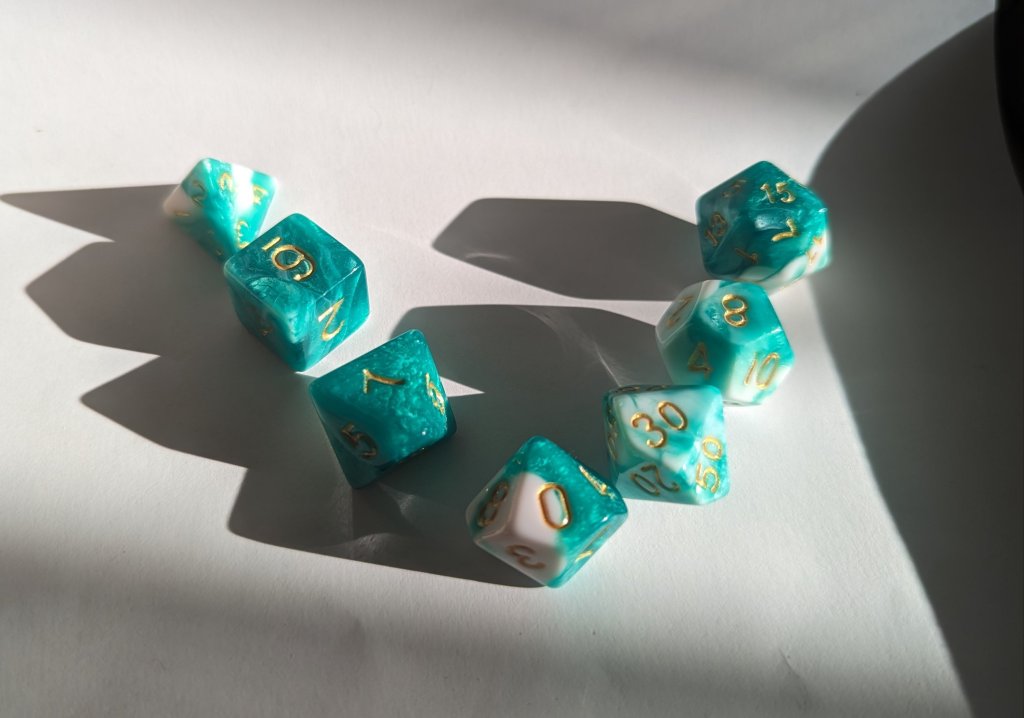
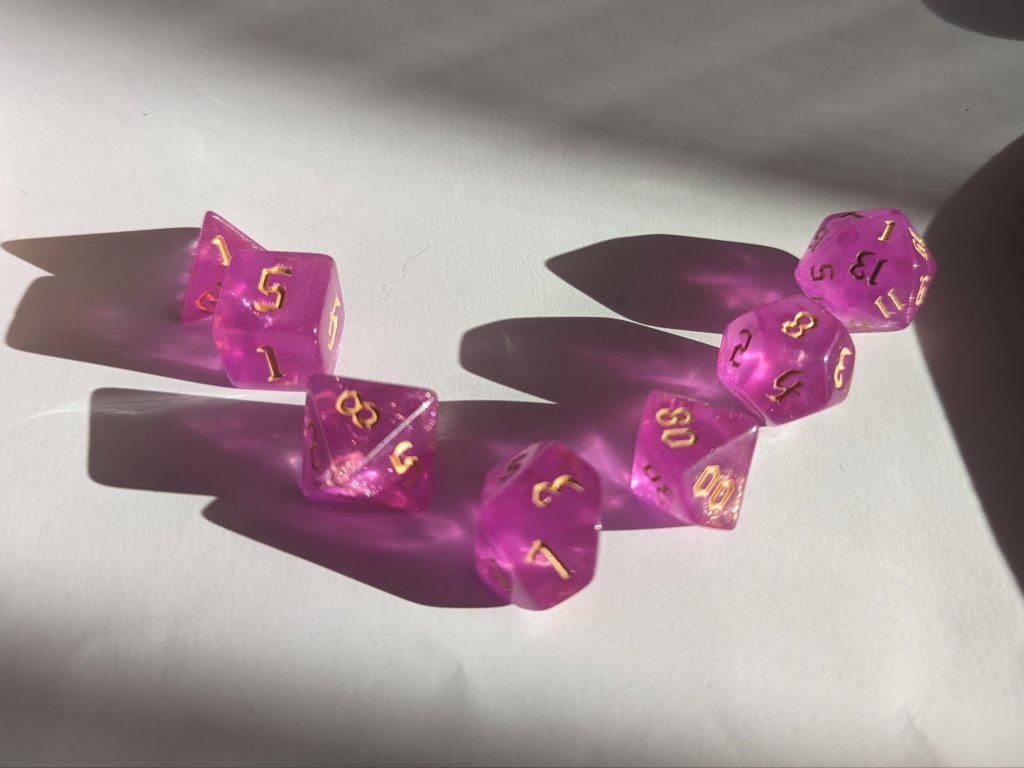
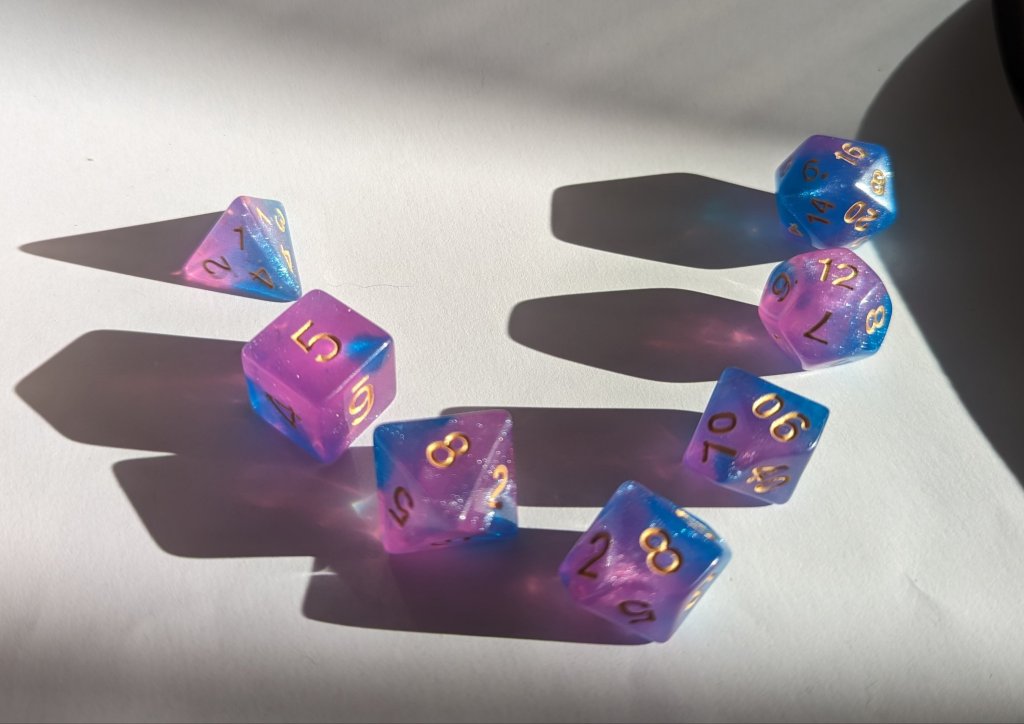
The inclusion of storage solutions, such as velvet and faux leather dice bags, various metal pins, dice trays, lanyards, gift boxes, dice holders, a birthday card (gives you +1 Wisdom, allows you to “level up” and other such themes), patches, d20 earrings, a dice roller cup, faux leather dice cases, and even neat d20 dice necklace or keychains, further enhances the overall customer experience. This attention to packaging not only reflects the company’s dedication to quality but also makes their products ideal for gift-giving, as the presentation adds a touch of luxury to the dice-buying experience.
Quality and Craftsmanship:
One of the standout features of Mystery Dice Goblin’s products is the emphasis on quality and craftsmanship. The standard polyhedral dice sets are made from high-quality materials, ensuring durability and longevity. The numbers are engraved or inked with precision, enhancing readability during gameplay. Metal dice sets, a favorite among tabletop gaming enthusiasts, are crafted with attention to detail, featuring intricate designs and a satisfying weight in hand.
The website’s commitment to quality extends to the filled dice, providing a unique twist to gaming sessions. Special edition sets often showcase exclusive designs, further highlighting the dedication to craftsmanship and the creation of truly exceptional products. These include a range of dice with liquid cores or filled dice (meaning that they are generally clear with some sort of character or object in the middle).
Design and Aesthetics:
Mystery Dice Goblin stands out for its commitment to providing aesthetically pleasing dice sets that go beyond mere functionality. The designs are diverse, catering to different themes and preferences within the gaming community. The standard polyhedral sets come in a variety of colors, offering options for every taste, from classic and elegant to bold and vibrant.
Metal dice sets, a favorite for their heft and tactile appeal, are available in an array of finishes, including antique, matte, and polished surfaces. The intricate engravings on these metal dice add a touch of sophistication, enhancing the overall visual appeal. The filled and liquid core sets are gorgeous but also bring an element of excitement to tabletop gaming, creating a visually stunning experience.
Special edition sets showcase the creative prowess of Mystery Dice Goblin’s designers, featuring exclusive and limited-edition designs that cater to specific themes or franchises. Whether inspired by fantasy worlds, sci-fi universes, or historical periods, these special edition sets elevate the gaming experience by providing unique and visually striking dice options.
Packaging and Presentation:
The attention to detail exhibited by Mystery Dice Goblin extends to the packaging and presentation of their products. Each dice set arrives in a thoughtfully designed box or pouch, adorned with the company’s logo. The packaging not only protects the dice during transit but also adds an extra layer of excitement and anticipation when opening the box for the first time. Known mostly for their actual “Mystery Dice” sets, the pouches contain a full set of the 7 polyhedral dice you all know and love. It was a delightful pleasure to open each one.
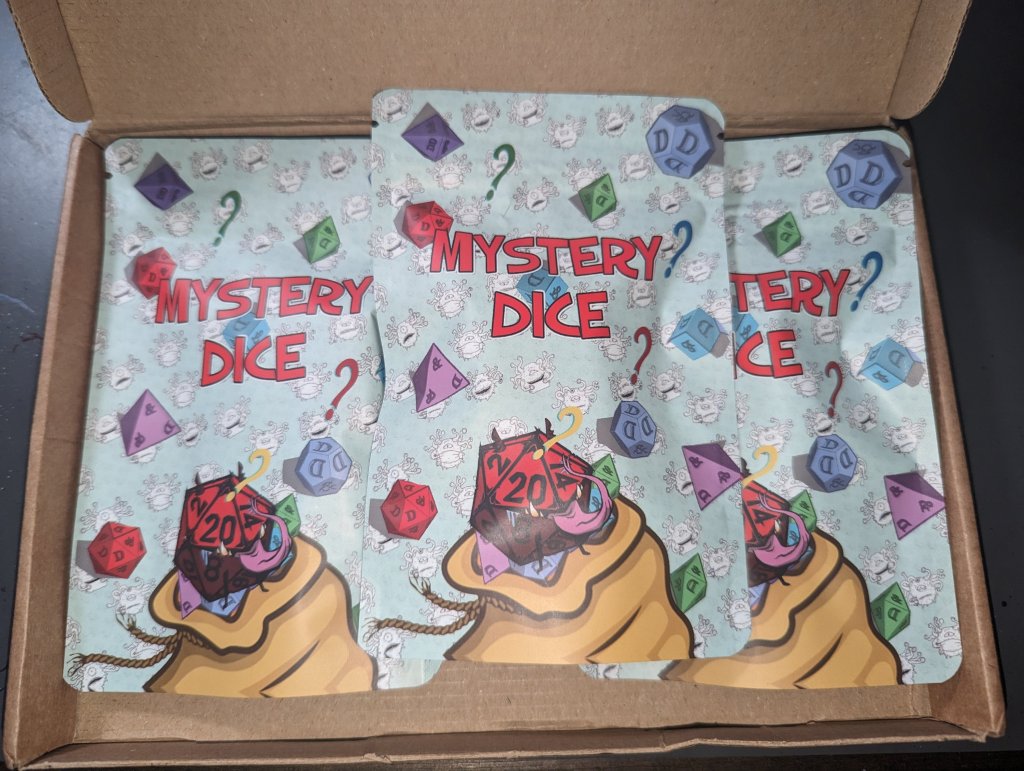
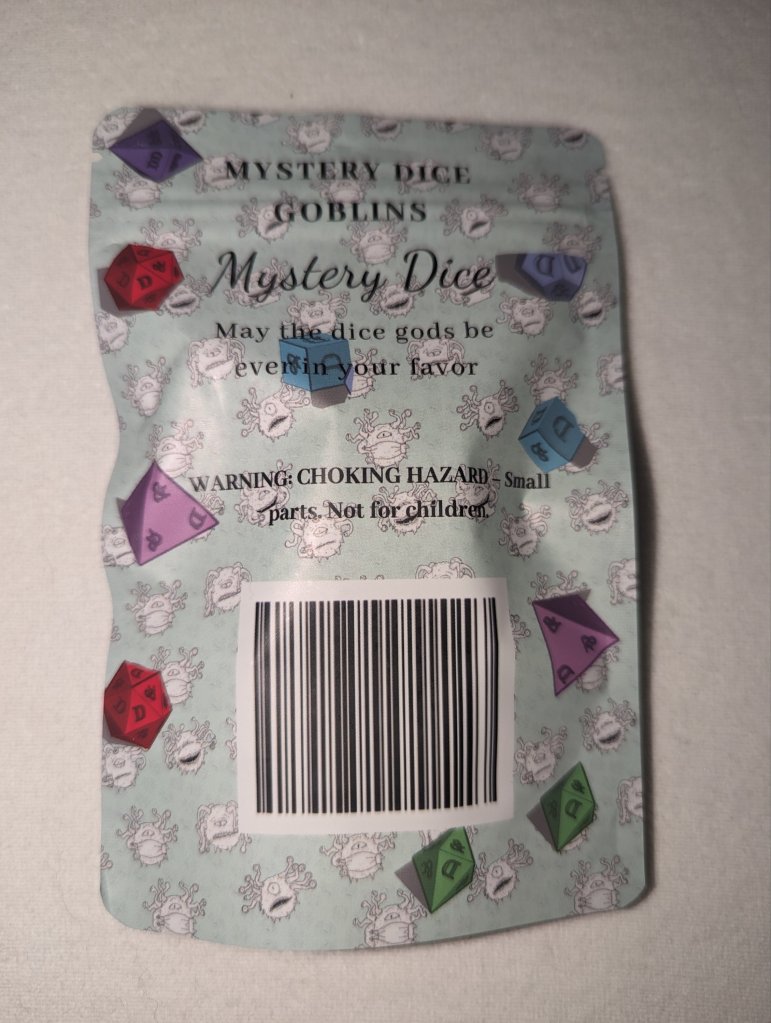
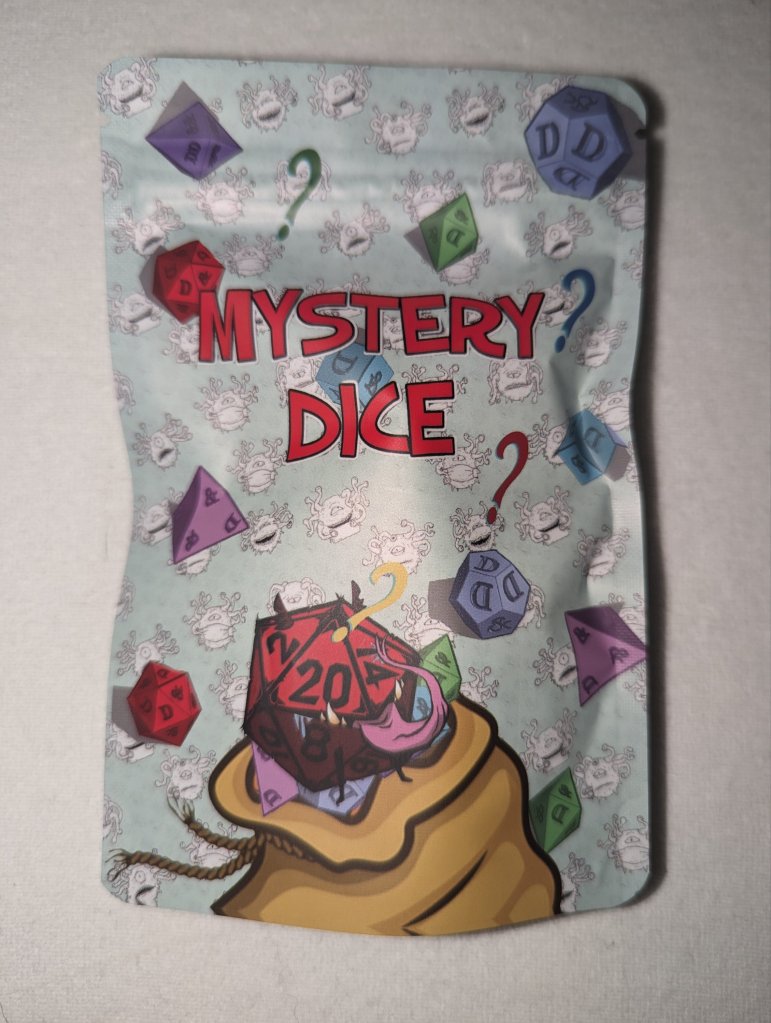
Customer Experience:
Navigating the Mystery Dice Goblin website is a user-friendly experience, with a well-organized layout that allows users to browse and filter products efficiently. The website provides detailed descriptions and images for each dice set, offering customers a comprehensive understanding of the design, materials, and features of the dice they are interested in.
The ordering process is straightforward, with secure payment options and transparent shipping information. Mystery Dice Goblin also offers responsive customer support, addressing inquiries and concerns promptly. The commitment to customer satisfaction is evident in the positive reviews and testimonials shared by the gaming community, highlighting the reliability of the brand and the quality of their products.
Conclusion:
In conclusion, Mystery Dice Goblin emerges as a reputable and innovative source for tabletop gaming enthusiasts seeking high-quality and visually appealing dice sets. The extensive product range, commitment to craftsmanship, and attention to detail set the brand apart in a competitive market. Whether you’re a seasoned gamer looking for a new addition to your collection or a newcomer eager to elevate your tabletop experience, Mystery Dice Goblin proves to be a reliable and exciting destination for all your dice needs. The combination of quality, design, and customer-focused practices positions Mystery Dice Goblin as a standout player in the world of tabletop gaming accessories!
So, head on over to https://mysterydicegoblin.com and order YOUR mystery set, and let me know what kind of sets you get in the comment section below!
In fact, if you follow this link, you’ll get a 15% discount!!
Until next time, Dear Readers…
Turning Your Game Into a Podcast
Dear Readers, creating a podcast from your D&D game is a great way to share the magic of your adventures with a wider audience. Transforming your tabletop sessions into an engaging audio experience requires careful planning and some technical know-how, but the rewards can be well worth the effort. In this blog post, we’ll explore the steps to turn your D&D game into a captivating podcast.
1. Conceptualizing Your Podcast
Before diving into the technical aspects, consider the theme and format of your podcast. Will it be a straightforward actual play, or will you include additional content like interviews, discussions, or world-building episodes? Define the tone and style to set the foundation for your podcast.
2. Choosing the Right Equipment
Investing in decent audio equipment is crucial for a podcast’s success. While you don’t need a professional studio setup, a good quality microphone, headphones, and possibly a pop filter can significantly enhance your audio. Popular microphone choices include the Blue Yeti and Audio-Technica ATR2100x-USB.
3. Recording Software
Selecting reliable recording software is essential. Audacity, GarageBand, or Adobe Audition are popular choices for recording and editing audio. Familiarize yourself with the software’s features to ensure you capture clean and clear recordings.
4. Establishing Ground Rules
Communicate with your players about the podcast’s format and any changes to gameplay. Establish ground rules for minimizing table talk, avoiding overlapping conversations, and maintaining a narrative focus. This ensures a smoother transition from a private game to a podcast-friendly format.
5. Creating Character Introductions
Craft memorable and concise character introductions to help listeners connect with your players. Encourage players to share a brief background and personality traits to make the characters more relatable. This step enhances the podcast’s storytelling aspect.
6. Editing for Engagement
Editing plays a crucial role in podcasting. Trim unnecessary pauses, rule discussions, and unrelated banter to maintain a dynamic pace. Add atmospheric music or sound effects to heighten dramatic moments and immerse listeners in the fantasy world.
7. Podcast Artwork and Branding
Design eye-catching podcast artwork that reflects the essence of your D&D game. Consistent branding across platforms, including social media and podcast directories, helps establish a recognizable identity for your show.
8. Choosing a Hosting Platform
Select a reliable podcast hosting platform to store and distribute your episodes. Popular choices include Libsyn, Podbean, and Anchor. Ensure the platform supports your podcast’s anticipated growth and provides analytics to track your audience’s engagement.
9. Marketing and Promotion
Build anticipation for your podcast by creating teaser trailers and sharing them on social media. Leverage platforms like Twitter, Instagram, and Reddit to connect with the D&D community. Engage with other podcasts and creators to cross-promote and expand your listener base.
10. Consistency and Regular Updates
Consistency is key in the podcasting world. Establish a regular release schedule and stick to it. Whether it’s weekly, bi-weekly, or monthly, maintaining a predictable cadence helps retain and attract listeners.
11. Engaging with Your Audience
Encourage listener interaction by incorporating segments like Q&A sessions or fan-submitted content. Building a community around your podcast fosters a sense of belonging and loyalty among your audience.
12. Monetizing Your Podcast
Consider potential revenue streams for your podcast, such as sponsorships, merchandise, or listener support through platforms like Patreon. Monetization can help cover expenses and further motivate you and your players to continue producing quality content.
Conclusion
Transforming your D&D game into a podcast is an exciting venture that combines your passion for tabletop roleplaying with the creative potential of audio storytelling. By following these steps and staying dedicated to quality and consistency, you can share your adventures with a broader audience and become a cherished part of the ever-growing RPG podcasting community. Happy podcasting, dungeon masters!
Until next time, Dear Readers…
P.S. – This was supposed to post 4 days ago. Not sure what happened, but I hope you enjoyed this post!
Holy Smokes, It’s Been a Minute…
Dear Readers, first off, yes, I’m still here! I’ve been ridiculously busy the last few weeks, especially considering my oldest son got married last Friday (I actually did the officiating!). The lead up to the actual wedding was nuts.
Add to that, I have several pay-to-play gigs that I am doing that I had to do planning for, and you get a lot of blog not getting written.
But things have settled down again.
Whew!
Add to all that, and I developed a new Multiple Sclerosis symptom, where if I stand up too quickly, my blood pressure bottoms out and I pass out. Yeah, that was a fun one. A week before the wedding.
Thankfully, the scratch to my eyebrow had all but healed so there weren’t any signs of it in the wedding photos.
But enough about me and my woes. Back to blogging!
I have several projects in the works at this moment.
1) A Product Review for a new software of which the Kickstarter recently ended that I had all but forgotten about. The Tomb of Adventure Design – Fantasy Adventure Builder. It’s supposedly a program designed to help design adventures and encounters, cutting prep work down to a minimum. I’m pretty excited. I actually sprung for the package that includes the commercial license. I will likely be publishing a few adventures here for you Premium Subscribers, and some encounter tables for everyone to see and use.
2) More miniature painting! I have a veritable host of miniatures that I need to paint. I am so behind in my commissions. I’m trying desperately to catch up while maintaining quality of work that I am known for.
3) A Product Review of the new Planescape setting books. I bit the bullet and bought the digital copy on dndbeyond.com. I’m going to try desperately to do a thorough review without spoiling the actual adventure itself. Wish me luck on that one. If I can’t make it work without spoilers, I probably just won’t write it.
Of course, with all this, I will also be doing the occasional other post on random stuff that I come up with or think about. I’m super excited. I really enjoyed doing the monster spotlight posts, so I’ll probably be continuing those here and there. I’ll also be continuing to post episodes of The Inglorious Ingrates. You guys seem to be enjoying those so I will post more episodes.
Well, that’s all I have for today. More to follow soon.
Until next time, Dear Readers…
Inglorious Ingrates Episode 21: Where It Began
The Ingrates head back to Borest to find a surprise waiting for them. Who is terrorizing the town now?
How-To DM: Running an Epic Boss (BBEG) Fight
Dear Readers, I’m going to try a different format for this post to see how I feel about it. If you love it or hate it, let me know in the comments section below!
Introduction
One of the most exhilarating aspects of D&D is facing formidable foes in epic boss battles. These climactic encounters can be the pinnacle of a campaign, providing players with unforgettable experiences. In this blog post, we will explore techniques for designing and running epic boss battles in D&D, with a focus on creating memorable and engaging encounters. Whether you are a Dungeon Master looking to challenge your players or a player eager to understand what makes a boss battle truly epic, this guide is for you.
Table of Contents
- Understanding the Anatomy of an Epic Boss Battle
- Design Principles for Epic Boss Battles
- A. Story Integration
- B. Unique Mechanics
- C. Multiple Phases
- D. Location and Environment
- E. Minions and Allies
- F. Player Engagement
- Balancing the Encounter
- A. CR Considerations
- B. Action Economy
- Building Tension and Immersion
- Epic Rewards and Consequences
- Case Study: The Ancient [insert color here] Dragon
- Player Tips for Epic Boss Battles
- Conclusion
1. Understanding the Anatomy of an Epic Boss Battle
Before diving into the details of designing epic boss battles, it’s essential to understand the basic components that make up these thrilling encounters:
- A Formidable Foe: The boss is the central antagonist, a unique and powerful adversary that the players must overcome.
- Climactic Setting: Boss battles often take place in unique locations, adding a sense of grandeur and tension to the encounter.
- Engaging Mechanics: Epic boss battles are more than simple slugfests. They incorporate unique and challenging mechanics that test the players’ skills and teamwork.
- Narrative Significance: Boss battles should advance the story and provide resolution or progression to the campaign’s plot.
- Tension and Immersion: The encounter should be emotionally engaging, drawing players into the action and making them feel the stakes involved.
- Rewards and Consequences: The outcome of the battle should have significant implications for the campaign, and players should be appropriately rewarded or face consequences.
2. Design Principles for Epic Boss Battles
To create truly epic boss battles, consider these design principles:
A. Story Integration
The boss battle should seamlessly fit into the campaign’s narrative. It should resolve storylines, reveal critical information, or introduce new plot elements. Make sure the boss’s motivations and actions align with the world and story you’ve crafted.
Example: If the campaign centers around preventing an evil cult from summoning a world-ending demon, the boss might be a high-ranking cult leader who reveals the true nature of the ritual.
B. Unique Mechanics
Epic boss battles should feature mechanics that distinguish them from ordinary encounters. These mechanics can involve environmental hazards, special abilities, or dynamic phases. Mechanics should challenge players’ problem-solving abilities and keep them engaged.
Example: The boss might periodically summon portals to other planes, introducing unpredictable monsters or environmental changes.
C. Multiple Phases
To maintain player engagement and prevent battles from becoming repetitive, consider dividing the boss encounter into multiple phases. Each phase should bring new challenges and mechanics, requiring players to adapt and strategize.
Example: A lich boss might start as a frail spellcaster, then transition into a fearsome melee combatant after reaching half health (wouldn’t that be a change they wouldn’t expect!).
D. Location and Environment
The setting of the boss battle should be visually striking and play a significant role in the encounter. Utilize terrain, traps, and interactive elements to create a dynamic battlefield that adds excitement and complexity.
Example: A boss fight on the unstable platforms of a volcanic cavern, with lava geysers erupting at intervals, provides both danger and tactical opportunities.
E. Minions and Allies
Bosses often have minions or allies to support them, adding another layer of challenge to the encounter. These allies can disrupt the players’ tactics, protect the boss, or provide additional objectives.
Example: A vampire lord might have a cadre of thralls who harass the players, forcing them to decide whether to focus on the minions or the boss.
F. Player Engagement
Epic boss battles should be emotionally engaging. Use vivid descriptions, role-playing, and in-game events to immerse players in the story and make them care about the outcome. Create dilemmas and moral choices that deepen the narrative.
Example: The boss could reveal a sympathetic motive, causing players to question whether they should attempt to redeem or destroy the antagonist.
3. Balancing the Encounter
Balancing an epic boss battle is a challenging task, but it’s crucial to provide an enjoyable and fair experience for your players. Consider the following aspects:
A. CR Considerations
The Challenge Rating (CR) of the boss should be appropriate for the party’s level and abilities. Remember that the CR of the boss should account for their unique mechanics and the potential presence of allies.
Example: If you have a party of four level 10 characters, a CR 10 boss may not pose much of a challenge, but if you factor in allies and unique mechanics, it can be an appropriate encounter.
B. Action Economy
One of the most critical aspects of balance is action economy. A single boss fighting against a group of players can often be overwhelmed. To address this, consider giving the boss legendary actions, lair actions, or multiple turns per round to maintain balance.
Example: A dragon boss might have legendary actions that allow it to make additional attacks, move, or use its breath weapon outside of its turn.
4. Building Tension and Immersion
Epic boss battles should evoke emotions and immerse players in the experience. Here are some techniques to achieve this:
- Descriptive Narration: Describe the boss’s appearance, actions, and surroundings vividly. Use sensory details to make the encounter come alive.
- Sound and Music: Play atmospheric music or sound effects to enhance the mood. A sudden change in music can signal a shift in the battle, creating anticipation.
- Reinforce Stakes: Make the players aware of the consequences of failure. The world or campaign should be altered in significant ways depending on the outcome.
- Character Connections: If possible, tie the boss to the players’ backstories or previous events in the campaign. Personal stakes can be highly motivating.
- Revealing Information: Provide the players with information or clues during the encounter that deepen the narrative or help them strategize.
5. Epic Rewards and Consequences
The outcome of an epic boss battle should be meaningful. Consider the following rewards and consequences:
- Loot and Treasures: Reward the players with unique, powerful items or artifacts that are directly related to the boss. These should be more than just statistical upgrades.
- Narrative Impact: The defeat of the boss should have a noticeable effect on the world. Allies may rally, or new threats may emerge in the campaign.
- Character Development: The battle should provide character development opportunities, such as moral choices, character growth, or the chance to fulfill personal goals.
6. Case Study: The Ancient Dragon
Let’s take a closer look at a classic epic boss in D&D: the ancient [insert color here] dragon. Dragons are iconic adversaries, and designing a memorable dragon encounter requires careful planning.
Story Integration: An ancient dragon is a legendary creature, and its presence in your campaign should be a significant event. Its motives could be tied to ancient prophecies, the ambitions of a dragon cult, or a threat to the world.
Unique Mechanics: To make the dragon fight memorable, give it distinctive abilities. For example, it could have a breath weapon that changes type every round or be able to call upon the elements for environmental effects (think dracohydra from Fizban’s)..
Multiple Phases: You could divide the encounter into two phases. In the first phase, the dragon primarily uses its breath weapon and flight to attack from a distance. When the dragon reaches half health, it lands and enters a melee combat phase, gaining new abilities and resistance to damage.
Location and Environment: Set the encounter in the dragon’s lair, a vast cavern filled with treasure, traps, and obstacles. This environment adds tactical depth to the battle. Lair actions become important here. Remember them and use them! Remember that those lair actions are part of the CR of the encounter!
Minions and Allies: The dragon might have a cadre of loyal kobold followers who aid it in the battle. These minions harass the players, potentially forcing them to split their focus.
Example (sure it’s 4e based, but the humorous scenario applies):
Player Engagement: Make the dragon’s motives complex. It might be guarding a powerful artifact it believes will save the world, and players must decide whether to confront or negotiate with the dragon.
Balancing the Encounter: A CR-appropriate ancient dragon is a significant threat, but the presence of allies, dynamic mechanics, and a two-phase encounter can keep the battle balanced and exciting.
Rewards and Consequences: If the players defeat the dragon, they acquire a portion (or all!) of its hoard and gain the dragon’s favor (or the results of its death), potentially earning future aid (even if it’s from the locals who were terrorized by said dragon). However, the dragon’s death may also have political and ecological consequences in the campaign world.
7. Player Tips for Epic Boss Battles
Players, you play a crucial role in making epic boss battles memorable. Here are some tips to enhance your experience:
- Strategize: Collaborate with your party to develop a solid battle plan. Effective coordination and strategy can turn the tide in your favor.
- Adaptability: Be prepared to adjust your tactics as the battle progresses and the boss reveals new mechanics or phases.
- Role-Playing: Engage with the story and immerse yourself in the narrative. Make choices that align with your character’s beliefs and motivations.
- Use Your Resources: Don’t hoard your consumable items or abilities. Epic boss battles are the time to unleash your most potent assets.
- Communication: Maintain open communication with your DM. If something isn’t clear or you have ideas, share them. A cooperative approach enhances the game for everyone.
8. Conclusion
Epic boss battles are a cornerstone of the D&D experience, offering players thrilling challenges and memorable moments. To create and run these encounters effectively, focus on story integration, unique mechanics, multiple phases, environment, allies, and player engagement. Balance the encounter by considering CR and action economy. Build tension and immersion through vivid storytelling and stakes. Make the outcome meaningful with epic rewards and consequences. Finally, players can enhance the experience by strategizing, adapting, role-playing, and communicating effectively.
In the end, the goal of an epic boss battle is not just to defeat a powerful foe but to create a shared, unforgettable story that will be talked about around the gaming table for years to come. So, whether you’re a DM or a player, embrace the challenge, and may your epic boss battles be legendary.
The Inglorious Ingrates Episode 20: The Consequences of War
The Ingrates, now that the war with WAR is over, begin looking at the realities of what the war caused as well as investigating these strange “diamonds” that fell from the sky. What are they and where did they come from?
Find out in today’s episode!
How-To DM: Tips for Customizing and Homebrewing Your D&D Campaign
Dear Readers, one of the things that makes D&D so special is its flexibility. While there are countless pre-made adventures and campaign settings available, many players and Dungeon Masters (DMs) choose to create their own worlds and stories. This process of customizing and homebrewing your D&D campaign can be incredibly rewarding, but it can also be a daunting task. In this guide, we will explore tips and techniques for getting creative and crafting a unique D&D experience that you and your players will never forget.
1. Start with a Strong Concept
Every great D&D campaign begins with a strong concept. Whether you’re building an entirely new world or adding depth to an existing one, having a clear idea of what your campaign is about will guide your decisions throughout the creative process. Consider the following questions:
- What is the central theme or conflict of your campaign?
- Are there any unique elements, such as a rare magical artifact or a powerful antagonist, that will drive the story?
- What is the tone of your campaign? Is it lighthearted, dark and gritty, or something in between?
Having a well-defined concept will help you stay focused and make meaningful design choices as you build your campaign.
2. Collaborate with Your Players
D&D is a collaborative game, and involving your players in the creative process can lead to a richer and more engaging campaign. Before you start designing your world and story, have a session zero with your players to discuss their expectations, character concepts, and any ideas they might have for the campaign. This collaborative approach not only ensures that everyone is on the same page but also allows you to tailor the campaign to your players’ interests.
Encourage your players to be active participants in world-building. They can help create NPCs, design locations, and contribute to the overall lore of the campaign setting. When players have a stake in the world, they are more invested in the story.
3. Build a Unique World
Creating a unique and immersive world is one of the most exciting aspects of customizing a D&D campaign. Here are some tips for building a captivating setting:
A. Geography and Landscapes
Consider the geography of your world. Are there diverse landscapes such as towering mountains, vast deserts, dense forests, or sprawling cities? Each region should have its own unique characteristics and challenges. Think about how these landscapes influence the cultures and societies that inhabit them.
B. History and Lore
Develop a rich history and lore for your world. Create ancient civilizations, legendary heroes, and mysterious events that have shaped the present. The history of your world should feel alive and interconnected, providing depth and context to the campaign.
C. Pantheon and Magic
Design a pantheon of gods or a system of magic that is unique to your world. Consider how these divine or magical forces impact the lives of your characters and the world at large. Magic can be a powerful storytelling tool, so think about its rules and limitations.
D. Factions and Societies
Populate your world with various factions, guilds, and societies. These organizations can serve as allies, adversaries, or sources of quests for your players. Each should have its own goals, beliefs, and agendas, adding complexity to the world’s political landscape.
4. Create Memorable NPCs
Non-player characters (NPCs) play a crucial role in bringing your world to life. Memorable NPCs can be the heart and soul of your campaign. Here are some tips for crafting compelling characters:
A. Personal Motivations
Give each NPC a clear motivation or goal. What do they want, and why do they want it? Understanding an NPC’s motivations can help you role-play them consistently and make their interactions with the players more meaningful.
B. Flaws and Quirks
Flaws and quirks make NPCs feel more real and relatable. Consider giving your NPCs unique personality traits, quirks, or flaws that set them apart. These traits can lead to interesting role-playing opportunities.
C. Relationships
Think about how NPCs are connected to one another and to the players’ characters. Developing relationships between NPCs can create intricate webs of intrigue and drama that players can get caught up in.
D. Evolving Characters
Allow your NPCs to evolve and change over the course of the campaign. This can be especially impactful if players witness the growth or transformation of a character they’ve known since the beginning.
5. Design Engaging Quests and Storylines
The heart of any D&D campaign is its quests and storylines. Here’s how to make them engaging and memorable:
A. Multiple Paths
Offer players multiple paths to reach their objectives. This allows for greater player agency and ensures that the story can adapt to their choices.
B. Moral Dilemmas
Incorporate moral dilemmas into your quests. These challenges can force players to make difficult decisions that have lasting consequences, adding depth to the story.
C. Pacing
Pay attention to the pacing of your campaign. Balance action-packed encounters with moments of exploration, role-playing, and downtime. Pacing keeps the game dynamic and exciting.
D. Foreshadowing
Use foreshadowing to hint at future events and plot twists. Subtle clues and hints can create a sense of anticipation and intrigue.
6. Homebrew Rules and Mechanics
While D&D provides a comprehensive set of rules, don’t be afraid to homebrew or customize rules and mechanics to better suit your campaign. Here are some ways to do it:
A. Unique Races and Classes
Consider creating unique races or classes specific to your campaign world. These options can add flavor and depth to your setting.
B. Magic Items
Design custom magic items that are tied to your campaign’s lore and history. These items can become iconic artifacts in your world.
C. Variant Rules
Experiment with variant rules from official D&D sourcebooks or create your own. Variant rules can change the feel and dynamics of the game, making it more tailored to your campaign’s needs.
D. House Rules
Establish house rules that make sense for your campaign. These rules can cover anything from character creation to combat mechanics.
7. Keep the Mystery Alive
Mystery is a powerful tool in storytelling, and it can keep your players engaged and eager to uncover the secrets of your world. Here’s how to maintain a sense of mystery:
A. Unanswered Questions
Introduce unanswered questions early in the campaign. These could be enigmatic prophecies, unsolved mysteries, or hidden truths waiting to be uncovered.
B. Clues and Revelations
Gradually provide clues and revelations that lead players deeper into the mysteries of your world. Each revelation should raise new questions.
C. Slow Drip of Information
Avoid overwhelming players with too much information at once. Instead, feed them information slowly and organically as they explore and investigate.
D. Player Investigation
Encourage players to actively investigate and piece together information. Reward their curiosity with meaningful discoveries.
8. Flexibility and Adaptability
No matter how well you plan your campaign, players will often take unexpected actions. Being flexible and adaptable as a DM is essential. Here’s how to handle unforeseen developments:
A. Improvisation
Learn to improvise. When players go off-script or do something unexpected, use your creativity to adapt to the situation.
B. Player Agency
Respect player agency. Allow players to make meaningful choices that impact the story, even if it means deviating from your original plans.
C. Embrace Collaboration
Collaborate with your players to co-create the story. Their input and ideas can lead to surprising and memorable moments.
D. Retcon if Necessary
Occasionally, you may need to retcon (retroactively change) certain details of the story to accommodate player actions. Just be transparent with your players when you do so.
9. Create Memorable Villains and Antagonists
A great campaign often hinges on the presence of compelling villains and antagonists. Here’s how to make them memorable:
A. Motivated Antagonists
Give your villains clear motivations and goals. Understanding what drives them makes them more interesting and believable.
B. Personal Ties
Establish personal ties between the villains and the player characters. This can create emotional investment and a deeper sense of conflict.
C. Complex Morality
Explore the moral complexities of your antagonists. Are they truly evil, or do they believe their actions are justified? Nuanced villains can lead to thought-provoking storytelling.
D. Escalating Threat
Make the threat posed by your antagonists escalate as the campaign progresses. This builds tension and a sense of urgency.
10. Embrace Player Creativity
One of the joys of D&D is the unexpected creativity that players bring to the table. Encourage and reward your players’ creativity:
A. Player Backstories
Incorporate elements from your players’ character backstories into the campaign’s narrative. This personal investment can make the story more meaningful to the players.
B. Player-Driven Plot Hooks
Allow players to contribute plot hooks and ideas. If a player suggests an interesting story element, find ways to weave it into the campaign.
C. Rule of Cool
Embrace the “rule of cool,” which means allowing exceptional or creative actions to succeed, even if they bend the rules slightly. This can lead to epic and memorable moments.
D. Collaborative World-Building
Give players opportunities to shape the world through their actions. Their choices and deeds should have a lasting impact on the campaign setting.
11. Maintain Consistency
While creativity and flexibility are essential, it’s also important to maintain consistency in your campaign. Consistency helps create a cohesive and immersive experience for your players:
A. World Rules
Establish clear rules and limitations for your world, including how magic works, the behavior of supernatural creatures, and the consequences of actions.
B. NPC Behavior
Keep NPCs consistent in their actions and motivations. Players should be able to predict how NPCs will react based on their established personalities and goals.
C. Story Arcs
Maintain continuity in your story arcs. Threads introduced in earlier sessions should be resolved or revisited in later sessions.
D. House Rules
If you introduce house rules, ensure that they are applied consistently throughout the campaign. Be transparent with your players about any rule changes.
12. Seek Feedback and Learn
Finally, don’t be afraid to seek feedback from your players. After each session or at key milestones in the campaign, ask your players for their thoughts and impressions. Their feedback can help you improve as a DM and tailor the campaign to their preferences.
Additionally, continue to learn and grow as a Dungeon Master. Study the works of other DMs, read D&D sourcebooks, and watch or listen to actual play sessions to gain insights into different storytelling styles and techniques.
Conclusion
Customizing and homebrewing your D&D campaign can be a thrilling and rewarding creative endeavor. It allows you to craft a unique and immersive world filled with memorable characters and epic adventures. By starting with a strong concept, collaborating with your players, and following the tips outlined in this guide, you can create a campaign that captivates and inspires both you and your players. So, gather your dice, sharpen your pencils, and embark on a journey of imagination and storytelling that will leave a lasting mark on your gaming group’s collective memory. May your campaign be filled with epic battles, heartfelt role-playing, and unforgettable moments of adventure.
Until next time, Dear Readers…
P.S. – Thank you all for your patience as I continue to navigate the family emergency that I’ve been dealing with. I apologize for the lack of and sporadic nature of my posts. At minimum, I intend on posting the old episodes of the Ingrates. I’ve found out that we have a number of faithful listeners for our little podcast, and I want them to continue enjoying the Ingrates, as I hope you all do and have. Thanks again.
Eldritch Foundry: A Product Review
Dear Readers, it hasn’t been since the dice review that I have been this excited to review a product!
As the name suggests, I am reviewing Eldritch Foundry’s custom miniature building website, from mini design all the way to receipt!
What It Is
For those unaware, Eldritch Foundry is a custom miniature building website where you can, you guessed it, build a custom miniature! You can customize just about anything about your mini that you would care to customize.
Designing Your Mini
First, let’s start with the designs. Now, I did my designing on my PC, but let me tell you…I almost wish I had done it on mobile! Let me show you:
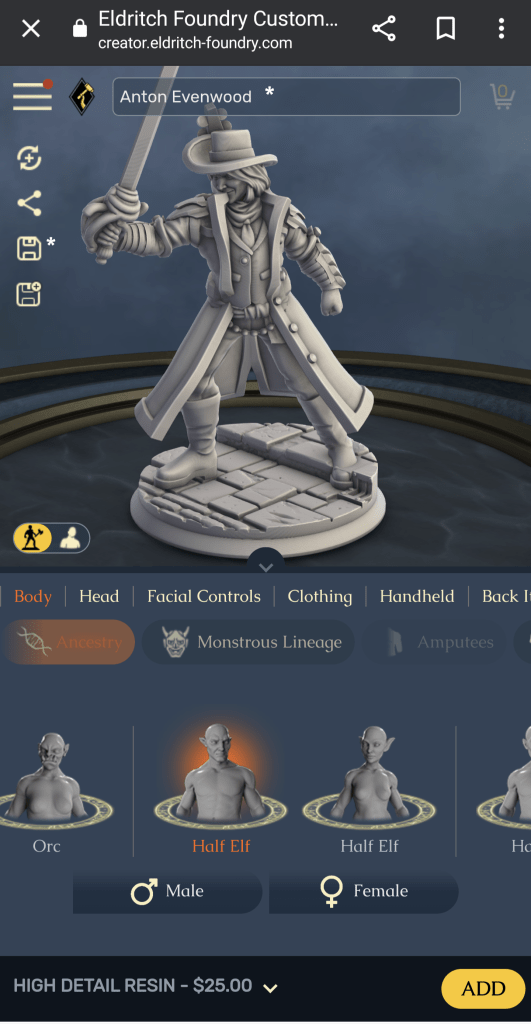
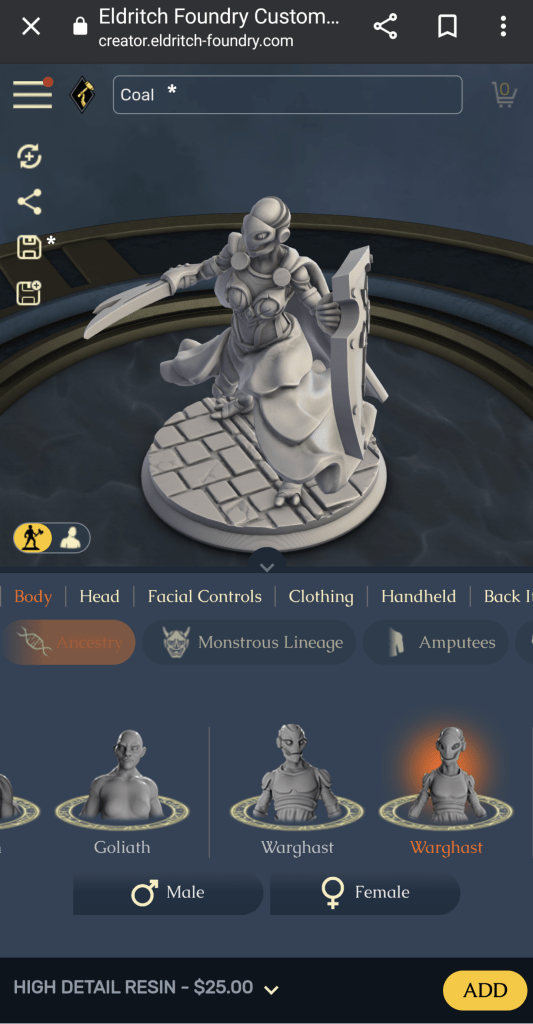
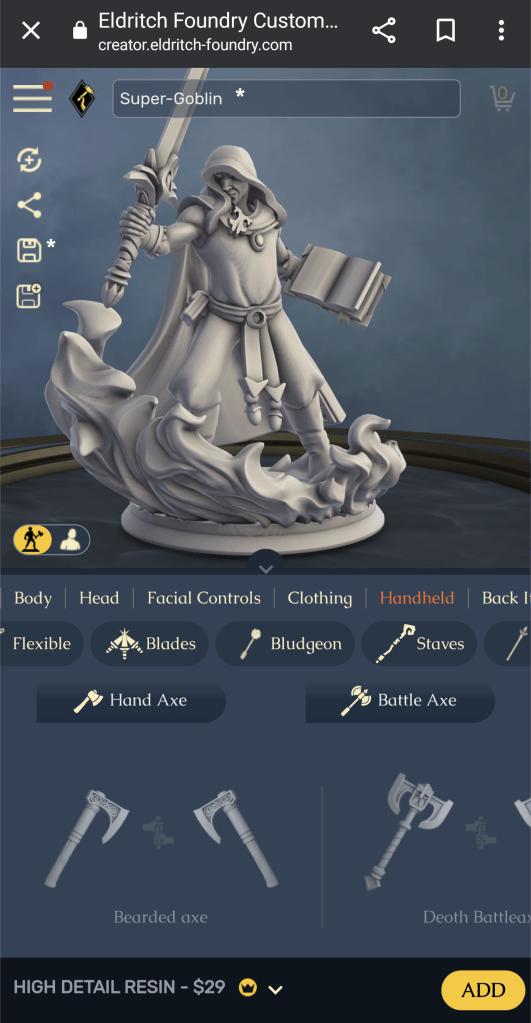
See what I mean?
You get ALL of the options you would for doing it on a PC browser with doing it on mobile!
You can customize race, lineage (if, for example, you want an elemental-type lineage), facial features, you name it, you can customize it. You can even customize things like body type/shape, widening/narrowing shoulders, etc…
Add-on
For a small premium (like with the last design above), you can even add cool base effects, like I did for my elven bladesinger! It’s only an extra $4, which, I almost don’t need to tell you, is fairly cheap when it comes to add-ons.
Bases
Speaking of bases, this was a huge plus for me: they have a rather wide selection of bases to choose from. Everything from a plain blank base, to more elaborate bases, like dungeon floor, cobblestone, giant gears, and more. And bases can be round, hex, and square as your heart desires. Base items are free, but as I said above, base effects come at a small premium, and there are a good few options, like spell tomes, flames (like I did),a demonic fog, and even a sci-fi “Void Shield,” which I thought looked cool.
One note on designs, though. If you pick a pose with some clothes/backpacks/side items, you can get some “clipping” problems, like you see in my first mini’s face into his collar. I did that on purpose so you can see what I mean. That said, you can customize even the poses! I ended up turning his head and adjusting it so the “clipping” problem was a non-issue. I’ll show you how he actually turned out a little bit later.
Shipping and Packaging
Next let’s take a look at shipping and packaging.
Shipping was fairly straightforward. It took a few weeks from start of order to it showing up at my doorstep. Mine shipped from the UK, going to USPS, and then to me.
Packaging was actually kind of impressive! Take a look:
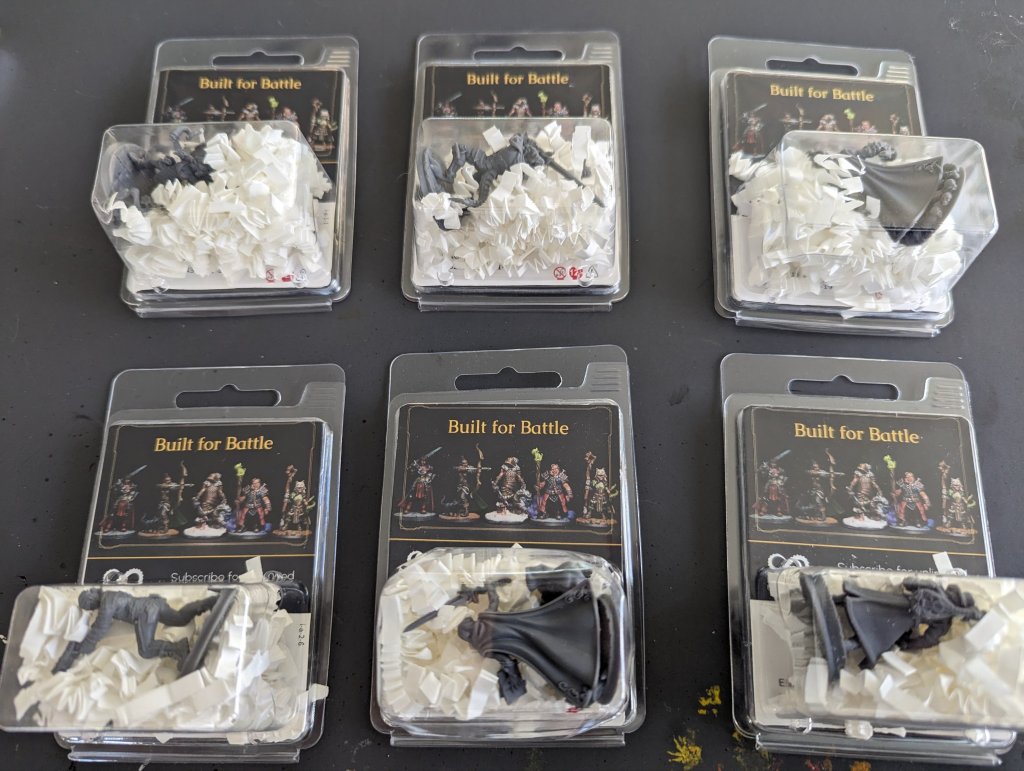
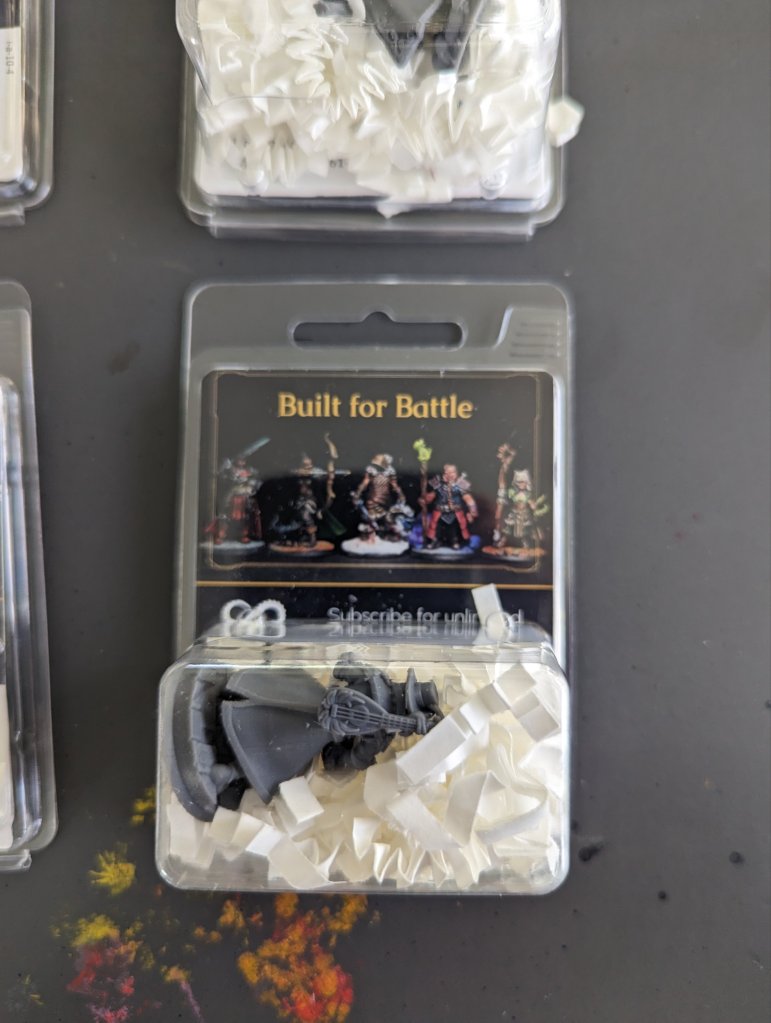
They use a type of scrunched up confetti stuff that really keeps the mini from damage. In fact, I had absolutely zero damaged minis. Considering these were shipped from overseas and they are resin? That’s a mean feat that was well worth noting. A note on shipping: if your order is $100 or more, shipping is free! That’s just 4 minis, and you get free shipping! That’s a pretty good deal, especially since shipping is normally just $11. When I get custom minis, I always get them in “bulk” anyhow, so this worked out well for me.
My Mini Designs
Now let me show you a selection of the minis that I ordered (I can’t show you all of them, as I ordered some as a surprise for my Adventurers League players, and they subscribe to The Blog…no peaking for you guys! But I’ll post them after I show them the minis…).

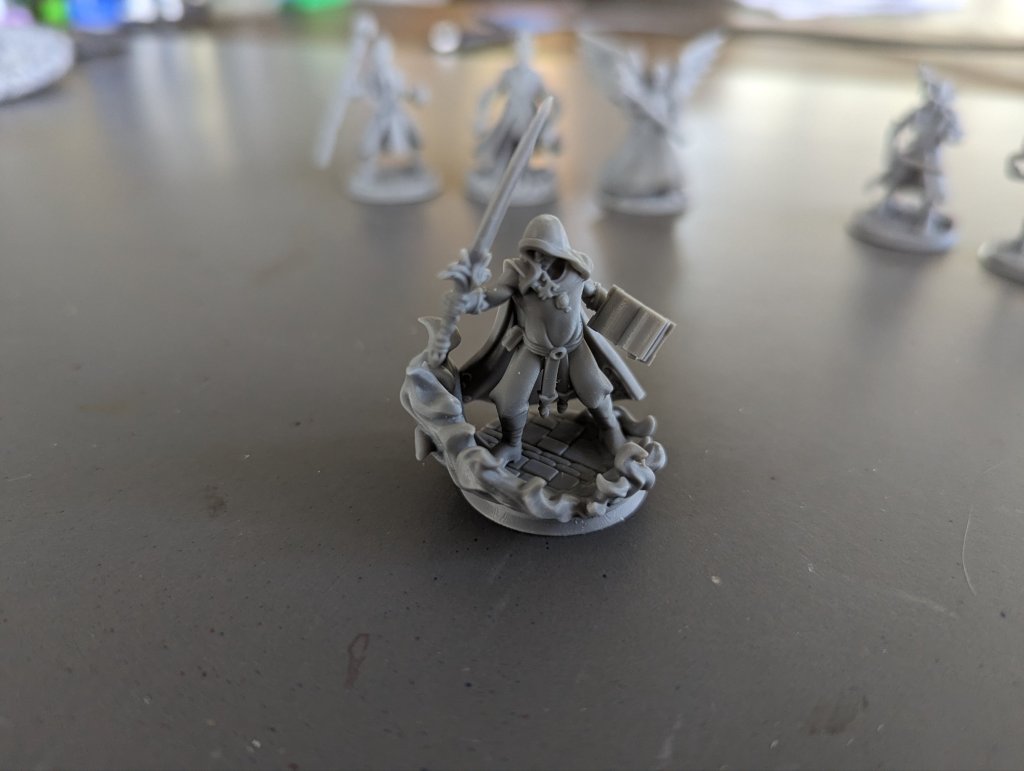
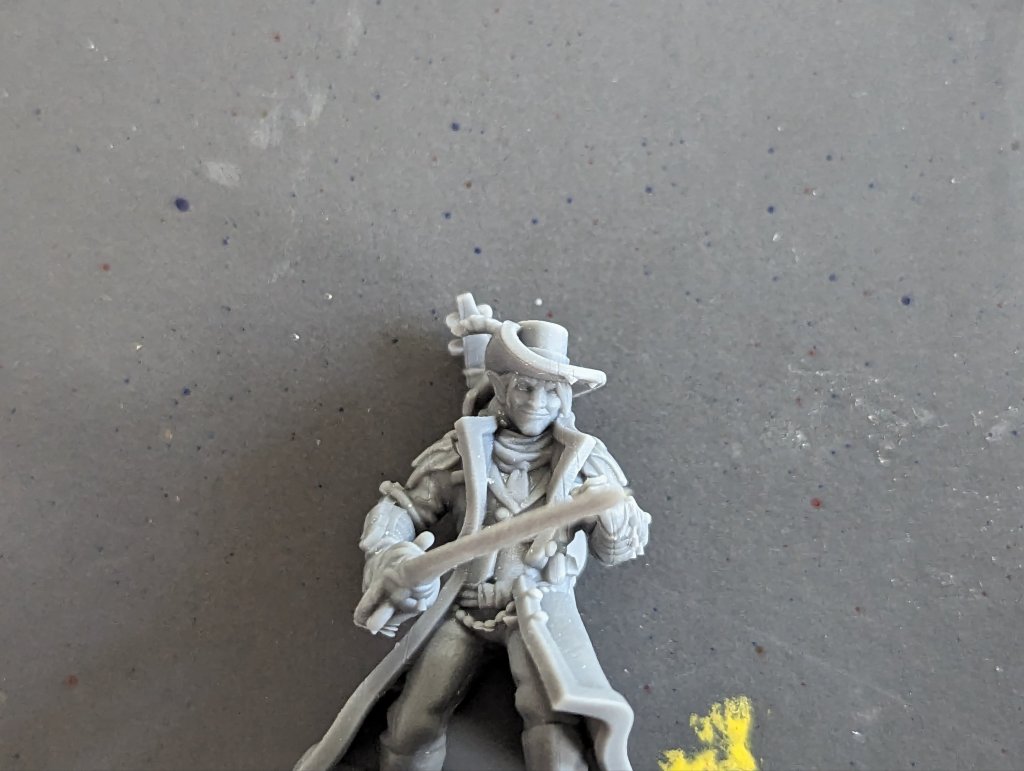
The minis came in good shape, with little, if any deformity. Probably the biggest issue I had, and it’s pretty minor, is that some of the supports were still on them. Take my winged aasimar, known as “The Priest.”
You can see some leftover support pieces in his wings as well as under his clothing near the base. Again, a minor issue that is easily dealt with.
STL File
On a side note, since we are talking supports and printing, you can actually get an STL file instead of the physical miniature for only $5! This is a steal considering other sites charge more than half again as much for an STL of your miniature. I ordered two STLs: one for a mini that’s an NPC in an ongoing campaign whom the party has fallen in love with, and the other STL of a mini that I was going to want several made. So if you are wanting a more economical option and you have access to a resin printer, this may be the option you want to go with.
Pricing
I was blown away at the pricing. They are coming out at $25 a mini, which is amazing for a completely customizable miniature, especially considering the insane detail(s) that come out on the miniature. As I noted before, adding a base effect (like fire, flying books, etc…) does cost an extra $4, but that’s no too bad considering similar products from competitors, which charge upwards of $10 or more for similar add-ons. Now, that said, I know that their primary competitor, Heroforge, only charges $19.99 for their plastic minis, but hear me out: I hate layer lines on my miniatures. I want a clean mini, and they don’t guarantee that, as they seem to be using some sort of FDM-type printer for their minis. Personally, I don’t care how small the layer lines are, because of the detail that I paint on my minis and the minis I do commissions for, I’m going to notice them and it will drive me up the wall to see them. Just knowing that they’d be there would make my eye twitch!
Conclusion
In conclusion, Eldritch Foundry has proven itself to be a standout in the world of miniature gaming. The combination of cutting-edge technology and a deep appreciation for the art of miniatures has resulted in a product that truly sets a new standard.
One of the most striking aspects of Eldritch Foundry’s miniatures is the unparalleled level of customization they offer. Whether you’re a seasoned painter looking for a new canvas or a tabletop enthusiast wanting to bring your character to life, the sheer variety of options is staggering. From selecting every minute detail of your miniature’s appearance to choosing its pose and base, Eldritch Foundry’s online platform empowers players to unleash their creativity.
Furthermore, the quality of the miniatures themselves is exceptional. The level of detail and precision in each figure is remarkable, and the materials used are of the highest caliber, ensuring durability and longevity. The resin casting process ensures that even the tiniest features, from facial expressions to intricate armor patterns, are faithfully reproduced.
While there are numerous options in the miniature market, Eldritch Foundry stands out as a company that not only understands the needs and desires of gamers and hobbyists but also delivers on those expectations. With their innovative approach to customization, high-quality craftsmanship, and dedication to the craft, Eldritch Foundry has undoubtedly earned its place as a top choice for miniature enthusiasts. Whether you’re embarking on epic adventures or simply reveling in the joy of miniature artistry, Eldritch Foundry’s miniatures are a testament to the endless possibilities that this beloved hobby offers.
Until next time, Dear Readers…
I know it’s been a minute, but…
So I know I haven’t posted in awhile. I’ve had an extended on-going family emergency happening.
That said, I’ll be getting back soon. I have another product review coming, and it’s going to be awesome.
In other news, Twitter/X might be charging soon. I’m not about that.
So here’s my Mastodon: @thedailydmblog@mastodon.social
Talk to you all soon!
Three Years…It’s Been THREE YEARS!!
Dear Readers, it has come to my attention that it has now been a total of three years since I began this project. And what a three years it has been! From relative obscurity to now being in the top 27 D&D blogs on the web, it has been quite the ride.
So, now what?
Well, I’m going to continue onward, of course!
I love writing and I love my hobbies, and so I will keep on keeping on.
Some upcoming projects:
- Getting back on the Ingrates Wagon – Losing those episodes took a lot of wind out of my sails. That said, the group and I are looking at what we want to do moving forward. We found out that we lost another episode recently, and it was a big one with an epic fight and story attached. That…one hurt.
But, to show you how far the Ingrates have come, here’s a movie poster that Arkon’s player had put together, with the Ingrates’ newest miniatures as well as the Four Horsemen ominously situated in each corner…
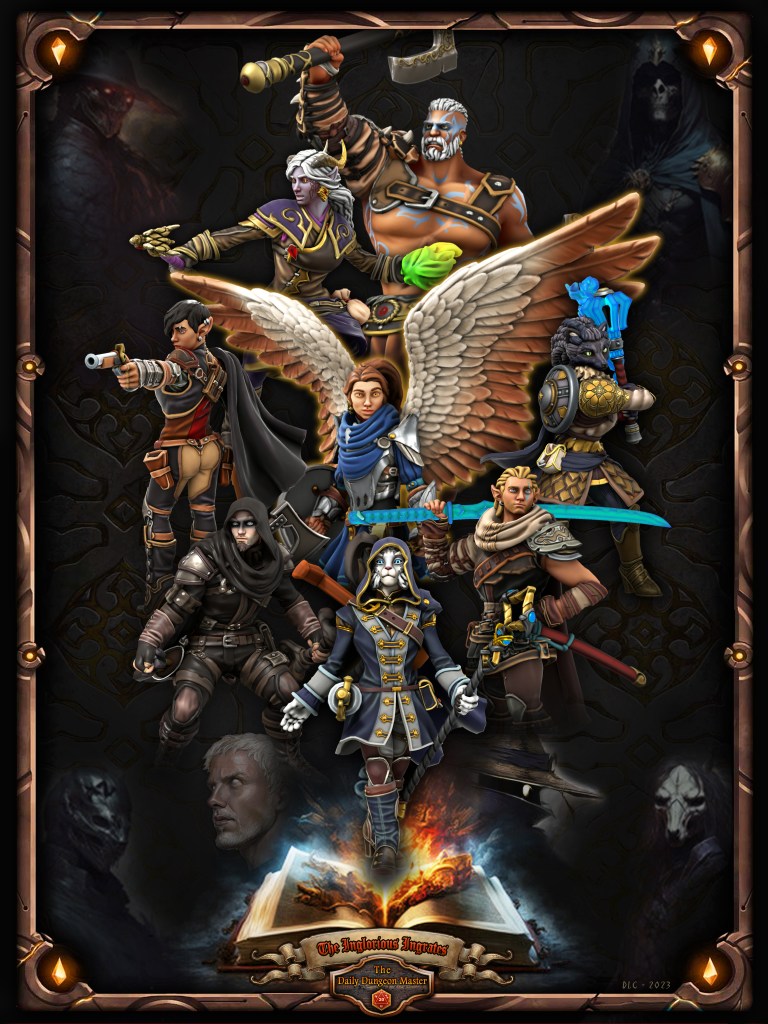
Starting at the top and working our way clockwise: Arkon, Mewsie, Aramil, Winter, Oliver, Kana’l, Dacyria, and Avery in the middle. We plan on having this blown up and framed and put in the store’s private game room where we play as a way of saying “We’ve been here over 2 years and going strong!!”
2. I have an upcoming product review that I am SO very stoked about. I don’t want to spoil anything, but I’ve already put in the order, so when I get it, I’ll do an unboxing and go over the process from creating the order to getting the product. Trust me on this one, you want to stay tuned for this…
Well, that’s all I have for today, Dear Readers. Join us next time for some more content, and here’s to another year!
Until next time, Dear Readers…
Exploring the Rich Universe of BattleTech: Mechs, Politics, and Intergalactic Warfare
Dear Reader, as you know, I have a large and varied number of interests and hobbies. Today, I want to expand to one of my other favorite hobbies: BattleTech.
The universe of BattleTech, a tabletop wargame and science fiction franchise, has captivated fans for decades with its intricate lore, complex politics, and epic battles between colossal mechanized war machines known as BattleMechs. Developed by FASA Corporation in the 1980s, the franchise has since expanded to encompass novels, video games, and even an animated series, creating a vast and immersive universe that continues to evolve. In this blog post, we will delve into the key aspects of the BattleTech universe, from its historical backdrop to its diverse factions and the iconic BattleMechs that define the franchise.
Historical Context and Factions
The BattleTech universe is set in the 31st and 32nd centuries, a time of political intrigue, warfare, and exploration. At its core, the universe is defined by the conflict between the Great Houses, powerful ruling families who control vast interstellar territories. These houses vie for supremacy, using their military forces, alliances, and espionage to gain the upper hand.
The five major Great Houses are the Federated Suns, Draconis Combine, Free Worlds League, Lyran Commonwealth, and Capellan Confederation. Each house boasts its own unique culture, political structure, and technological advancements. The intricate dynamics between these factions, including alliances, betrayals, and shifting allegiances, provide a rich tapestry for the stories and conflicts that unfold within the BattleTech universe.
The Rise of BattleMechs
Central to the BattleTech universe are the awe-inspiring BattleMechs – towering humanoid war machines piloted by skilled MechWarriors. These massive war engines are the backbone of the universe’s warfare, capable of massive firepower and unmatched mobility. The diversity of BattleMech designs, ranging from agile light mechs to heavily armored assault mechs, allows for a wide range of tactical possibilities and strategic choices.
The iconic ‘Mechs’ are equipped with an assortment of weapons, including lasers, missiles, and autocannons, each offering unique advantages and disadvantages on the battlefield. The combination of customizable loadouts and strategic thinking creates a dynamic combat system that has captured the imagination of players and fans alike.
The Inner Sphere and Beyond
Beyond the Great Houses and their political struggles, the BattleTech universe encompasses a vast array of worlds and factions. The Inner Sphere is the core region of inhabited space, where the Great Houses compete for dominance. However, beyond the Inner Sphere lies the Periphery, a frontier of independent worlds, bandit kingdoms, and unexplored territories.
The Clans, a technologically advanced and militaristic society, also play a significant role in the universe. Originating from the Periphery, the Clans are composed of warrior cultures and advanced technologies, making them formidable opponents in their attempts to conquer the Inner Sphere.
Evolving Lore and Expansions
One of the most compelling aspects of the BattleTech universe is its evolving lore. The franchise’s creators have continually expanded the universe through novels, sourcebooks, and video games, providing fans with new stories, characters, and conflicts. These expansions have delved into various aspects of the universe, from historical events to the lives of individual MechWarriors.
The “MechWarrior” series of video games allows players to experience the BattleTech universe firsthand, taking on the role of MechWarriors and participating in epic battles. These games combine tactical combat with RPG elements, offering players the chance to customize their BattleMechs, develop their characters, and engage in immersive storytelling.
Cultural Impact and Community
The BattleTech franchise has left an indelible mark on pop culture, inspiring countless fans to engage with its universe through various mediums. Novels, such as the “Battletech” series by Michael A. Stackpole and the “MechWarrior: Dark Age” series, have expanded the universe’s narrative depth, while video games like “MechWarrior Online” and “BattleTech” have allowed players to step into the cockpit of their favorite mechs.
The BattleTech community is passionate and engaged, with fans discussing lore, strategies, and fan-created content on forums, social media platforms, and conventions. The sense of camaraderie and shared enthusiasm for the universe has led to the growth of fan art, fan fiction, and even organized tournaments that celebrate the franchise’s legacy.
Conclusion: Endless Possibilities
The BattleTech universe continues to captivate fans with its deep lore, intricate political landscape, and iconic BattleMechs. As the franchise evolves and expands, it introduces new generations to the thrill of commanding massive war machines in interstellar conflicts. Whether you’re drawn to the strategic intricacies of the tabletop game, the immersive storytelling of the novels, or the adrenaline-pumping action of the video games, BattleTech offers a universe brimming with endless possibilities and epic battles that will stand the test of time. So, gear up, MechWarrior – the stars await your command.
Until next time, Dear Readers…
Merchandise Update
Dear Readers, as you may or may not remember, we sell Daily DM Blog and Ingrates merchandise here!
Also, as you may or may not know, this month marks the three year anniversary of the beginning of this blog (what a ride it’s been!)!
As my way of saying “Thanks,” I want to offer you all a $5 off coupon for the merchandise store! Simply use the code THANKYOU at checkout.
And thanks again, Dear Readers, as this blog’s success wouldn’t have been possible without you.
Until next time, Dear Readers…
D&D Crossover Campaigns: a How-To
Dear Readers, Dungeons & Dragons (D&D) has captivated the hearts and minds of players for decades, offering a limitless canvas on which to paint epic tales of adventure and heroism. But what if you could take this beloved tabletop role-playing game to the next level by blending it with other fictional universes? Welcome to the world of D&D crossover campaigns, where fantasy meets reality, and your favorite characters from different realms converge to create an unforgettable storytelling experience.
The Magic of Crossover Campaigns
D&D crossover campaigns are a unique way to infuse your tabletop adventures with elements from other pop culture universes. Imagine the thrill of seeing your party of adventurers traverse the landscapes of Middle-earth, face off against Sith Lords in a galaxy far, far away, or even explore the modern streets of Gotham City. The possibilities are as boundless as your imagination.
Setting the Stage: Choosing Your Universes
The first step in creating a D&D crossover campaign is selecting the universes you want to blend. Consider your players’ interests and the dynamics of the various worlds. Do you want to combine the magic of D&D with the technology of steampunk? Or perhaps fuse medieval fantasy with the supernatural intrigue of a Lovecraftian horror story? The key is to find a balance that allows both settings to shine while complementing each other.
Building the Bridge: Establishing Connections
The success of a crossover campaign hinges on how well the different universes are interconnected. There are several ways to achieve this:
- Parallel Dimensions: The worlds exist side by side in separate dimensions, and a mystical rift or portal allows characters to travel between them. This approach maintains the integrity of each world while enabling cross-dimensional adventures.
- Time Travel: Characters are transported to a different era, encountering the inhabitants and challenges of that time. This method can lead to fascinating cultural clashes and historical discoveries.
- Shared Multiverse: In this scenario, the universes coexist within a shared multiverse. Divine beings or cosmic forces oversee these connections, and characters can seamlessly navigate between worlds.
- Converged World: Combine elements from both universes into a new, merged reality. This option offers unparalleled creative freedom but requires careful world-building to ensure a cohesive experience.
Character Creation and Adaptation
One of the most exciting aspects of a D&D crossover campaign is adapting characters from other universes to fit the mechanics of D&D. Whether it’s a Jedi Knight, a superhero, or a wizard from Hogwarts, translating their abilities into D&D terms can be a thrilling challenge.
Consider the strengths and limitations of the characters’ original abilities and how they can be represented using D&D classes, races, and spells. Remember to prioritize game balance to ensure that crossover characters don’t overshadow traditional D&D characters.
World-Building: Fusing Realms
Creating a seamless fusion of two distinct worlds requires meticulous world-building. Here’s how to achieve it:
- Shared Lore: Integrate key elements of both universes’ lore into the campaign. This could involve adapting histories, mythologies, and cultures to fit the narrative.
- Geography: Design a map that combines iconic locations from both settings. Imagine the intrigue of exploring a city where the TARDIS sits next to an elven forest, or where King’s Landing neighbors the bustling streets of Diagon Alley.
- Technology and Magic Integration: Consider how technology and magic from both worlds interact. Do futuristic gadgets malfunction in a high-magic environment? Or does advanced technology disrupt the flow of magic?
- Cross-Cultural Interactions: Explore the social dynamics of your fused world. How do characters from different universes interact? Do they form alliances, face prejudice, or blend seamlessly into society?
Plot and Quests: Finding Common Ground
Crafting a compelling narrative that captures the essence of both universes is crucial. Here are some tips to create engaging quests:
- Shared Threat: Introduce a common enemy that threatens both worlds. This can unite characters from different backgrounds in a common cause.
- Parallel Objectives: Assign quests that cater to the strengths and skills of characters from both universes. This encourages collaboration and showcases each character’s unique abilities.
- Cultural Clashes: Design quests that force characters to confront the unfamiliar aspects of the other universe. This can lead to humorous misunderstandings or profound character development.
- Easter Eggs and References: Pepper your campaign with references to both universes. Reward players’ knowledge with hidden Easter eggs that bridge the gap between their favorite worlds.
Game Mastering a Crossover Campaign
Running a D&D crossover campaign requires a Game Master (GM) with a firm grasp of both universes’ mechanics and lore. Here are some GM-specific considerations:
- Research: Immerse yourself in the lore of both universes to ensure authenticity. This will also help you answer players’ questions about unfamiliar elements.
- Game Balance: Strive for balance between traditional D&D characters and crossover characters. This ensures that everyone has a chance to shine without overshadowing others.
- Flexibility: Crossover campaigns can be unpredictable due to the collision of different mechanics. Be prepared to improvise and adapt to unexpected situations.
- Player Engagement: Encourage players to embrace the unique aspects of the crossover world. Allow them to explore, experiment, and interact with the environment and its inhabitants.
Conclusion
D&D crossover campaigns offer a playground of endless creativity and discovery. By melding beloved universes with the immersive world of tabletop role-playing, you can craft stories that resonate with players on multiple levels. As you embark on this journey, remember that the heart of D&D lies in collaborative storytelling, and the magic of crossovers lies in the unexpected connections you forge between diverse realms. So, gather your fellowship, ignite your lightsabers, and let the dice decide the fate of your multidimensional adventure. The worlds are yours to explore, and the tales are yours to tell.
Cultivating Player Engagement in Dungeons & Dragons: Unleashing the Magic of Immersive Gameplay
In the captivating realm of Dungeons & Dragons (D&D), the Dungeon Master (DM) wields a storyteller’s wand, crafting narratives that come alive through the choices of players. At the core of this enchanting experience lies player engagement – the secret ingredient that transforms a mere gaming session into an unforgettable adventure. In this blog post, we delve into the art of cultivating player engagement, exploring strategies that DMs can employ to create a world that players can’t resist diving into.
Understanding Player Engagement
Player engagement is more than just a measure of time spent at the gaming table. It’s the emotional investment players have in their characters, the story, and the shared experience. Engaged players are those who eagerly anticipate the next session, discuss plot developments outside the game, and invest thought into their characters’ motives and actions. As a DM, your goal is to spark this fire of engagement and keep it burning bright.
Crafting a Compelling Narrative
Every D&D campaign begins with a story, a narrative that captivates players from the outset. Whether it’s a tale of epic heroism, political intrigue, or personal redemption, a well-crafted narrative is the cornerstone of player engagement. Start by developing a clear central theme or conflict that resonates with your players. The more they connect with the overarching story, the more engaged they’ll become.
Fleshing Out Memorable NPCs
Non-player characters (NPCs) are the supporting cast in your players’ adventure. The key to engaging players lies in creating NPCs with depth and authenticity. Give NPCs distinct personalities, motives, and quirks. When players feel like they’re interacting with real individuals, they become more invested in the game world. Remember, it’s not just about providing information; it’s about forging connections.
Empowering Player Agency
One of the most engaging aspects of D&D is the freedom it offers players to make choices that impact the story. Allow players to influence the narrative by responding dynamically to their decisions. The feeling of agency, where players know their choices matter, enhances their investment in the game. Present dilemmas that force tough decisions, and be ready to adapt the story based on their choices.
Immersive Worldbuilding
A richly detailed game world can transform players into ardent explorers. Take time to flesh out the world’s lore, cultures, and histories. Provide sensory details that evoke sights, sounds, and smells. By immersing players in a vibrant setting, you encourage them to interact with the environment and immerse themselves more deeply in the story.
Dynamic and Meaningful Combat
Combat encounters are a cornerstone of D&D gameplay, and they offer an excellent opportunity for engagement. Avoid mundane battles by incorporating strategic elements, dynamic terrain, and unique enemies. Describe combat in vivid detail, engaging players’ senses and pulling them into the action. Remember, combat isn’t just about rolling dice – it’s about the drama and tension of battle.
Building Emotional Connections
Emotions are a powerful tool for player engagement. Craft moments that evoke joy, sorrow, anger, and triumph. When players become emotionally invested in the characters and the story, they are more likely to remain engaged. Design scenarios that challenge their beliefs and values, and provide opportunities for character growth through emotional experiences.
Incorporating Personal Character Arcs
Just as characters grow in a novel, so too should player characters evolve throughout the campaign. Tailor individual character arcs that align with their backstories and goals. As characters face challenges that push them out of their comfort zones, players become more attached to their growth and development.
Regular and Consistent Sessions
Consistency is key when it comes to player engagement. Schedule regular sessions and stick to the plan as much as possible. Long gaps between sessions can lead to waning interest and forgotten plot points. Maintain momentum to keep players invested in the ongoing narrative.
Encouraging Roleplay
Roleplaying is the heart of D&D, and it’s a prime avenue for player engagement. Foster an atmosphere where players feel comfortable embodying their characters. Use open-ended questions and prompts to encourage in-character discussions and interactions. As players connect with their characters on a deeper level, engagement naturally follows.
Utilizing Cliffhangers and Suspense
The allure of the unknown is a powerful engagement tool. End sessions with well-placed cliffhangers that leave players eagerly awaiting the next installment. Suspense piques curiosity and keeps players invested in discovering the outcome of pivotal moments.
Feedback and Collaboration
Engagement is a two-way street. Regularly seek feedback from your players to understand what aspects of the game they enjoy and where improvements can be made. Collaborate with them to shape the narrative and the world, incorporating their ideas and preferences. When players feel their input matters, their engagement intensifies.
Conclusion
Cultivating player engagement is a blend of art and science. It requires a deep understanding of your players’ desires, a mastery of storytelling techniques, and a commitment to creating an immersive experience. By crafting compelling narratives, nurturing player agency, and building emotional connections, you can transform your D&D sessions into unforgettable adventures that keep players eagerly coming back for more. As a DM, you hold the key to unlocking the magic of player engagement – a treasure trove that enriches the world of D&D and brings it to life in ways you never imagined.
Unlocking the Secrets: Exploring Legendary Items and Artifacts in Dungeons & Dragons
Dear Readers, in the boundless realm of Dungeons & Dragons, where imagination takes flight and epic adventures await, few elements captivate both players and Dungeon Masters as much as legendary items and artifacts. These remarkable treasures hold within them the essence of the fantastical, the allure of power, and the echoes of history. In this comprehensive exploration, we will delve into the realm of these enigmatic artifacts, understanding their significance, creation, integration into campaigns, and the role they play in shaping the very fabric of the game.
The Significance of Legendary Items and Artifacts
Legendary items and artifacts are not mere gear, gold, or gadgets. They are conduits of narrative potential, harbingers of change, and symbols of the extraordinary. These objects bear names that resonate through the ages, and they possess capabilities that can redefine the trajectory of an adventure. From the awe-inspiring sword said to cleave mountains to the amulet whispered to control time, these items embody the essence of high fantasy.
Crafting Worlds with Legendary Items
The creation of legendary items and artifacts often begins at the intersection of storytelling and mechanics. Dungeon Masters have the unique opportunity to infuse these treasures with life and lore. Each item can be a thread woven into the tapestry of the campaign world, connecting characters, factions, and events. The history behind these items should be steeped in myth, history, and magic, evoking a sense of wonder and curiosity that drives players to seek them out.
Rarity as a Catalyst for Adventure
Legendary items and artifacts are rare by design, and their scarcity is an essential element in their allure. Players should not stumble upon these treasures casually; they must journey through quests, confront challenges, and make pivotal choices. The rarity of these items transforms their acquisition into a significant achievement, a culmination of effort that elevates both characters and players alike.
The Nexus of Power and Balance
In the world of Dungeons & Dragons, balance is key. Legendary items and artifacts, while imbued with tremendous power, must be introduced thoughtfully. The infusion of immense abilities should not undermine the challenges that the game presents. Instead, these items can serve as tools that expand a character’s capabilities, enhancing their unique playstyle while adhering to the delicate equilibrium that makes the game engaging and fair.
Forging Quests and Trials
The path to obtaining a legendary item or artifact is a quest in itself, an epic journey that mirrors the very tales told within the game. Crafting these quests requires careful consideration of the item’s history, the party’s dynamics, and the overarching narrative. Quests can encompass a spectrum of challenges, from unraveling cryptic riddles to engaging in epic battles, from negotiating with ancient beings to deciphering the intricacies of forgotten rituals. These trials should test not only a character’s combat prowess but also their wit, diplomacy, and moral compass.
Narrative Infusion and Player Engagement
The emergence of a legendary item within a campaign introduces a pivot point, an opportunity for both players and characters to evolve. These artifacts can catalyze character growth, alter alliances, and spark unforeseen consequences. As characters wield these relics, they become part of the legacy, inheritors of stories and fates that resonate with the core of the game’s narrative spirit. Players are more than observers; they become active participants, steering the course of events and etching their own stories into the annals of the campaign.
A Tapestry Woven with Myths and Legends
Legendary items and artifacts often draw inspiration from real-world myths, legends, and folklore. This interweaving of cultural narratives into the realm of D&D adds a layer of depth that resonates with players on a fundamental level. From the sword in the stone to the fabled cup of immortality, these items carry echoes of stories that have stood the test of time, igniting the imaginations of players and evoking a sense of connection to the broader human narrative.
Customization and Homebrew Mastery
While official D&D materials offer a plethora of legendary items and artifacts, the realm of customization and homebrewing provides limitless possibilities. Dungeon Masters can craft items tailored to their campaign’s unique themes, settings, and player dynamics. However, a delicate touch is required to maintain game balance and cohesiveness. Every homebrewed artifact should be a harmonious addition to the world, enhancing the experience rather than distorting it.
Conclusion: Unlocking Imagination
Legendary items and artifacts are keys that unlock the door to boundless imagination. They bridge the gap between reality and fantasy, offering players a tangible connection to the world they explore. As Dungeon Masters, we have the privilege of wielding these keys, weaving tales that intertwine with the essence of these treasures. And as players, we grasp the keys, unlocking not only the potential of the items but also the potential within ourselves to shape stories, create memories, and partake in the timeless tradition of storytelling. So, whether it’s the sword that cleaves mountains or the amulet that controls time, remember that the true magic lies not just in the item, but in the stories it ignites and the worlds it awakens.
Until next time, Dear Readers…
A Dazzling Journey into D&D Dice Magic: An Enchanting Review of MagiSeven.com Dice Sets
Dear Readers, you know how much I love doing product reviews, and this one was one of my favorites!
The realm of tabletop gaming is a diverse and thrilling universe, and at the heart of this world lies the humble yet mesmerizing dice. Today, we embark on an enchanting journey as we explore the extraordinary gemstone dice sets offered by MagiSeven.com. Renowned for their exceptional craftsmanship and unique designs, MagiSeven.com has captivated the hearts of gamers and collectors alike. In this comprehensive review, we delve into the magical allure of these dice sets, examining their quality, aesthetics, and overall gaming experience. Join us as we unravel the secrets behind the magic of MagiSeven.com.
My Set: First off, my set was the absolutely gorgeous labradorite set, found here.
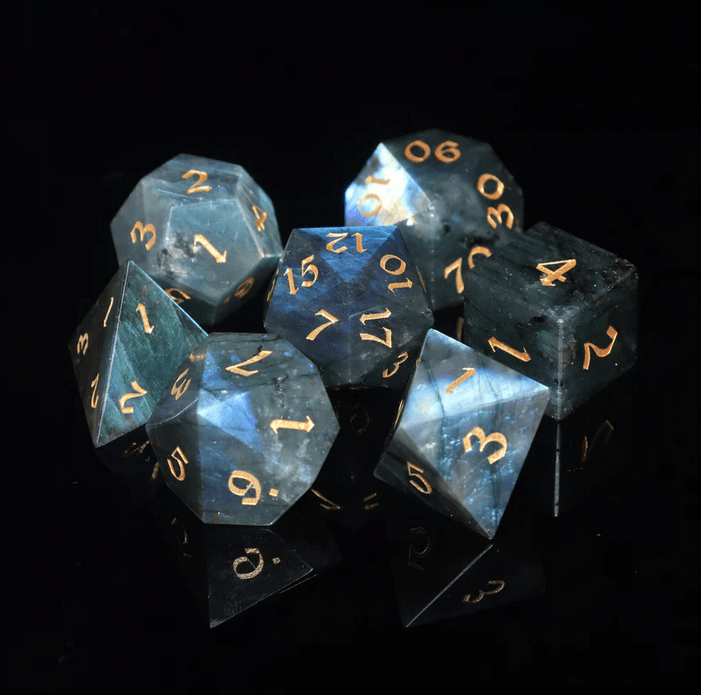
As you can see, these are not phoney, nor are they cheap knock-offs. These amazing gemstone dice are the genuine deal – actual labradorite. Even better, they are sharp-edged! When purchasing, I’m not going to sugarcoat things: I had the hardest time picking out a set!! I almost settled on the amethyst set, but I liked the color of the labradorite set better.
Quality and Craftsmanship: When it comes to dice, durability and precision are paramount. MagiSeven.com leaves no stone unturned in delivering exceptional quality. Each gemstone dice set is meticulously crafted using premium materials, ensuring longevity and superior performance. The dice exhibit well-balanced weight distribution, allowing for consistent rolls and a satisfying feel in the hand. The numbers are etched with precision, promoting legibility without fading or wear over time. Additionally, the dice are resistant to chipping and scratches, demonstrating their resilience.
Aesthetics and Design: MagiSeven.com sets itself apart from the crowd with its enchanting and visually stunning designs. From ethereal celestial motifs to intricate mythical creatures, each dice set is a work of art. The color palettes are rich and vibrant, enhancing the allure of the dice. Whether you prefer the opulent elegance of the Rose Quartz set or the cosmic wonder of the Amethyst set, MagiSeven.com has a design to suit every taste and preference. Furthermore, the dice possess a remarkable depth and translucency that adds an extra layer of visual appeal.
The dice are not just aesthetically pleasing, but they also have functional design elements. MagiSeven.com offers several unique features, such as their precision-cut edges, which allow for more accurate rolls, and larger, more prominent numbers that facilitate easy reading. These thoughtful design choices enhance the overall gaming experience and make these dice sets a joy to use.
Gaming Experience and Versatility: Dice are more than mere tools; they hold the power to transport players into fantastical worlds. MagiSeven.com understands this magic and has crafted their dice sets to elevate the gaming experience. The balanced weight distribution ensures fair and random rolls, leaving no room for doubt or bias. Each roll of the dice becomes a moment of anticipation, enhancing the immersion and excitement of any game.
The versatility of MagiSeven.com dice sets is another commendable aspect. Whether you’re a Dungeons & Dragons enthusiast, a board game aficionado, or a collector seeking exquisite pieces, these gemstone/glass dice sets cater to all. The set option is limited to the classic 7-piece sets, but offer enough unique limited editions, as well as offering a plethora of choices to suit different preferences and gaming needs. MagiSeven.com has truly captured the essence of inclusivity and diversity in the world of dice.
The Bottom Line: MagiSeven.com dice sets weave a spellbinding tale of craftsmanship, aesthetics, and gaming excellence. With their impeccable quality, stunning designs, and immersive gaming experience, they stand as a testament to the artistry and passion that goes into creating exceptional dice sets. Whether you’re a seasoned gamer or a newcomer to the tabletop realm, the allure of MagiSeven.com’s dice sets is undeniable.
These dice sets not only bring an element of magic and beauty to your gaming sessions but also make for stunning collector’s pieces. The attention to detail, durability, and thoughtful design choices make MagiSeven.com dice sets a worthwhile investment. Prepare to be transported into a world where each roll of the dice holds the promise of adventure and wonder.
Additionally, compared with other dice providers, MAGISEVEN D&D dice are superior if for no other reason than their reasonable price: Each dice set from the MAGISEVEN store is provided by the local factories directly. That means that there are no middleman traders to raise the cost (bonus!). Besides, all the orders at magiseven.com support free shipping worldwide (more information about the package and shipping Q&A; SCORE, ANOTHER BONUS!). Moreover, All of MAGISEVEN gemstone dice sets are produced by the largest gemstone dice factory, which is professional and experienced in making D&D dice for about 15 years. Therefore, MAGISEVEN are VERY confident with the quality of each D&D dice set.
In summary, MagiSeven.com dice sets have earned their rightful place as a prominent player in the tabletop gaming community. They exemplify the perfect fusion of artistry and functionality, providing gamers and collectors with a truly enchanting experience. Certainly, you’ll be very satisfied with the quality too! Don’t miss out on the opportunity to embrace the magic and elevate your gaming journey with the captivating dice sets from MagiSeven.com. With the last link, you even get a 10% coupon off of your purchase!
Head on over to MagiSeven.com and get your unique set!
Cyberpunk 2077 and a Rabbit Hole
Dear Readers, as you may have gleaned from the title, I recently upgraded my computer and purchased the game Cyberpunk 2077. Firstly, may I say that this is an amazing game. The gameplay is outstanding (think Skyrim/Fallout except in a dystopian cyberpunk future!), the story is just nothing short of amazing, and the graphics…oh, the graphics. I have the settings turned to the max and it is an absolutely stunning and gorgeous game. Keep in mind that I have it now, and far after the bugs have been worked out and resolved.
Then I remembered: there is a TTRPG named Cyberpunk!
It was this point where I went down one heck of a rabbit hole. I found the original game. Found out that there were several editions that have come out since, leading us to the edition out today, called Cyberpunk RED. Then I discovered the core rulebook and the starter box. So I bought them. Then I discovered a module book. And more dice. And other items to aid in gameplay, like a companion app, an online character sheet creator, and so much more.
Then I found the website. Holy smokes! The sheer number of resources!
And more books!
Then I had another idea: how would I go about finding a group of suckers players to run a game with?
My mind went directly to Roll20.
The rabbit hole went down…SO far.
Roll20 searching found that they do support and have content for Cyberpunk RED! Then I started looking at those prices!
Needless to say, I’ve begun building myself a Cyberpunk RED collection. I don’t know where in the world I’ll store it (I barely have enough space for my D&D stuff (don’t look at me like that…everybody has hobbies; mine just happens to be playing and collecting D&D stuff!), but I’ll figure that out later!
So my current “shiny” is Cyberpunk RED. I’ve been reading up on the rules ad nauseam, practicing making character sheets, reading the examples they have in the books, and so on and so forth.
This rabbit hole has taken me here today, begun on…I want to say Thursday or Friday of last week? Something like that. Maybe as early as Wednesday. Probably Thursday though. Maybe.
I digress.
The point of the matter is that I have discovered something of a lost gem in the TTRPG community.
Of course, I have something to say about it…
My Review
Cyberpunk RED, the latest installment in the Cyberpunk franchise, is an immersive role-playing game that thrusts players into a dark and gritty dystopian world. Developed by R. Talsorian Games, this game successfully builds upon its predecessors and offers a thrilling experience filled with complex narratives, deep customization options, and an engaging combat system. With its intricate world-building and attention to detail, Cyberpunk RED manages to capture the essence of the cyberpunk genre and delivers an unforgettable gaming experience.
World-Building and Narrative
One of the standout features of Cyberpunk RED is its extremely detailed world. Set in the year 2045, the game presents a believable and immersive dystopian setting known as Night City. The city comes alive with its neon-lit streets, towering skyscrapers, and a diverse cast of characters. The lore of the game is meticulously crafted, providing players with a deep understanding of the social, political, and economic aspects of this futuristic world.
The narrative is captivating and keeps players engaged throughout their journey. The main storyline, along with numerous side quests and missions, offer a wide range of choices and consequences that impact the world and its inhabitants. The game master’s guide (found at the end of the core rule book) provides a wealth of information and tools to help game masters create their own compelling stories, making each playthrough a unique and personal experience.
Character Customization and Progression
Cyberpunk RED offers an extensive character creation system that allows players to build their own unique protagonists. From choosing their character’s background, skills, and attributes to customizing their appearance, players have ample freedom to shape their virtual personas. The lifepath system adds depth to the characters, providing different starting points and storylines based on their chosen background.
As players progress, they can further specialize their characters by investing in specific skills and abilities. The game offers a diverse range of character classes, such as Netrunners, Techies, and Solos, each with their own unique playstyles and abilities. This depth of customization ensures that players can create characters tailored to their preferred playstyles and tactics.
Gameplay and Combat
The gameplay in Cyberpunk RED strikes a balance between role-playing and action. Exploration is a key aspect of the game, as players navigate the sprawling Night City and interact with its inhabitants. The open-world environment encourages players to uncover hidden secrets, take on side quests, and immerse themselves in the rich tapestry of the world.
Combat in Cyberpunk RED is fast-paced and exhilarating. Whether engaging in gunfights, melee combat, or hacking encounters, players are presented with a wide array of tactical options. The combat system is intuitive, with rules that are easy to grasp yet offer depth for strategic decision-making. The inclusion of cyberware upgrades and futuristic weaponry adds an extra layer of excitement to the combat encounters.
Artwork and Presentation
The visual design of Cyberpunk RED is nothing short of stunning. The artwork captures the cyberpunk aesthetic flawlessly, with its vibrant neon colors, gritty cityscapes, and detailed character illustrations. The rulebook and supplementary materials are beautifully crafted, providing a visually pleasing and immersive experience. The layout and organization of the rulebook make it easy to navigate, ensuring that players can quickly find the information they need during gameplay.
Conclusion
Cyberpunk RED is a remarkable addition to the cyberpunk genre, delivering a captivating role-playing experience in a dystopian future. With its intricate world-building, engaging narrative, deep customization options, and thrilling combat system, the game successfully immerses players in the dark underbelly of Night City. Whether you’re a fan of the genre or new to the cyberpunk universe, Cyberpunk RED is a must-play title that will leave you craving more of its exhilarating and immersive gameplay.
So, all that said, my verdict? I SO desperately want a chance to play this. Like…I cannot describe how much I want to play this. Even just a few sessions.
*sigh*
Oh, well. Maybe one day.
Until next time, Dear Readers…
Monster Highlight: The Allip
In the dark corners of the Dungeons & Dragons (D&D) universe, where fear and nightmares reign, the allip emerges as a chilling and malevolent specter. Born from the tortured souls of those who learned too much, this haunting creature embodies despair and madness. Today, we delve into the lore and characteristics of the allip, exploring its origins, abilities, and the spine-tingling encounters players may face when confronted by this spectral terror.
Origins and Lore
The allip’s origins can be traced back to mortal beings who learned a secret protected by a powerful being that protected it with a curse usually killing the mortal. These tortured souls, while learning the secret and consumed by despair and madness, transform into allips upon their death, becoming trapped between the realms of the living and the dead. Their spectral form reflects their tortured psyche, their minds forever shattered and their sanity beyond redemption.
Appearance and Behavior
Allips appear as ethereal entities, wisps of darkness that defy easy description. Their forms constantly shift and twist, making it difficult to focus on any specific feature. Their voices echo with a haunting cacophony, comprising the anguished whispers of the mad and the sobbing cries of those lost to despair attempting to unburden themselves of the secret by telling it to others. These unsettling qualities give rise to the allip’s reputation as one of the most fearsome and unsettling monsters in the D&D universe.
Abilities and Powers
Allips possess a range of supernatural abilities, allowing them to torment and manipulate those unfortunate enough to cross their path. One of their most fearsome powers is the ability to do large amounts of psychic damage. These come in the form of their maddening touch (4d6+3 psychic damage, 1 target), their howling babble (forces an opponent to make a Wisdom save or take 2d8+3 psychic damage and be stunned, targeting all creatures within 30 feet of it), and their whispers of compulsion, where up to three targets must make a wisdom saving throw or take 2d8+3 psychic damage and use its reaction to make a melee weapon attack against another creature of the allip’s choice!
In addition to their psychological attacks, allips possess other chilling abilities. They can move effortlessly through solid objects, passing through walls and locked doors with ease, granting them the element of surprise. Moreover, their ethereal nature renders them resistant to physical attacks (unless magical), making them even more elusive and challenging opponents. They are also resistant to acid, fire, lightning, and thunder damage. Add to this, their immunity to cold, necrotic, and poison damage, and you have a fearsome adversary.
Encounters and Strategies
Encountering an allip can be a terrifying ordeal for even the most seasoned adventurers. These spectral beings tend to lurk in dark and desolate places, such as abandoned asylums, haunted ruins, or lost libraries. They are drawn to places steeped in lore.
When engaging with an allip, parties must be prepared for an intense mental battle. The creature’s ability to do psychic damage can render even the bravest warrior powerless. Protective spells that bolster mental fortitude, such as protection from evil or mind blank, can provide crucial defenses against the allip’s onslaught. Clerics and paladins who can turn undead can also be useful in aiding the party in its fight against one or more allips.
Strategies for combat against an allip often revolve around countering their ethereal nature. Spells like magic missile or force-based attacks can effectively harm these elusive foes, as can magical weapons. Rogues and rangers with an affinity for stealth and precision can also play a vital role in exploiting an allip’s vulnerabilities.
Conclusion
The allip, a haunting specter born from the madness of learning a secret too powerful to keep, embodies the essence of madness and dispair. Its unsettling appearance, along with its ability to do copious amounts of psychic damage, make it a formidable adversary. Players who dare to face the allip must be prepared to battle not only with swords and spells but with the strength of their own minds. Surviving an encounter with an allip is a testament to a party’s resilience and resourcefulness. Whether as a fearsome enemy or a captivating element in storytelling, the allip’s presence adds a chilling and unforgettable dimension to the game.
Unleashing the Magic: Exploring the Spellcasting Classes in D&D
In the vast and captivating world of Dungeons & Dragons (D&D), magic is an essential component that adds depth and excitement to the gameplay. Spellcasting classes provide players with the ability to wield incredible powers, shape reality, and alter the course of epic adventures. Today, we’ll delve into the enchanting realm of spellcasting classes in D&D, exploring the unique features, mechanics, and possibilities they offer.
Wizard: Masters of Arcane Knowledge
At the forefront of spellcasting classes in D&D stands the wizard, the quintessential scholar of magic. Wizards are masters of the arcane arts, dedicating their lives to the pursuit of knowledge and unraveling the mysteries of spellcasting. What sets them apart is their vast repertoire of spells. By meticulously preparing spells from their spellbook, wizards can harness a wide array of magical effects, making them highly versatile in various situations. They excel at arcane rituals, spell research, and scribing new spells into their books, making the wizard class a favorite among players who enjoy meticulous planning and strategic gameplay.
Sorcerer: Harnessing Innate Power
Unlike wizards who derive their magic from diligent study, sorcerers possess innate magical abilities. Their powers are an inherent part of their being, flowing through their bloodlines. Sorcerers tap into this wellspring of raw magic and channel it to cast spells. This makes them masters of spontaneity, able to conjure spells on the fly without preparation. With a limited number of known spells, sorcerers rely on their metamagic options to modify spells and augment their effects. Sorcerers provide players with the opportunity to embrace their character’s natural-born gift and unleash their magical potential in dynamic and unexpected ways.
Warlock: Forging Pacts with Otherworldly Beings
Warlocks make pacts with powerful entities from other planes of existence, such as fey creatures, demons, or eldritch beings. These supernatural patrons grant warlocks access to their otherworldly powers, making them formidable spellcasters. What sets warlocks apart is the nature of their spellcasting. Rather than relying on a spellbook or innate abilities, they receive spells directly from their patron. Warlocks also possess unique invocations, which enhance their magical abilities and grant them additional benefits. The warlock class appeals to those who seek a deeper narrative connection with their character and enjoy a dark and mysterious flavor in their gameplay.
Cleric: Divine Servants and Miracles
Clerics are devoted followers of deities, drawing their magical might from the divine forces they worship. These pious spellcasters are the healers, guardians, and spiritual guides of their party. Clerics gain access to a wide range of spells that reflect their chosen deity’s domain, allowing them to heal wounds, banish undead, or smite their enemies with divine wrath. With the ability to channel divine energy, clerics can also restore vitality to their allies and turn the tide of battle. The cleric class brings a touch of divine power to the game, emphasizing faith, devotion, and the eternal struggle between good and evil.
Druid: Guardians of Nature
Druids, the guardians of the natural world, draw their magic from the primal forces of nature itself. They are deeply connected to the land, animals, and elemental energies. Druids can shape-shift into animals, commune with spirits, and command the forces of earth, air, fire, and water. Their spellcasting is closely tied to their wild shape ability, which allows them to transform into different creatures, enhancing their versatility in combat and exploration. With a focus on harmony, balance, and the preservation of nature, druids offer a unique spellcasting experience that emphasizes their connection with the natural world.
Bard: Masters of Song and Spell
Bards are charismatic performers who wield magic through the power of music and storytelling. They combine their enchanting melodies with spellcasting, creating a captivating blend of artistry and arcane prowess. Bards have the ability to inspire their allies, granting them bonuses to their abilities and bolstering their courage. They can also cast spells that manipulate emotions, deceive enemies, or heal wounds with their soothing melodies. Bards are versatile spellcasters, capable of adapting to any situation and leaving a lasting impact on both the battlefield and the hearts of those around them.
Paladin: Warriors of Virtue
Paladins are holy knights who fight for justice, righteousness, and the ideals they hold dear. They draw their magical powers from their unwavering devotion to a higher cause, typically a deity or an oath. Paladins are skilled in both martial combat and divine spellcasting, making them formidable adversaries on all fronts. Their spells often revolve around smiting evil, protecting their allies, and bolstering their own combat abilities. Paladins embody the concept of a holy warrior, standing as a beacon of light against the darkness and inspiring others with their unwavering faith.
Ranger: Masters of the Wilderness
Rangers are skilled hunters and scouts who possess a deep connection with the natural world. They draw upon their bond with the wilderness to cast spells that aid them in their explorations and enhance their survival skills. Rangers have a unique spellcasting mechanic known as “Ranger Spells,” which grants them spells focused on tracking, wilderness survival, and communing with animals. Their spellcasting abilities complement their exceptional combat prowess, making them versatile adventurers who thrive in the untamed wilderness.
Conclusion
Spellcasting classes in D&D offer players an immersive and magical experience, allowing them to shape the narrative and overcome challenges through the power of magic. Each class brings its own unique flavor, mechanics, and role-playing opportunities to the table. Whether you seek the intellectual pursuit of knowledge as a wizard, the raw power of innate magic as a sorcerer, or the divine connection of a cleric, there is a spellcasting class to suit every playstyle and character concept.
Exploring the various spellcasting classes in D&D opens up a world of possibilities, allowing players to unleash their creativity, adaptability, and strategic thinking. The spellcasting classes provide a rich tapestry of abilities, spells, and character development, offering countless opportunities for memorable adventures and exciting gameplay.
So, gather your spell components, prepare your incantations, and unleash the magic within. Embark on a spellbinding journey and discover the wonders of spellcasting classes in Dungeons & Dragons. May your spells hit their mark, and may the magic of your imagination illuminate your path to legendary adventures.
How-to: Mastering the Art of Scheduling D&D Games – A Guide for Dungeon Masters and Players
Scheduling Dungeons & Dragons (D&D) games can often feel like herding cats, with conflicting schedules, real-life responsibilities, and various commitments of the players involved. However, with effective planning and communication, you can create a seamless gaming schedule that accommodates everyone’s needs and ensures an immersive and enjoyable D&D experience. In this post, we’ll explore some tried-and-true strategies to help Dungeon Masters and players master the art of scheduling D&D games.
- Establishing Clear Communication Channels – To successfully schedule D&D games, establishing clear and efficient communication channels is crucial. Create a group chat or use a platform like Discord or Slack where everyone involved can communicate and share updates regarding game schedules. This ensures that everyone stays informed and provides a space for discussions about availability and preferences.
- Discuss and Determine Availability – Once you have established a communication channel, encourage everyone to share their availability. It’s important to understand the constraints and commitments of each player. Consider factors such as work schedules, family obligations, and time zones. By collecting this information, you can identify common windows of availability and choose the best time for the majority.
- Use a Shared Calendar – A shared calendar can be an invaluable tool for scheduling D&D games. Platforms like Google Calendar or dedicated scheduling apps allow you to create events and invite participants, enabling them to mark their availability directly on the calendar. This visual representation helps you identify overlapping free time slots, making it easier to schedule sessions that work for everyone.
- Establish a Regular Schedule – Consistency is key when it comes to scheduling D&D games. Establishing a regular schedule, such as playing every other Saturday or every Wednesday evening, can help players plan their lives around these designated times. When the game becomes a recurring event, it becomes easier for everyone involved to prioritize it and ensure their availability.
- Flexibility and Alternatives – Sometimes, despite your best efforts, conflicts may arise. It’s essential to approach scheduling with flexibility. Consider alternative options such as rescheduling the session to a different day or time, playing shorter sessions, or even dividing the group into smaller teams for separate adventures if necessary. Flexibility fosters cooperation and keeps the game running smoothly.
- Plan Ahead – Proper planning goes a long way in ensuring successful D&D game scheduling. As a Dungeon Master, prepare game sessions in advance, including storyline arcs, encounters, and character developments. Providing players with an overview of upcoming sessions and key plot points allows them to manage their schedules better and prioritize game nights.
- Online Tools and Virtual Platforms – The rise of online gaming platforms and virtual tabletops has made scheduling D&D games more accessible than ever. Platforms like Roll20, Fantasy Grounds, or Tabletop Simulator provide virtual spaces for players to gather, role-play, and engage in thrilling adventures. These tools often include built-in scheduling features, making it easier to organize game sessions and invite players to join.
- Be Respectful of Boundaries – Remember that everyone involved in the D&D game has responsibilities and commitments outside of the game. Respect each player’s boundaries and limitations. Encourage open communication about availability changes and conflicts so that adjustments can be made accordingly. By fostering a respectful and understanding environment, you create a positive gaming experience for everyone.
Conclusion
Scheduling D&D games can be a challenging task, but with effective communication, flexibility, and careful planning, it can be a seamless process. By establishing clear communication channels, discussing availability, utilizing shared calendars, and establishing a regular schedule, you set a solid foundation for successful game scheduling. Additionally, being flexible, planning ahead, and utilizing online tools and virtual platforms can greatly enhance the scheduling experience.
Remember to be respectful of each player’s boundaries and commitments outside of the game. Life happens, and conflicts may arise. By fostering an environment of understanding and open communication, you can work together to find alternative solutions and make adjustments when needed.
Ultimately, the key to scheduling D&D games lies in collaboration and compromise. As a Dungeon Master or player, your goal is to create an immersive and enjoyable experience for everyone involved. By investing time and effort into scheduling, you pave the way for exciting adventures, epic battles, and unforgettable memories within the world of D&D.
So, gather your party, start the conversation, and embark on a journey to master the art of scheduling D&D games. With patience, communication, and a touch of creativity, you can create a gaming schedule that accommodates the diverse lives and schedules of your players, ensuring a fantastic D&D experience for all. Happy gaming!
My Bad
Apparently, my posts were not posting and I had no idea until today. Come to find out, I had scheduled them to be posted on the right days…in the wrong year!!
Yeah, so there was that.
That said, still working on the Premium Content Inglorious Ingrates issue. Sorry it’s taking so long, but, we’re trying to make it worthwhile.
In other news, I finally finished another of my commissions!
It’s one heck of an ugly half-ogre. Here, take a look:
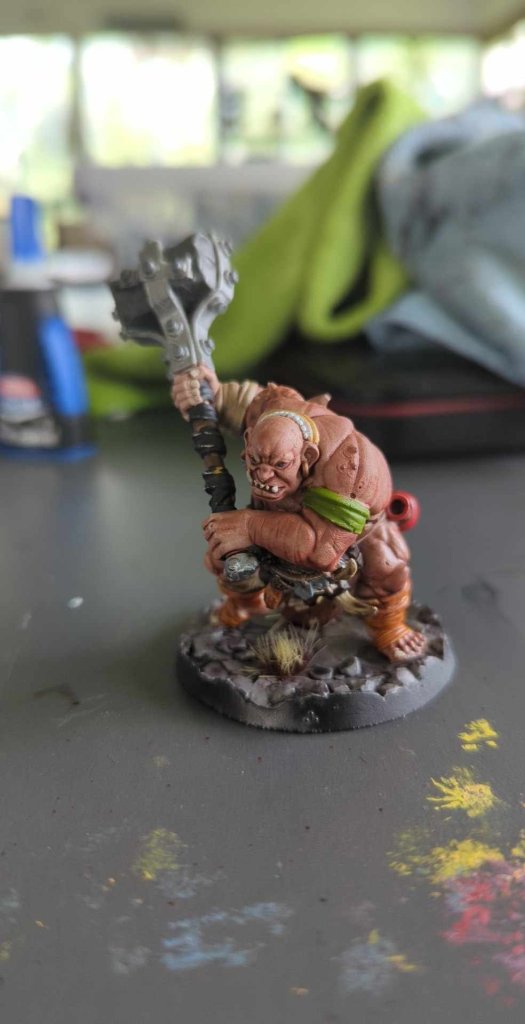
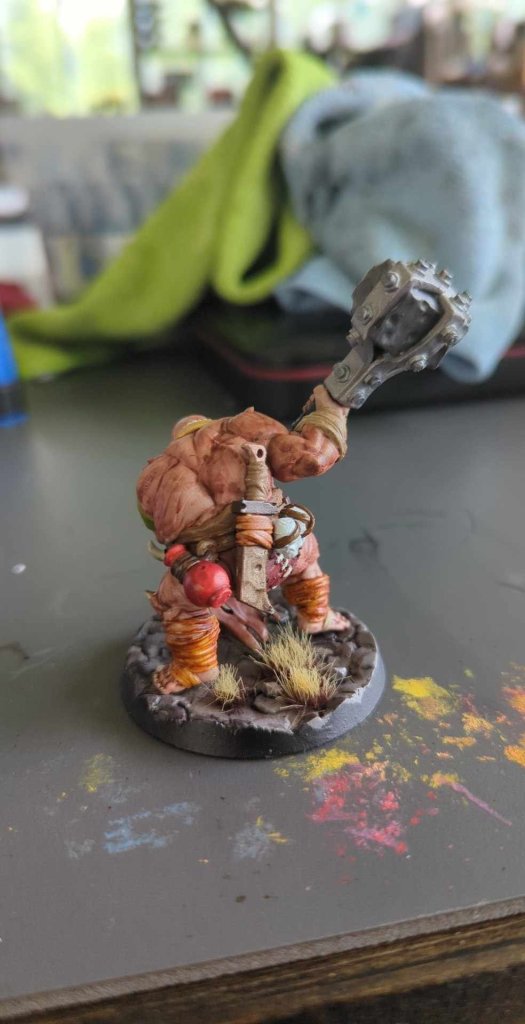
He’s properly hideous, and I love him. And the dude I painted him for loved him, too.
Sorry there aren’t progress pictures. I didn’t even think about it, honestly.
But I digress.
Well, that’s all I got for today! I’ll have more tomorrow, and going forward.
Until next time, Dear Readers…
Happy Father’s Day!
To all fathers, father-like figures, and single moms filling in for both parents in your lives, a hearty Happy Father’s Day!
Sincerely,
The Daily DM Blog Team
A Little Time Off
So this post was scheduled out because I knew it would be coming:
I’m taking the week off for Father’s Day. Apparently there have been plans made. Not sure what.
I guess I’ll find out!
Speed Paints 2.0 a Review Part II
Dear Readers, I’ve pretty much finished the mini I was working on (I didn’t do any basing yet),and the results are… mixed.
Here’s the mini:
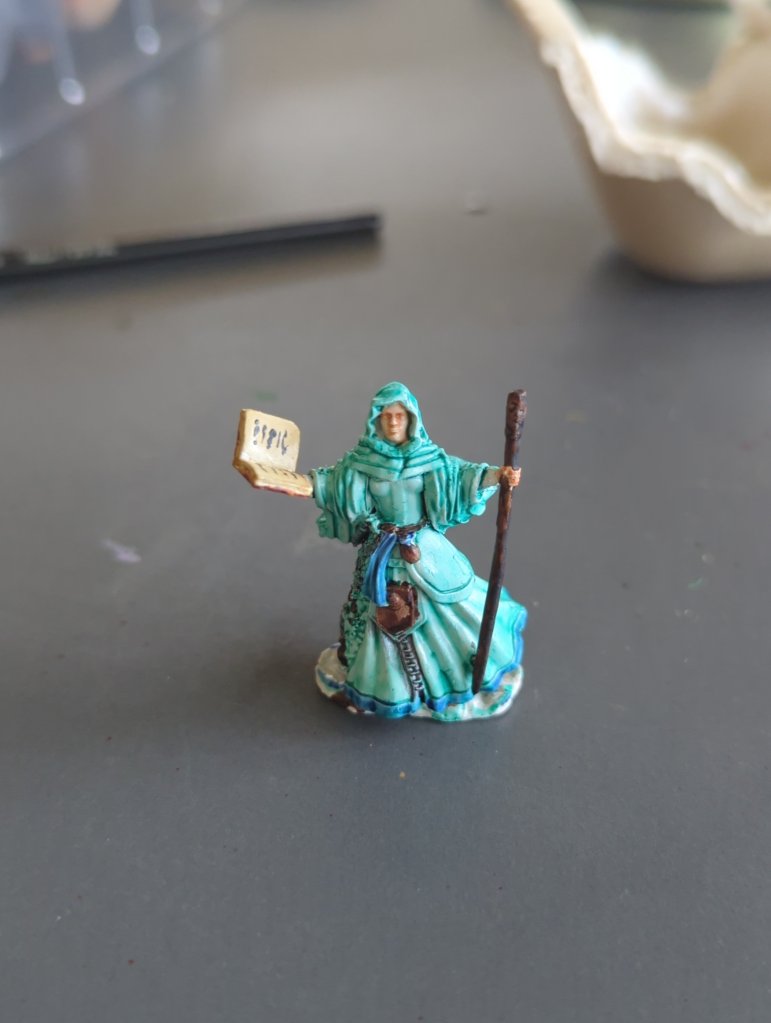
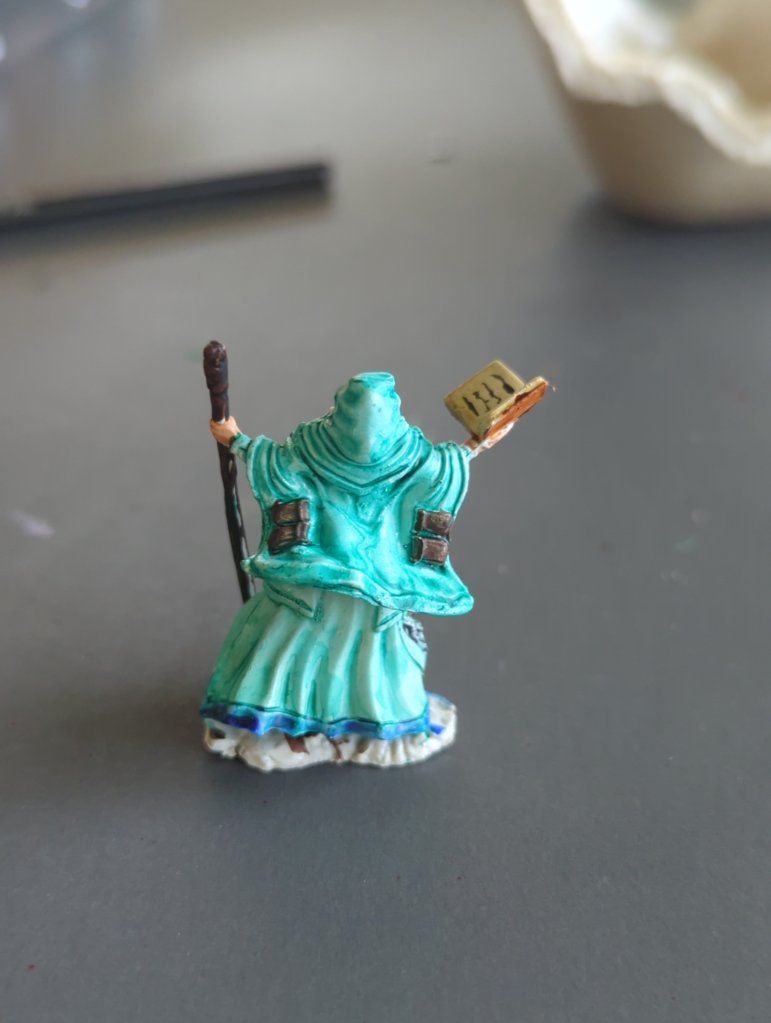
The Good
-The paints go on smooth and dry fairly quickly, enabling multiple coats to go on easily.
-The paints show up well and do what they are supposed to do without reactivation of the paints between coats.
-The color range that Army Painter has in this line is rather…extensive, all things considered.
-Large areas can be painted quickly with great results
The Challenges
-Detail work is outside of the scope of this pain line, still requiring standard acrylics to do the smaller detailed parts (we’re talking pouches, belts, ropes, potions, etc…)
Overall
Overall, I give the new Speed Paints 2.0 an A-. Speed Paints aren’t meant to, I believe, do detail work, but it does a great job for everything else. If you are just needing tabletop quality (most of what I do) for painting, this is your line of paints!
Until next time, Dear Readers…
Inglorious Ingrates Episode 19: The Aftermath
The Ingrates deal with the fallout with the battle with WAR, and are tasked with helping deal with the consequences of the battle.
Premium Content: I Got a New Toy!
Dear Subscribers, we’re still working on the problems with the Ingrates episodes we lost, so today I get to share with you the details of a new “toy” that I purchased…an Ender 3 V2 Neo 3D printer!
Here’s a look at it and what I think…
Subscribe to get access
Read more of this content when you subscribe today.
That’s all I have today, so tune in next week!
Until next time, Dear Subscribers…
New Paints! Speed Paint 2.0: a Review
Dear Readers, I know normally, do painting updates on Sundays, but I just got these in last night, and I wanted to try them out!
I’ve been pretty happy with the speed paints that I’ve had. They worked well, with one exception: if you paint too close with one color next to another, the speed paint medium reactivated! This meant colors bleeding into each other, and a total mess.
Not. Fun.
I mean, I’d reviewed the previous speed paint set, but hadn’t actually had the issue, but that was due more to technique than anything else. And if I had to layer colors or paint colors too close to each other (thin strips of color or the like),this would have become an issue, as it had for many other people.
No longer!
Apparently, they fixed the reactivation issue. All that needs to happen is for the user to allow 15-20 minutes in-between coats/colors, and one is good to go! They also recommend doing light colors first and working your way out darker.
A big welcome to Speedpaint 2.0 f on Army Painter!
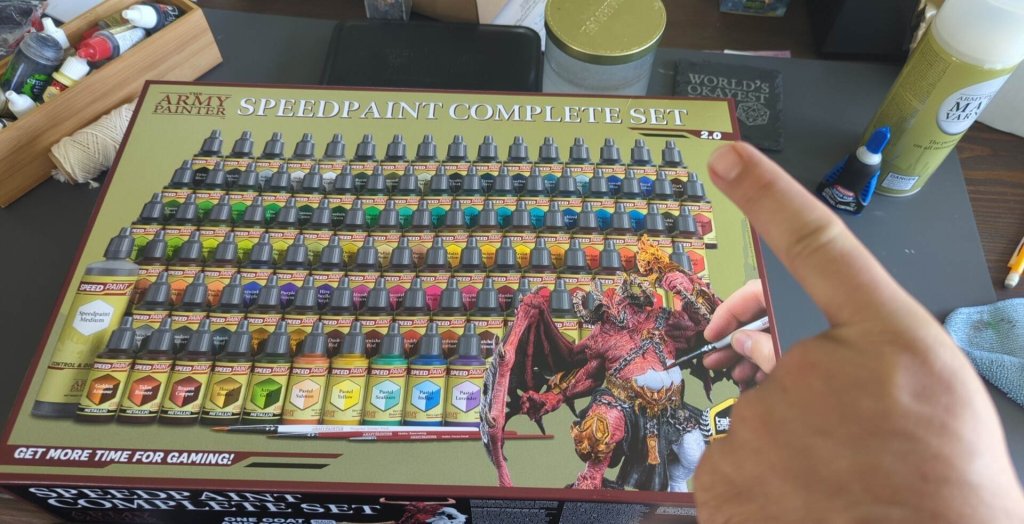
I went ahead and purchased the Complete Set, having found it on sale on a website called Watchtower Games (https://watchtower.shop).
I am so very excited to use them.
What’s In the Box
Th set I received had 89 paints, 1 small bottle of speed paint medium, one large bottle of speed paint medium, and 3 brushes. Frankly, the sheer number of paints, even for a complete set of specialty paints, is astounding. Among the paints are the “standard paints” as well as a handful of pastel colored paints and 10 of the the newest line of metallic speed paints.
So, using that technique, let’s see how it comes out…
I’ll be painting a female human wizard today. Nothing too elaborate.
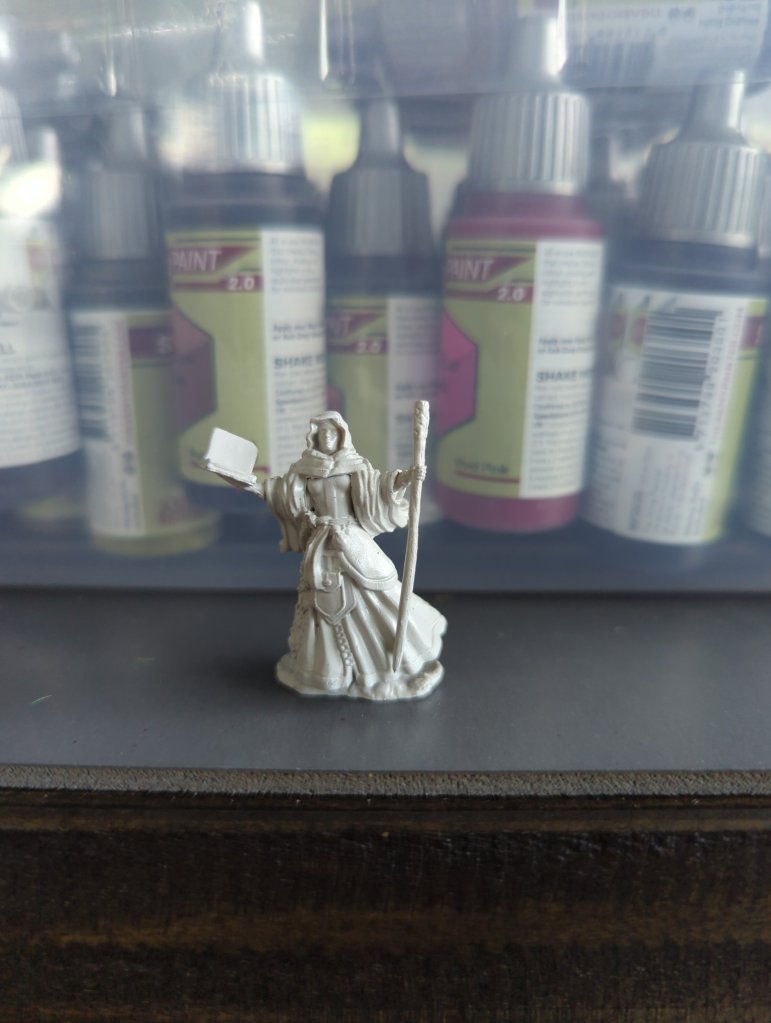
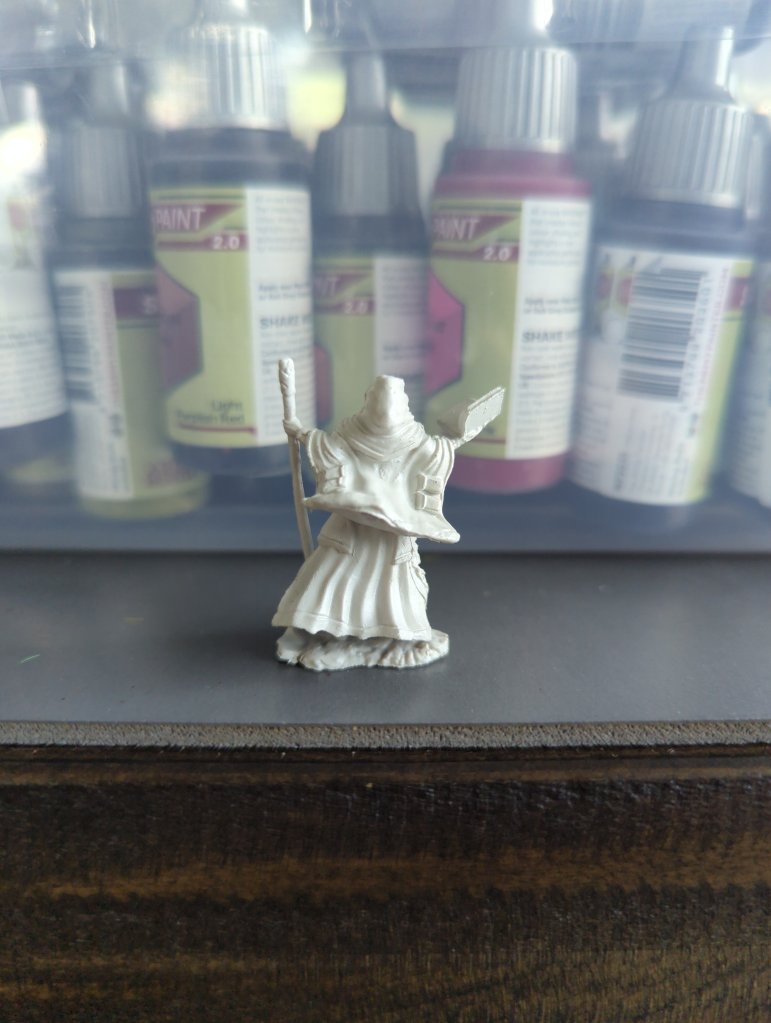
Here are the colors I have chosen for the mini:
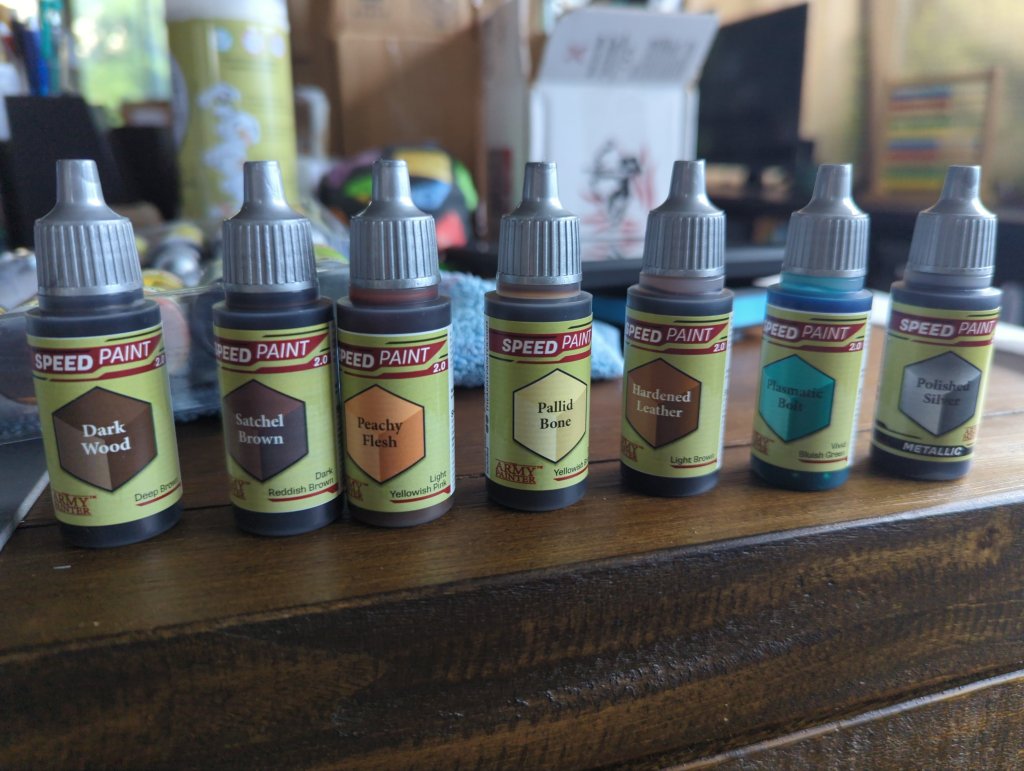
Dark Wood for the staff, Satchel Brown for her, well, her satchel, Peachy Flesh for her skin, Pallid Bone for the spell book pages, Hardened Leather for the spell book binding, Plasmatic Bolt for her robes, and Polished Silver for the metal bits.
I’m starting with the skin bits and the spell book pages first, being the lightest colors.
And so far so good!
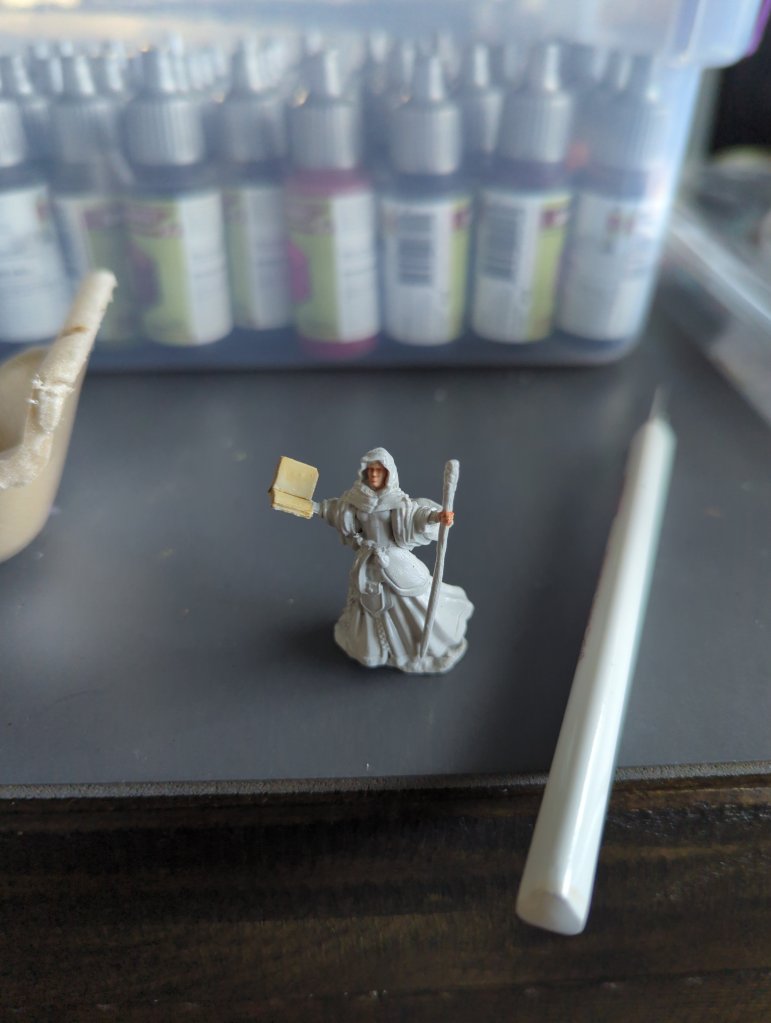
I’ll be doing some fine detail work later with Matt Black to put some runes on the pages, but that’s future me to do.
Next I’ll be painting the robe and the staff.

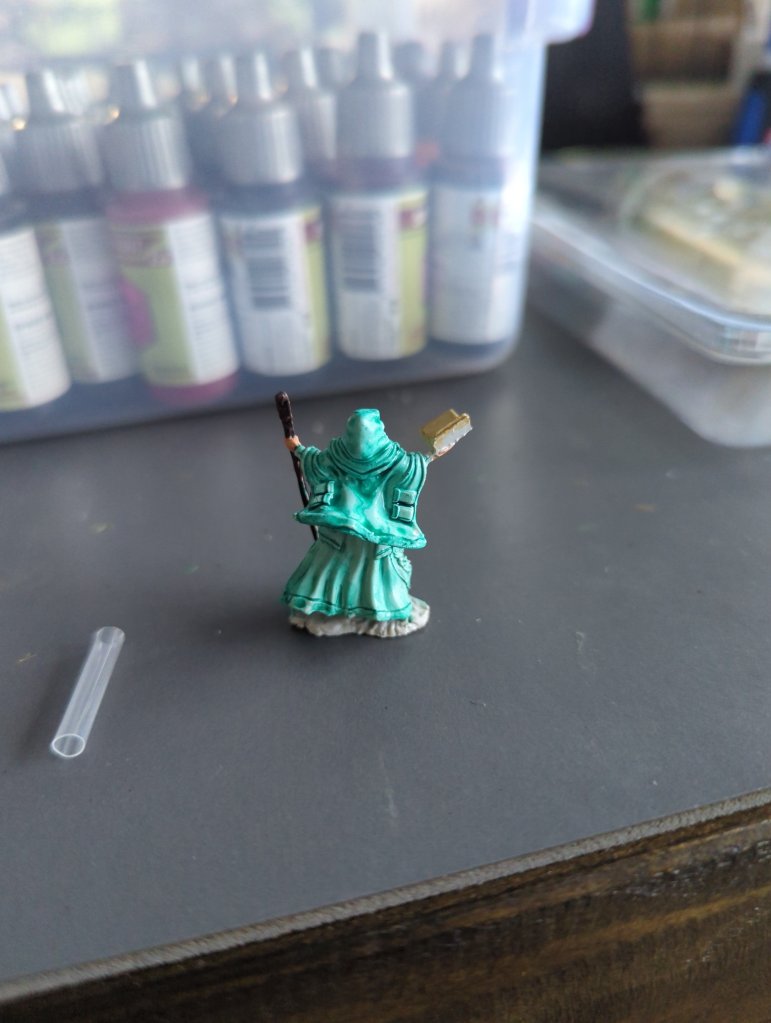
If you can’t tell, I’m trying to keep colors/coats away from each other while letting others dry.
Well, that’s all I have time for today. I should have the rest finished later this week and I’ll include those pictures with my next post.
Until next time, Dear Readers…
Painting Update: Female Human Barbarian
Dear Readers, boy oh boy do I have a painting update for you!
I’ve finished her!
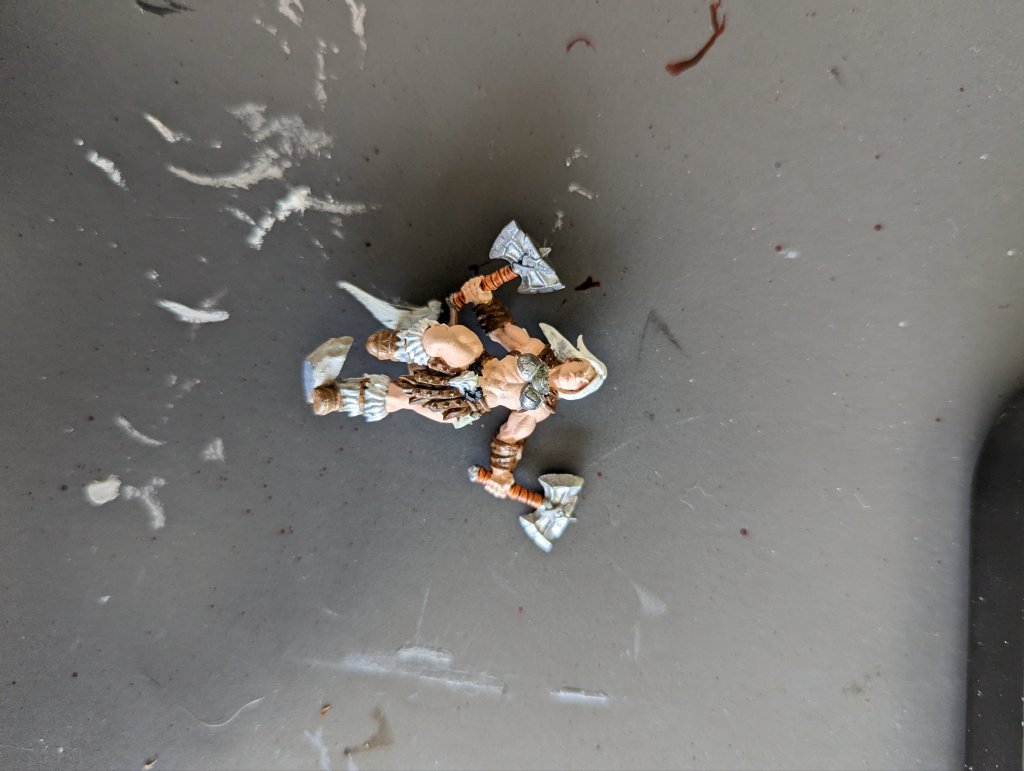
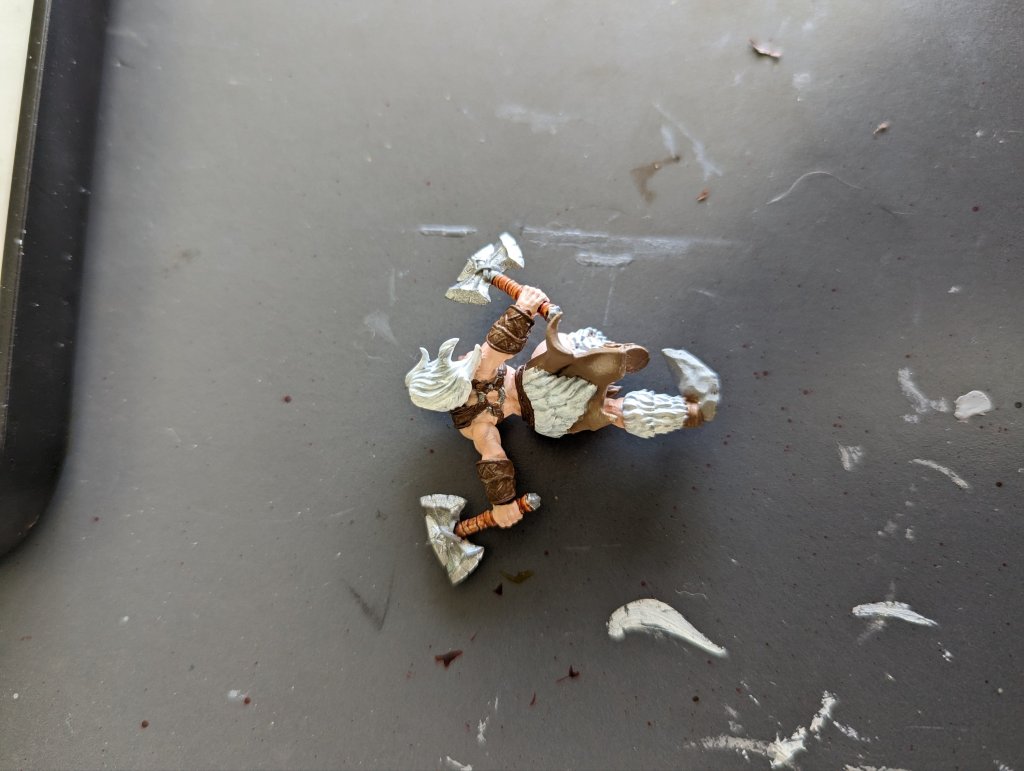

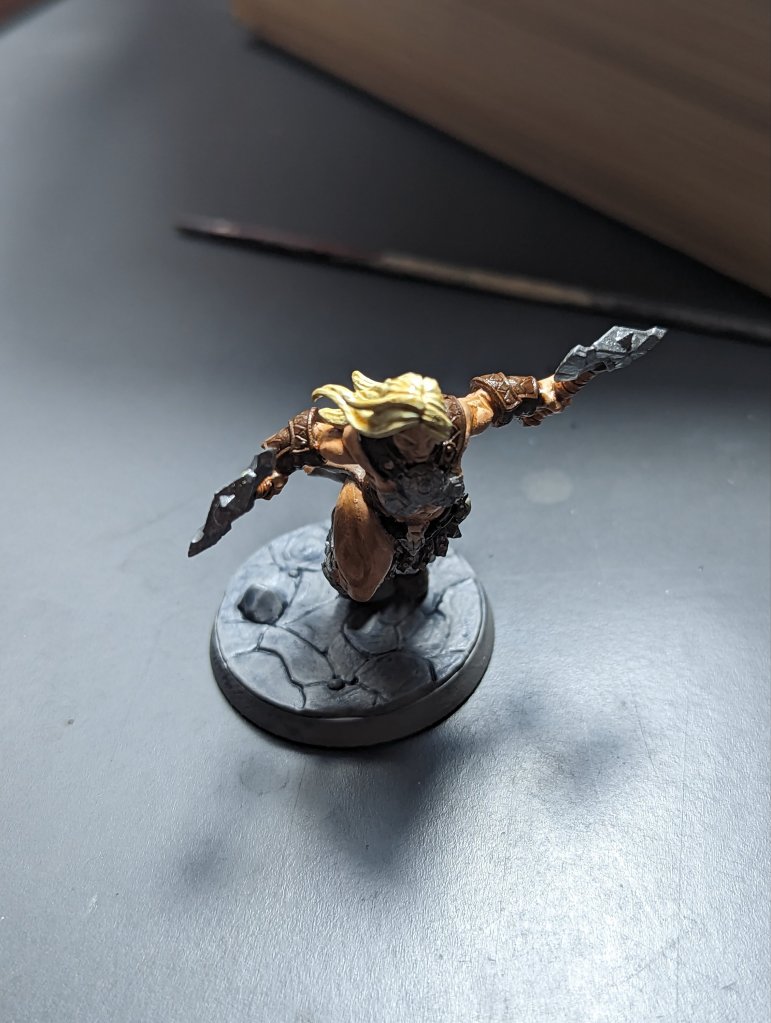
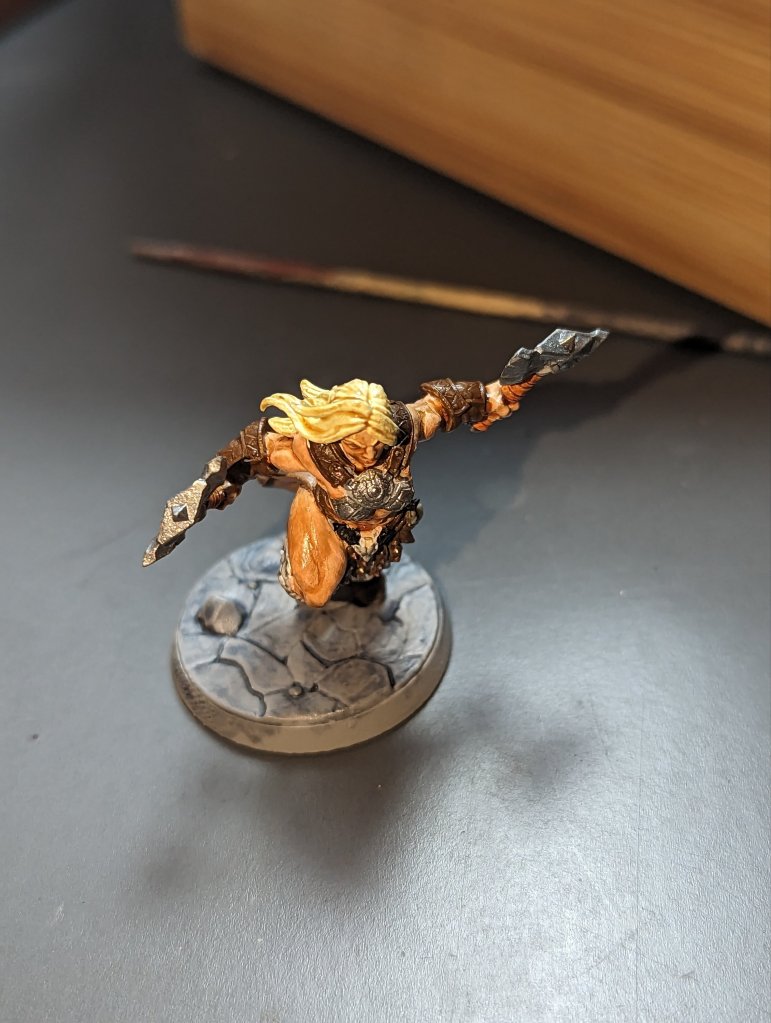
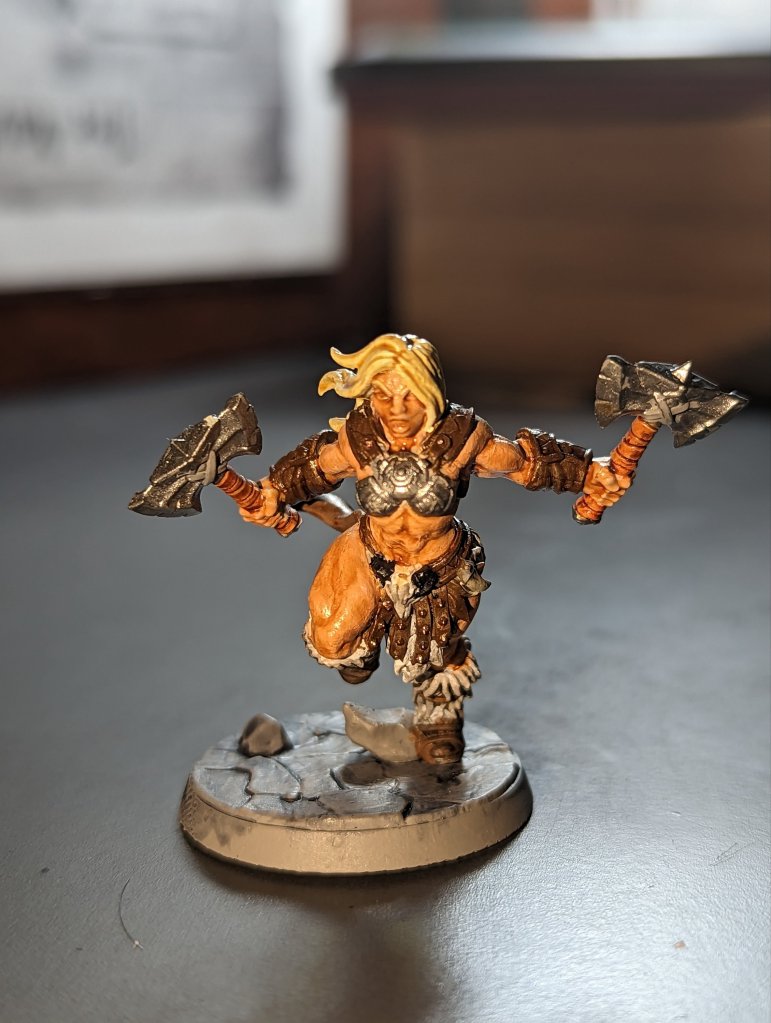
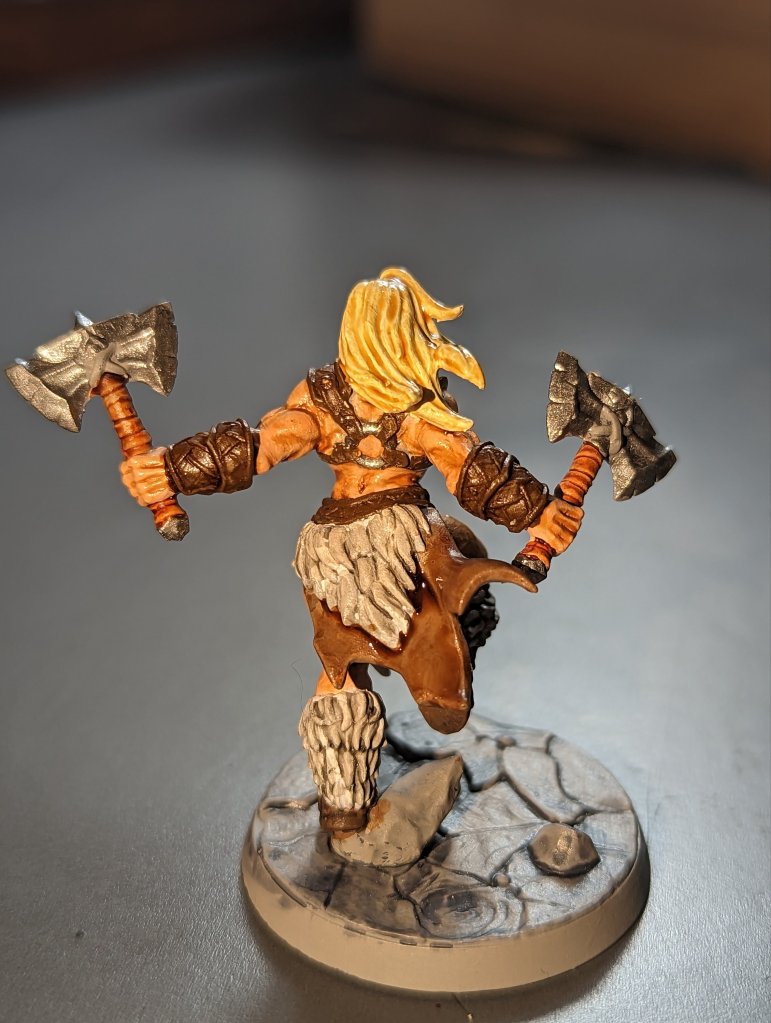


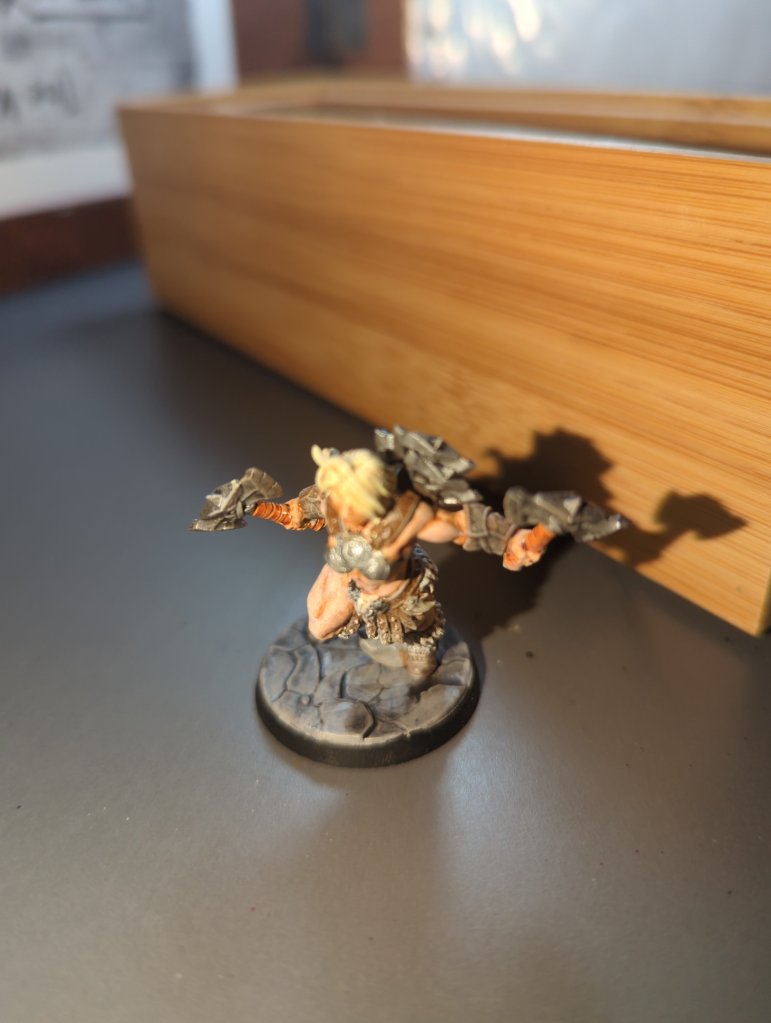
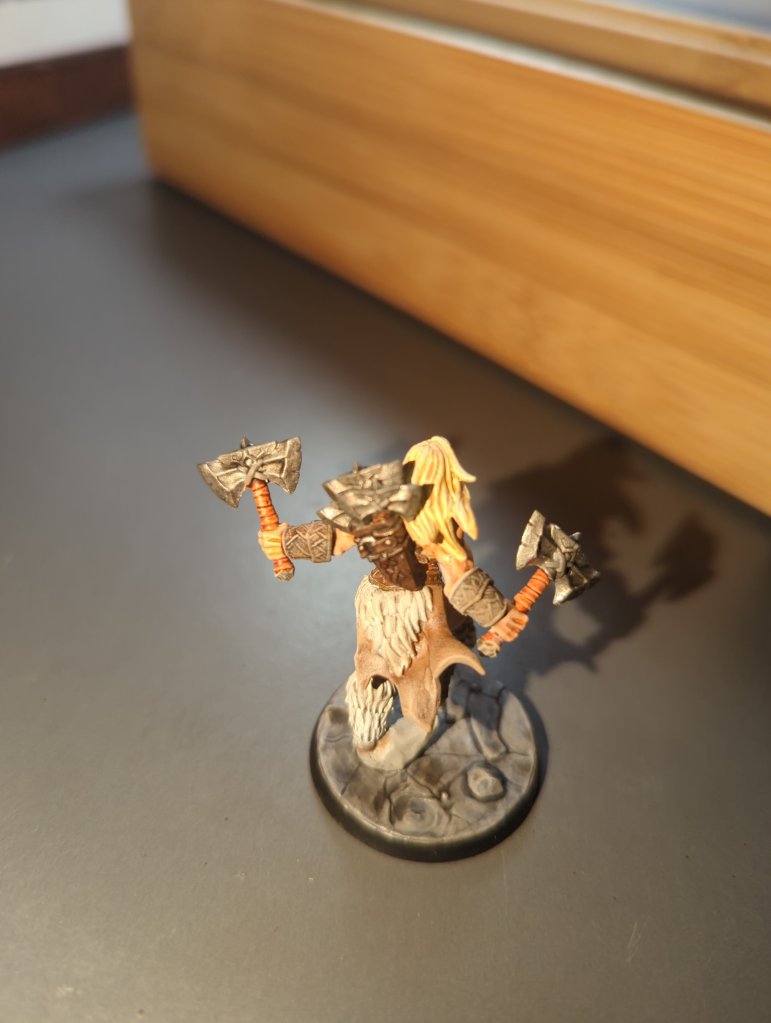
There we go!
I hope you like the job I did on this commission!
Next up?
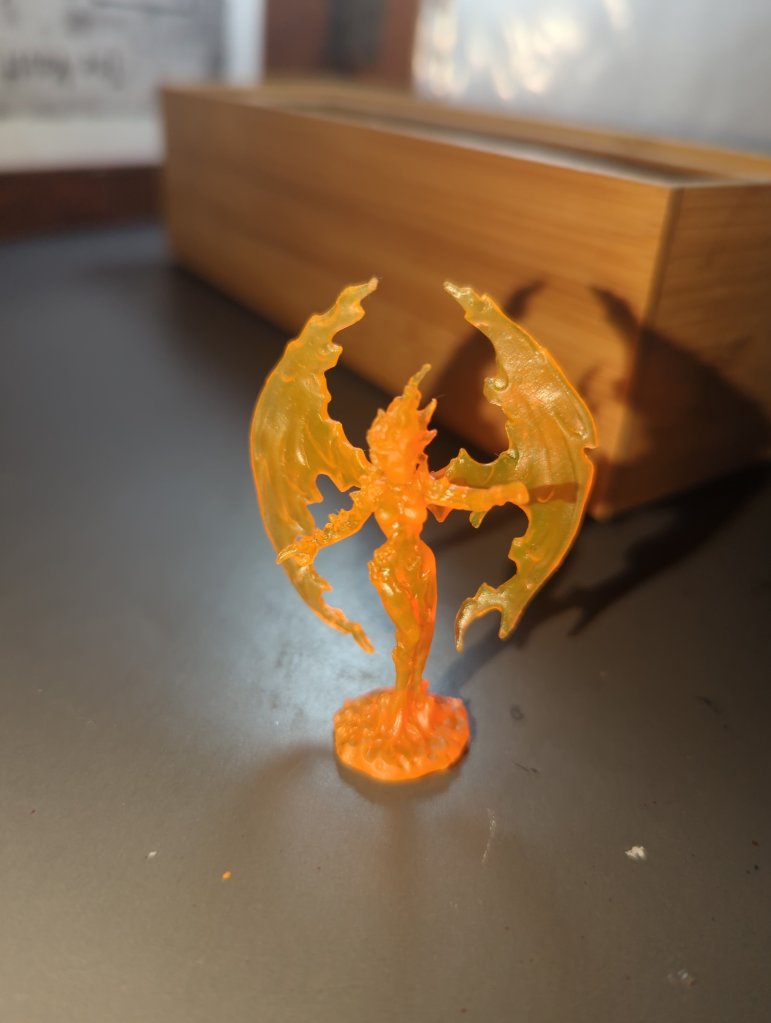
And…
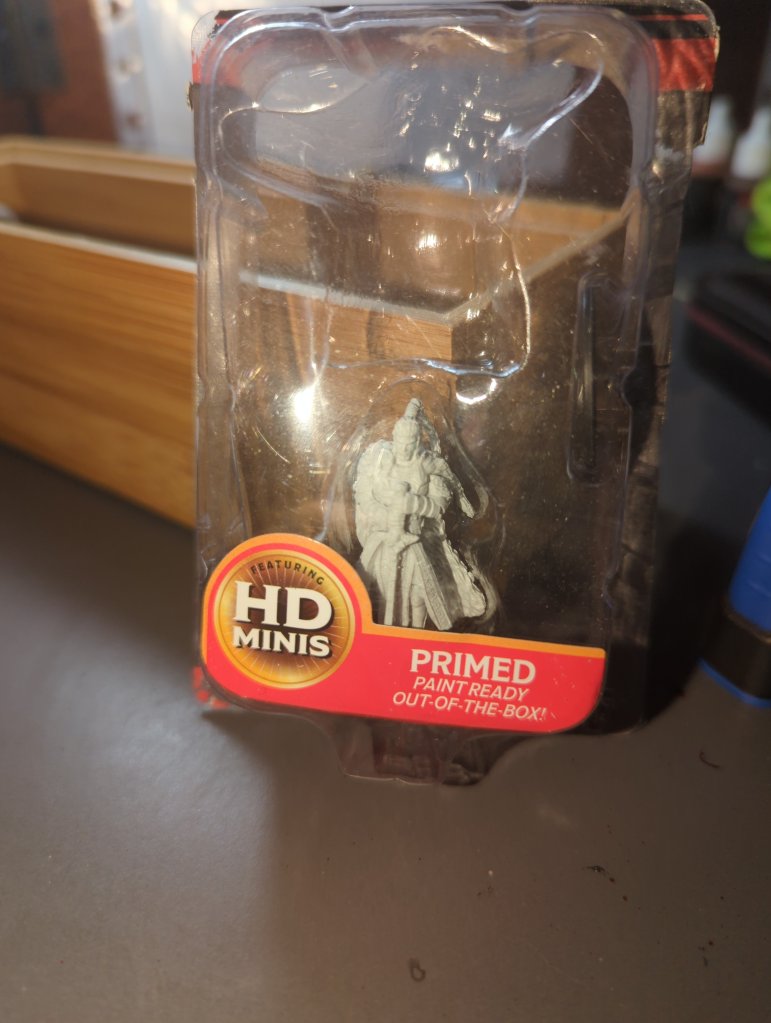
Well, that’s all I have for now! Join me in two Sundays for the next painting update!
Until next time, Dear Readers…
The Ultimate Guide to Crafting Magic Items in D&D
One of the most exciting aspects of playing Dungeons and Dragons is the possibility of discovering or creating magical items. Magic items can enhance a player’s abilities, provide unique abilities, or add flavor to a character’s story. Crafting magic items is an important aspect of Dungeons and Dragons, and can be a fun and rewarding experience for players and dungeon masters alike. In this guide, we will explore the ins and outs of crafting magic items in Dungeons and Dragons.

Understanding Magic Items
Before we dive into the process of crafting magic items, it’s important to understand what they are and how they work in the game. Magic items are special items that possess supernatural abilities that are beyond the capabilities of mundane items. They can range from simple trinkets to powerful weapons and armor. Magic items can be found as treasure in dungeons, purchased from merchants, or crafted by skilled artisans.
Each magic item has a specific rarity, which determines its power level and availability. Common magic items are relatively weak and easy to come by, while legendary magic items are incredibly powerful and rare. The rarity of a magic item also determines its cost and availability. The more powerful the item, the more expensive and difficult it is to obtain.
Magic items are also categorized by type. There are seven categories of magic items: armor, potions, rings, rods, scrolls, staffs, wands, and weapons. Each type of magic item has its own unique properties and abilities. For example, a magic weapon might have the ability to deal extra damage to certain creatures or grant a bonus to attack rolls.
Crafting Magic Items
Crafting magic items is a complex process that requires time, resources, and skill. In order to craft a magic item, a character must have proficiency in the appropriate tools and materials, as well as the appropriate magical knowledge. The process of crafting a magic item involves several steps, each of which requires a different level of skill and resources.
Step 1: Gathering Materials
The first step in crafting a magic item is gathering the necessary materials. These materials can include rare and exotic components, such as gemstones, dragon scales, or the feathers of a phoenix. In order to obtain these materials, characters may need to embark on quests, defeat powerful monsters, or barter with exotic merchants. Some materials may also require a specific type of magical energy or enchantment in order to be properly used in crafting.
Step 2: Planning and Design
Once the necessary materials have been acquired, the character must begin the process of planning and designing the magic item. This involves determining the item’s properties and abilities, as well as its appearance and other aesthetic features. The character must also determine the appropriate magical energies and enchantments to imbue the item with, which requires a deep understanding of magical theory and practice.
Step 3: Enchanting the Item
The next step in crafting a magic item is enchanting the item. This involves imbuing the item with the appropriate magical energies and enchantments. This process requires a high level of skill and knowledge, as well as access to magical tools and resources. The character must carefully control the magical energies involved in the enchantment process in order to avoid dangerous and potentially deadly magical feedback.
Step 4: Finishing Touches
Once the item has been enchanted, the character must put the finishing touches on the item. This may involve polishing the item, adding decorative elements, or imbuing it with additional magical abilities. The character must also ensure that the item is properly balanced and functional, and that its properties and abilities are clearly defined.
Step 5: Attuning to the Item
Finally, in order to use the magic item, the character must attune to it. This involves spending time and focusing on the item, becoming attuned to its magical energies and properties. This process typically takes a short rest, during which the character meditates and attunes themselves to the item. Once attuned, the character gains access to the item’s properties and abilities.
Crafting Rules and Guidelines
Crafting magic items is a complex process, and the rules for crafting vary depending on the edition of Dungeons and Dragons being played. In general, however, crafting rules are designed to be flexible and adaptable to the needs of individual games and campaigns.
One of the most important considerations when crafting magic items is the rarity of the item being crafted. The more powerful and rare the item, the more difficult and expensive it is to craft. Additionally, the time required to craft a magic item varies depending on its rarity and complexity. Common items may only take a few days to craft, while legendary items may take months or even years to complete.
Another important consideration is the character’s proficiency and skill level. In order to craft a magic item, a character must have proficiency in the appropriate tools and materials. Additionally, the character’s skill level will determine the success rate of the crafting process. A highly skilled character is more likely to successfully craft a powerful and effective magic item than a less skilled character.
In addition to these general guidelines, there are also specific rules and guidelines for crafting each type of magic item. For example, crafting a magic potion requires proficiency in the Alchemist’s Supplies tool, while crafting a magic weapon requires proficiency in the appropriate weapon-making tools. The specifics of these rules will depend on the edition of Dungeons and Dragons being played, as well as the preferences of the dungeon master.
Tips for Crafting Magic Items
Crafting magic items can be a rewarding and enjoyable experience, but it can also be a complex and challenging process. Here are some tips to help make the process smoother and more enjoyable:
- Plan Ahead: Before beginning the crafting process, take the time to plan out the item’s properties, abilities, and appearance. This will help ensure that the item is well-balanced and fits with the character’s story and personality.
- Collaborate with the Dungeon Master: Crafting magic items can be a collaborative process between the player and the dungeon master. Work together to ensure that the item fits with the game’s rules and lore.
- Use Inspiration: Don’t be afraid to draw inspiration from other sources, such as fantasy literature, movies, or video games. This can help add depth and richness to the item’s design and backstory.
- Experiment: Crafting magic items is a creative process, so don’t be afraid to experiment with new ideas and concepts. This can lead to unique and interesting items that add depth and complexity to the game.
- Make it Personal: Crafting a magic item is an opportunity to add personal flair and flavor to a character’s story. Consider incorporating personal elements into the item’s design and backstory, such as family history or past adventures.
Examples of Magic Items
There are countless magic items that can be crafted in Dungeons and Dragons, each with its own unique properties and abilities. Here are just a few examples of magic items that could be crafted in a game (some are variants on already existent magic items):
- The Sword of Flame: This magical sword is imbued with the power of fire, granting it the ability to deal extra fire damage to enemies. It also has the ability to cast fire spells, such as Fireball or Wall of Fire, a certain number of times per day.
- The Ring of True Invisibility: This magical ring grants its wearer the ability to turn invisible for a short period of time. It can also provide protection from detection and scrying spells.
- The Cloak of High Elvenkind: This magical cloak grants its wearer the ability to move silently and blend into shadows, making it ideal for sneaking and hiding. It can also provide protection from certain types of attacks and spells.
- The Amulet of Life: This magical amulet grants its wearer the ability to resist death, allowing them to survive fatal blows and injuries. It can also provide temporary hit points and increased regeneration.
- The Bow of the Wind: This magical bow is imbued with the power of air, granting it the ability to deal extra lightning damage to enemies. It also has the ability to cast wind spells, such as Gust or Wind Wall, a certain number of times per day.
- The Book of Shadows: This magical tome contains a collection of powerful spells and magical knowledge, allowing its owner to cast spells that would normally be beyond their abilities. It can also provide insight into magical lore and arcane secrets.
- The Shield of Faith (not to be confused with the spell of a similar name): This magical shield grants its wielder increased protection from attacks and spells, as well as the ability to dispel curses and negative effects. It can also provide temporary hit points and increased resistance to damage.
Conclusion
Crafting magic items is an important part of the Dungeons and Dragons experience, allowing players to customize their characters and add depth and complexity to the game. While the process can be complex and challenging, it is also highly rewarding, providing players with unique and powerful items that can aid them on their adventures.
Whether crafting a magical sword or a powerful potion, the key to success is careful planning, collaboration with the dungeon master, and a willingness to experiment and be creative. With these tips and guidelines in mind, players can create magic items that are truly unforgettable and add depth and richness to their Dungeons and Dragons experience.
How-To Introduce New Players to D&D: A Guide for DMs
Dear Readers, for new players, D&D can be intimidating and overwhelming. This is where the DM comes in, as it is their job to guide new players through the process of playing D&D and make sure that they have a fun and memorable experience.
In this guide, we will discuss some tips and tricks that DMs can use to introduce new players to D&D.
- Explain the Basics
The first step in introducing new players to D&D is to explain the basics of the game. This includes explaining the different types of dice, the different abilities that players can have, and the basic rules of the game. It is important to keep the explanations simple and straightforward, as new players may be overwhelmed by too much information.
- Create Characters Together
Creating a character is one of the most important aspects of D&D, as it is how players interact with the world and each other. When introducing new players to the game, it is a good idea to create characters together. This allows the DM to guide the players through the process and answer any questions they may have. It also helps to ensure that the players create characters that fit into the world and the story that the DM has created.
- Use Pre-Made Characters
If creating characters from scratch is too overwhelming for new players, the DM can provide pre-made characters. Pre-made characters are already created and have their own unique abilities and traits. This allows new players to jump right into the game without having to worry about character creation.
- Start Small
When introducing new players to D&D, it is important to start small. This means creating a simple story with basic mechanics and rules. Starting small allows new players to get comfortable with the game and its mechanics before moving on to more complex stories and gameplay.
- Explain the Story
The story is an important aspect of D&D, and it is the DM’s job to explain it to the players. When introducing new players to the game, it is important to take the time to explain the story and the world that the players will be interacting with. This includes explaining the different factions and characters that exist in the world, as well as any important historical events that may have occurred.
- Keep it Fun
D&D is all about having fun, and it is important to keep that in mind when introducing new players to the game. This means creating a fun and engaging story, allowing players to make their own choices, and encouraging them to be creative in their gameplay.
- Encourage Roleplaying
Roleplaying is an important part of D&D, as it allows players to fully immerse themselves in the game and their characters. When introducing new players to the game, it is important to encourage roleplaying and make sure that the players feel comfortable doing so. This can be done by providing prompts and opportunities for roleplaying, as well as by setting a positive and welcoming tone at the table.
- Be Patient
Introducing new players to D&D can be a challenging process, and it is important to be patient. New players may need extra time to understand the rules and mechanics of the game, and they may make mistakes along the way. It is important to remember that everyone was a new player at some point, and to be supportive and encouraging throughout the process.
- Use Visual Aids
Visual aids can be a helpful tool when introducing new players to D&D. This can include maps, illustrations of characters and monsters, and other visual aids that can help players visualize the world and the characters they are interacting with. This can make the game more immersive and engaging for new players.
- Provide Feedback
Feedback is an important aspect of any game, and D&D is no exception. When introducing new players to the game, it is important to provide feedback and constructive criticism when necessary. This can help players improve their gameplay and make the overall experience more enjoyable for everyone at the table.
- Encourage Collaboration
Collaboration is key to a successful D&D game. When introducing new players to the game, it is important to encourage collaboration between players. This can be done by setting up scenarios where players need to work together to solve a problem or overcome an obstacle.
- Keep the Rules Simple
D&D has a lot of rules and mechanics that can be overwhelming for new players. When introducing new players to the game, it is important to keep the rules simple and straightforward. This can help players understand the game more easily and enjoy it more.
- Use Props and Music
Props and music can be a great way to enhance the immersive experience of D&D. Using props like physical maps, figurines, and other physical items can help players visualize the world they are playing in. Playing background music can also help create an atmosphere that is more engaging and immersive for new players.
- Provide Context
Context is important in D&D, as it can help players understand the world they are playing in and the characters they are interacting with. When introducing new players to the game, it is important to provide context for the story and the world. This can be done by explaining the history of the world, the different factions and characters that exist within it, and the overall tone and atmosphere of the game.
- Use NPCs
Non-player characters (NPCs) are an important part of any D&D game. They can provide players with important information, help them solve problems, and add depth and complexity to the story. When introducing new players to the game, it is important to use NPCs effectively. This means creating interesting and engaging NPCs that can help guide players through the story and provide them with important information and resources.
Conclusion
Introducing new players to D&D can be a challenging process, but it is also an incredibly rewarding experience. By following these tips and tricks, DMs can help new players feel comfortable and confident in the game and ensure that they have a fun and memorable experience. Whether using pre-made characters, starting small, or using visual aids, there are many ways to introduce new players to D&D and help them become fully immersed in the game. With patience, collaboration, and a positive attitude, DMs can create a welcoming and engaging environment for new players to explore the world of D&D.
Until next time, Dear Readers…
The Inglorious Ingrates Episode 18: The Great Battle of Our Time
The Ingrates finally face off against WAR in this stunning conclusion of Chapter 1 of the Inglorious Ingrates, and lose a companion! Who will it be? Join us to find out!
5 Common Mistakes to Avoid as a New D&D Player
As a new player, it can be overwhelming to learn the rules and the world of D&D. Here are five common mistakes to avoid as a new D&D player.
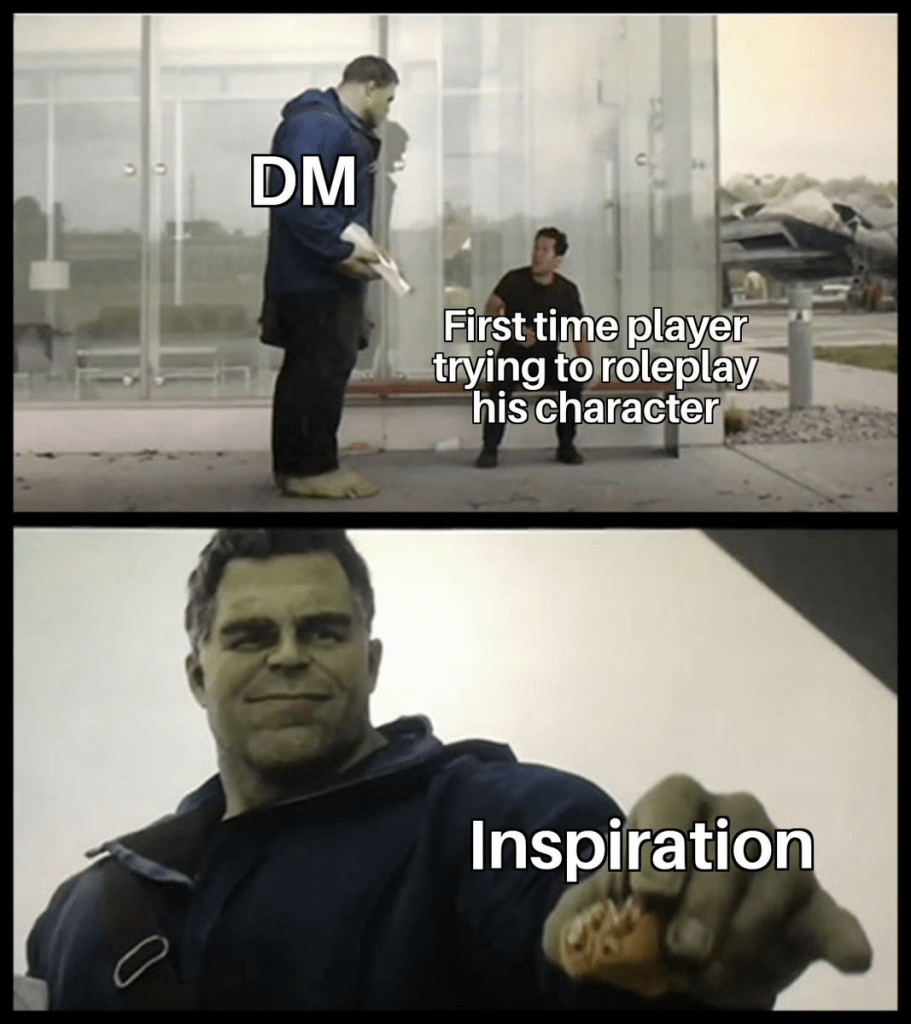
Mistake #1: Not understanding your character
When you create your character, you’re not just creating a set of stats and abilities. You’re creating a personality, a backstory, and a motivation for why they’re adventuring. It’s important to understand your character’s motivations and goals so you can role-play them accurately. Your character’s personality and backstory can also inform how they approach challenges in the game.
For example, if you’re playing a paladin who has sworn an oath of vengeance against evil, you might approach a situation differently than if you were playing a rogue who is only out for personal gain. Knowing your character’s personality and motivations can also help you make decisions in-game. If your character is prone to anger, they might be more likely to attack an NPC who insults them. If your character is kind-hearted, they might try to talk their way out of a fight.
One way to get to know your character better is to write a backstory. This can be a few paragraphs or several pages, depending on how detailed you want to get. Your backstory should explain where your character comes from, their family and friends, and any significant events that have happened in their life. This can give you a better understanding of your character’s motivations and how they would react in certain situations.
Mistake #2: Not paying attention
D&D is a collaborative game, and it’s important to pay attention to what’s happening at the table. This means listening to the Dungeon Master (DM) when they describe the scene and paying attention to what other players are doing. If you’re not paying attention, you might miss important information or clues that could help you in the game.
For example, if the DM describes a room with a hidden door, but you’re not paying attention, you might not realize that there’s a way to bypass the enemies in the next room. Or if another player is trying to negotiate with an NPC, but you’re not paying attention, you might accidentally say or do something that ruins the negotiation.
It’s also important to pay attention to the rules of the game. D&D has a lot of rules, and it can be overwhelming for new players. But if you’re not paying attention to the rules, you might miss out on important details or make mistakes that could affect the game. If you’re not sure about a rule, ask the DM or another player for clarification.
Mistake #3: Not working together
D&D is a team game, and it’s important to work together to achieve your goals. This means collaborating with your fellow players to solve puzzles, defeat enemies, and complete quests. If you’re not working together, you might find that the game becomes more difficult or that you miss out on opportunities to succeed.
For example, if you’re playing a fighter and your party includes a cleric and a wizard, you might want to work with the cleric to protect the wizard while they cast spells. Or if you’re playing a rogue and your party includes a bard and a ranger, you might want to work with the bard to distract enemies while the ranger takes them out from a distance.
It’s also important to communicate with your fellow players. If you have an idea for how to approach a situation, share it with the group. If you’re not sure what to do, ask for input from your party members. Working together and communicating can make the game more enjoyable for everyone and can lead to some great moments of teamwork.
Mistake #4: Not understanding the game mechanics
D&D has a lot of rules and mechanics that can be difficult to understand, especially for new players. It’s important to take the time to read and understand the basic rules, as well as any specific rules for your character’s abilities and spells.
One common mistake is not understanding how combat works. Combat in D&D is turn-based, with each player taking turns to take actions. It’s important to understand your character’s abilities and how they work in combat, as well as the different types of actions you can take, such as attacking, casting spells, or using items.
Another important mechanic to understand is the dice. D&D uses several different types of dice, such as a d20, which is used for most skill checks and attack rolls, and a d6, which is used for damage rolls. Understanding how the dice work and when to use them is crucial to playing the game.
If you’re not sure about a rule or mechanic, don’t be afraid to ask the DM or another player for clarification. It’s better to take a few minutes to understand the rules than to make a mistake that could affect the game.
Mistake #5: Not having fun
D&D is a game, and the most important thing is to have fun. If you’re not enjoying the game, it’s important to talk to your group about why and try to find a solution. Maybe you’re not interested in the campaign setting or the type of gameplay. Or maybe you’re not comfortable with the group dynamic.
It’s important to communicate with your group and find a solution that works for everyone. Maybe you can switch to a different campaign or try a different style of play. Or maybe you can have a discussion about what everyone wants out of the game and find a way to incorporate everyone’s interests.
Remember, D&D is a game of imagination and creativity, and the possibilities are endless. Don’t be afraid to take risks, try new things, and have fun.
Conclusion
Dungeons & Dragons is a fantastic game that can provide hours of entertainment and a chance to connect with others through shared storytelling. As a new player, it can be overwhelming to learn the rules and the world of D&D. But by avoiding these common mistakes, you can make the most of your experience and have a great time playing.
Take the time to understand your character, pay attention to what’s happening at the table, work together with your party members, understand the game mechanics, and most importantly, have fun. With these tips, you’ll be well on your way to becoming a skilled adventurer in the world of D&D.
Professional DMing
Just an “in case you are interested”: I do professional DMing now as a side gig. I don’t charge much, and most of what I’m running are one-shots! So if you are interested, here’s a link to my startplaying.games bio, where you can see what I am running and when!
https://startplaying.games/gm/thedailydm
For anyone particularly interested, I’m running a game tonight!
It’s an Eberron one-shot, and it’s going to be a lot of fun.
Hope to see you at the table…
Until next time, Dear Readers…
Monster Highlight: Arcanoloth
The arcanoloth is a unique and fascinating creature from the world of Dungeons and Dragons (D&D). As an outsider from the Lower Planes, the arcanoloth is an incredibly powerful and intelligent creature, capable of wielding incredible magic and commanding legions of demons and devils.
In this blog post, we’ll explore the origins, appearance, abilities, and tactics of the arcanoloth, as well as some ideas for how you might incorporate this fearsome creature into your own D&D campaigns.

Origins and Appearance
The arcanoloth is a type of yugoloth, a race of fiendish beings that serve as mercenaries and soldiers in the Blood War between the demons of the Abyss and the devils of the Nine Hells. Yugoloths are known for their cunning, treachery, and skill in battle, and the arcanoloth is no exception.
Arcanoloths are typically jackal-headed creatures that can take the form of any humanoid race, and are always neatly groomed. They are often dressed in ornate robes and carry staves or wands imbued with powerful magic. Despite their less than intimidating appearance, arcanoloths are extremely intelligent and sophisticated creatures, capable of navigating the complex politics of the Lower Planes and manipulating mortals with ease.
Abilities and Tactics
As befits a creature of its power and status, the arcanoloth has a range of abilities that make it a formidable foe for any party of adventurers. One of its most impressive abilities is its mastery of magic. Arcanoloths can cast spells from a wide variety of schools, including divination, enchantment, and evocation.
They are expert strategists, capable of quickly analyzing their opponents’ weaknesses and exploiting them to their advantage. They prefer to fight from a distance, using their spells and summoned creatures to wear down their opponents before closing in for the kill.
Despite their intelligence and cunning, however, arcanoloths are not invincible. They are, despite their magic resistance, susceptable to certain types of magic, particularly spells that target their minds or disrupt their ability to cast spells (although they have no specific vulerability). They also have relatively low hit points compared to other powerful fiends, making them vulnerable to focused attacks.
In terms of tactics, an arcanoloth will typically try to avoid direct combat whenever possible. Instead, it will use its magic to gather information about its enemies and devise a plan of attack. If it is able to summon reinforcements, it will do so, relying on its minions to soften up its opponents before it enters the fray. If forced to fight alone, it will use hit-and-run tactics, peppering its enemies with spells and then retreating to a safe distance to regroup.
Incorporating Arcanoloths into Your Campaign
If you’re looking to add some excitement and danger to your D&D campaign, incorporating an arcanoloth is a great way to do so. Whether you want to use it as the main villain of your campaign or as a powerful lieutenant in the service of a greater evil, an arcanoloth is sure to provide a challenging and memorable encounter for your players.
To introduce an arcanoloth into your campaign, you could start by dropping hints about its presence in the area. Maybe the players hear rumors of a powerful wizard who has taken up residence in a nearby castle or tower. Or perhaps they come across a group of demons or devils who are serving as the arcanoloth’s minions. As they investigate further, they discover that the arcanoloth is using its magic to manipulate the politics of the region, working behind the scenes to further its own agenda.
Once the players become aware of the arcanoloth’s presence, you can start to introduce it more directly. Perhaps they are ambushed by a group of demons or devils sent by the arcanoloth, or they discover that the wizard they’ve been hunting is actually an arcanoloth in disguise. From there, you can design encounters that challenge your players both mentally and physically, as they must navigate the arcanoloth’s traps and minions while trying to discover its ultimate goal.
Another way to incorporate an arcanoloth into your campaign is to use it as a pawn of a greater evil. Maybe the arcanoloth is serving as an advisor to a powerful demon lord or archdevil, and the players must defeat it in order to gain access to its master. Or perhaps the arcanoloth has been sent on a specific mission by its superiors, such as retrieving a powerful artifact or assassinating a key figure in the mortal world.
Regardless of how you choose to use the arcanoloth in your campaign, there are a few key things to keep in mind. First, remember that arcanoloths are extremely intelligent and cunning creatures. They will not engage in direct combat unless they are confident of victory, and they will use their magic and minions to soften up their opponents before attacking. Second, remember that arcanoloths are not invincible. They are vulnerable to certain types of magic and focused attacks, so make sure to give your players opportunities to exploit these weaknesses.
Conclusion
The arcanoloth is a fearsome and fascinating creature from the world of Dungeons and Dragons. With its mastery of magic, command of demons and devils, and cunning intellect, it is a formidable foe for any party of adventurers. Whether you choose to use it as the main villain of your campaign or as a powerful pawn in the service of a greater evil, incorporating an arcanoloth is sure to provide a challenging and memorable encounter for your players. So why not give it a try and see how your players fare against this deadly fiend?
Until next time, Dear Readers…
The Role of Roleplaying and Improvisation in D&D Gameplay
One of the defining features of D&D is its emphasis on roleplaying and improvisation, which allows players to immerse themselves in a fictional world and interact with other players in character. In this post, we will explore the role of roleplaying and improvisation in D&D gameplay, and how they contribute to the overall experience of the game.
Roleplaying in D&D
Roleplaying in D&D refers to the act of taking on a fictional character and playing them out in the game. This involves creating a personality, backstory, and motivations for your character, and making decisions based on what your character would do, rather than what you as a player would do. This is an essential part of D&D gameplay, as it allows players to become fully immersed in the game world and interact with other characters in a way that feels authentic.
One of the most significant benefits of roleplaying in D&D is the ability to develop a sense of empathy and understanding for other people. When players take on the role of a character, they must think about the character’s motivations, desires, and fears, which can help them gain insight into the perspectives of others. This can be especially valuable for players who struggle with social skills or find it challenging to communicate with others in real life.
Another benefit of roleplaying in D&D is the opportunity to explore different aspects of oneself. Playing a character who is vastly different from oneself can allow players to experiment with new personality traits, beliefs, and behaviors, and gain a deeper understanding of themselves in the process. This can be a powerful tool for personal growth and self-discovery.
Improvisation in D&D
Improvisation in D&D refers to the ability to think on one’s feet and respond to unexpected situations in the game. This can involve making decisions based on limited information, coming up with creative solutions to problems, and adapting to changes in the game world. Improvisation is an essential part of D&D gameplay, as it allows players to create a dynamic and engaging story that is unique to their group.
One of the most significant benefits of improvisation in D&D is the ability to foster creativity and innovation. When players are forced to think creatively and come up with solutions on the fly, they can develop new skills and ways of thinking that can be applied to other areas of their lives. This can be especially valuable for players who work in creative fields or who are looking to develop their problem-solving skills.
Another benefit of improvisation in D&D is the opportunity to collaborate and work as a team. When players are faced with unexpected challenges, they must work together to come up with a solution, which can help build trust, communication skills, and a sense of camaraderie among the group. This can be especially valuable for players who struggle with teamwork or find it challenging to work with others in real life.
The Role of Roleplaying and Improvisation in D&D Gameplay
Roleplaying and improvisation are two essential components of D&D gameplay, and they work together to create a rich and immersive experience for players. When players take on the role of a character and engage in authentic interactions with other characters, they create a sense of realism and depth that can be hard to replicate in other forms of entertainment. Improvisation adds an element of unpredictability and creativity to the game, allowing players to create a story that is unique to their group and that evolves over time.
Roleplaying and improvisation also contribute to the social and emotional benefits of D&D gameplay. By taking on the role of a character and engaging in authentic interactions with other characters, players can develop a sense of empathy and understanding for others, as well as explore different aspects of themselves. Improvisation can foster creativity, innovation, and teamwork, which can be valuable skills both in and outside of the game.
Roleplaying and improvisation also help to create a sense of investment in the game world and the story being told. When players become attached to their characters and the story they are creating, they are more likely to stay engaged in the game and invest time and effort into developing their characters and advancing the plot. This can create a sense of ownership over the story and the game world, which can be a powerful motivator for players.
Roleplaying and improvisation can also create a more immersive and engaging experience for players. When players fully embrace their characters and the story being told, they can become fully immersed in the game world, which can create a sense of excitement and adventure. This can be especially true when players are faced with unexpected challenges or plot twists, as it can create a sense of tension and anticipation that is hard to replicate in other forms of entertainment.
Tips for Roleplaying and Improvisation in D&D
While roleplaying and improvisation are essential components of D&D gameplay, they can be challenging skills to develop. Here are some tips for players looking to improve their roleplaying and improvisation skills:
- Think about your character’s backstory and motivations. Before the game starts, spend some time developing your character’s personality, backstory, and motivations. This will give you a framework for how your character would behave in different situations.
- Stay in character. When you are playing your character, try to stay in character as much as possible. This means speaking and behaving as your character would, rather than as yourself.
- Listen to the other players. Pay attention to what the other players are saying and doing, and try to respond in character. This can create more authentic and engaging interactions between characters.
- Take risks. Don’t be afraid to take risks and make bold decisions. This can create more exciting and dynamic gameplay, and can lead to unexpected plot twists and developments.
- Be open to improvisation. When unexpected situations arise, try to be open to improvisation and come up with creative solutions. This can create a more dynamic and engaging story, and can lead to new and exciting developments in the game.
Conclusion
Roleplaying and improvisation are essential components of D&D gameplay, and they work together to create a rich and immersive experience for players. Roleplaying allows players to fully immerse themselves in the game world and engage in authentic interactions with other characters, while improvisation adds an element of unpredictability and creativity to the game. Together, these skills can help players develop empathy, creativity, teamwork, and problem-solving skills, all while having fun and engaging in a unique and exciting form of entertainment.
 The Daily Dungeon Master Blog